











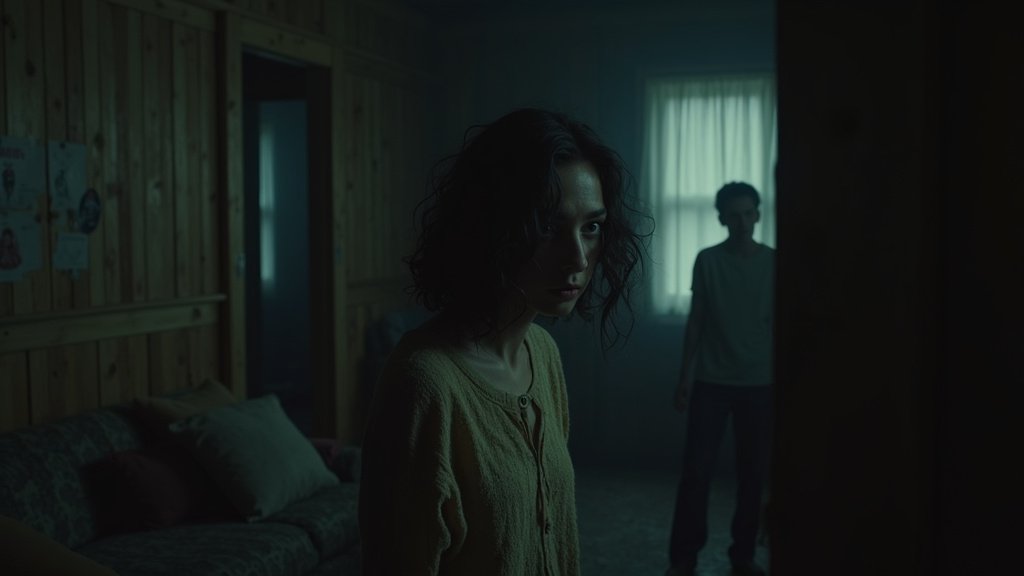
The latest cinematic offering from acclaimed horror director Osgood Perkins, “Keeper,” has arrived, presenting audiences with a film that is as visually striking as it is narratively elusive. Released on November 14, 2025, this new movie, the Osgood Perkins Keeper, delves into the unsettling terrain of a couple’s anniversary retreat that descends into a disorienting nightmare, cementing Perkins’ reputation for crafting distinct and often polarizing genre pieces.
Analyzing the Osgood Perkins Keeper Experience
“Keeper” follows Liz (Tatiana Maslany), a city-dwelling artist, and her doctor boyfriend, Malcolm (Rossif Sutherland), as they travel to his family’s secluded cabin for their one-year anniversary. From the outset, the film establishes an atmosphere thick with foreboding. Early moments hint at darker themes, with an opening montage depicting women in distressing situations, immediately signaling that Liz’s romantic getaway might be fraught with peril. The introduction of Malcolm’s boorish cousin, Darren, and his model girlfriend, Minka, further disrupts the intended tranquility, adding an extra layer of social discomfort to the isolated setting. This cabin horror retreat sets a disturbing tone for the Osgood Perkins Keeper.
Tatiana Maslany’s Standout Performance in the Osgood Perkins Keeper
At the heart of “Keeper” is a powerhouse performance from Tatiana Maslany. Critics have almost universally praised her portrayal of Liz, describing her turn as a committed, emotionally exhaustive, and absolutely central to the film’s success. Maslany expertly navigates Liz’s descent into confusion, terror, and a desperate search for agency, convincing audiences of her character’s escalating distress even when the narrative falters. Her ability to shift from vulnerability to a more primal strength is consistently highlighted as a standout element, often keeping the movie afloat when its storytelling becomes muddled. Tatiana Maslany horror is truly on display in this Perkins new film.
Perkins, known for his work on “Longlegs” and “The Monkey,” employs his signature style, which often leans into surrealism, dream logic, and a palpable sense of dread. “Keeper” is no exception, creating a sensory horror experience that prioritizes mood and psychological unease over conventional jump scares. The film’s visual artistry is frequently lauded, with cinematographer Jeremy Cox capturing the stark, rural Canadian landscape and the claustrophobic interiors of the cabin to maximum effect. Striking monster designs and evocative imagery contribute significantly to the film’s unsettling ambiance, making it a feast for the eyes for those willing to surrender to its peculiar wavelength. This mood driven horror offers a unique visual horror movie experience.
Narrative Ambiguities and Criticisms of the Osgood Perkins Keeper
However, “Keeper” is not without its criticisms, and these largely center on its narrative construction. Many reviews point to a muddled plot and an over-reliance on exposition that, paradoxically, undermines the suspense it aims to build. While some critics appreciate the film’s ambiguity and its invitation to embrace interpretive freedom, others found the story underdeveloped, with a rote premise thinly veiled by surrealism. The pacing also garners mixed reactions; some see it as a deliberate slow burn that effectively builds tension, while others found it tedious, with a prolonged buildup that doesn’t always yield a satisfying payoff. The screenplay, penned by Nick Lepard, is described as both maddeningly vague and unnecessarily explanatory, creating a tonal imbalance that leaves some viewers feeling intellectually shortchanged. This ambiguous horror film is certainly divisive.
Despite these narrative stumbles, the film’s finale is often described as a “bravura” or “bonkers” conclusion that provides memorable chills and a visceral impact. The exploration of themes such as gaslighting, warped masculinity, and patriarchal control is also noted. The cabin itself serves as a potent symbol of a repeating curse, and the creatures encountered represent repressed trauma and the reclaiming of autonomy, lending themselves to psychological and feminist horror interpretations. A deep psychological horror analysis might unpack these elements further within the Osgood Perkins Keeper.
Ultimately, “Keeper” is positioned as a challenging but rewarding film for a specific audience. It’s a new movie that leans heavily into its atmosphere and visuals, propelled by an exceptional lead performance. While its narrative may not cohere for everyone, Osgood Perkins continues to prove himself a distinctive voice in modern horror, delivering a film that, for better or worse, leaves a lasting, unsettling impression. For those who appreciate abstract storytelling and visually rich, mood-driven horror, this latest offering from Perkins is certainly one to consider for movie reviews and discussions about the Osgood Perkins Keeper.
More Stories
Waterbaby’s ‘Memory Be a Blade’ Delves Deeply into Post-Breakup Healing
Waterbaby’s Debut ‘Memory Be a Blade’: A Deep Dive into Post-Breakup Healing
Latest Movie Reviews: Four New Films Offer Diverse Critical Praise