











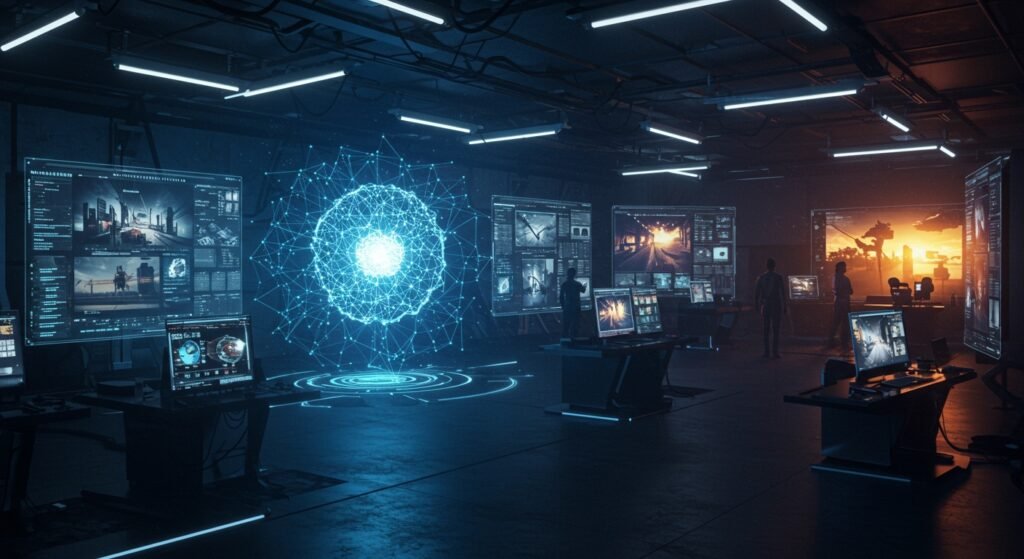
Artificial intelligence (AI) is poised to fundamentally redefine the landscape of the entertainment industry, moving far beyond its current role in mere content recommendation and personalization. According to insights published by Rob Enderle in TechNewsWorld on May 12, 2025, the future of creative media could see AI evolve into an “algorithmic muse,” actively participating in the crafting of stories and experiences that are not only more personal but deeply interactive.
This impending transformation suggests a significant shift in how narratives are conceived, delivered, and consumed across various platforms. Enderle’s analysis points to a future where AI could drive adaptive storytelling in traditional media like books, movies, and television, allowing narratives to potentially shift or tailor themselves in subtle or even significant ways based on various factors. Simultaneously, the gaming world is anticipated to benefit immensely, with the development of smarter Non-Player Characters (NPCs) capable of more complex interactions and environments exhibiting truly adaptive design, responding dynamically to player actions.
The Algorithmic Shift in Storytelling
The core of this transformation lies in AI’s capacity to move from analyzing past consumption patterns to generating novel content. Instead of simply suggesting what a user might like based on their history, AI could begin to write scenes, compose music, or even direct virtual camera movements. This “algorithmic muse” concept implies a collaborative, or perhaps even lead, creative role for AI in the production pipeline.
The implications for traditional media are profound. Imagine a novel that subtly changes character descriptions or subplot elements based on reader feedback, or a television series where minor plot points can adapt in response to viewer engagement metrics captured in real-time. While full-scale, dynamic narratives present immense technical challenges, AI-driven adaptation offers a path toward more personalized and potentially more engaging content across books, movies, and TV.
Interactive Worlds and Gaming’s Evolution
The gaming industry, already at the forefront of interactive entertainment, stands to gain significantly from advancements in AI. The development of smarter NPCs is a long-held goal, promising virtual characters with more believable behaviors, motivations, and responses, moving beyond scripted dialogue and actions.
Furthermore, AI can power adaptive design within games themselves. Environments could dynamically change, challenges could scale precisely to a player’s skill level, and the game world could react in complex, non-linear ways to player decisions. This level of dynamism promises game experiences that feel uniquely tailored and endlessly replayable, pushing the boundaries of immersion and interactivity.
Audience as Active Collaborator
Perhaps one of the most intriguing possibilities explored is the potential for AI-driven collaboration with the audience. Enderle’s piece suggests a future where viewer contributions could be actively integrated into the evolving narrative. This isn’t just about voting on a plot point; it could involve submitting dialogue suggestions, character backstories, or even directing virtual scenes that AI incorporates.
To incentivize this participation, a system where viewer contributions are rewarded is envisioned. The concept of a “Narrative Nudge” bonus is mentioned as a potential mechanism for acknowledging and compensating audience members whose creative input helps shape the direction or details of the content. This model transforms passive consumption into active co-creation, blurring the lines between artist and audience.
Navigating Legal Frontiers
Despite the exciting potential, the path forward is fraught with significant challenges, particularly in the legal domain. The integration of AI into creative processes and the potential for audience contribution raise complex questions regarding intellectual property (IP) and copyright.
Determining ownership when AI generates content, when human artists collaborate with AI, or when audience members contribute to a final product becomes incredibly complicated. Establishing clear legal frameworks for AI-generated works, defining collaboration models, and managing the rights associated with viewer contributions are noted as a significant hurdle that the industry and legal systems must overcome for this future to be fully realized.
In conclusion, the era of the “algorithmic muse” is upon us. AI is poised to move from helper tool to creative partner, promising entertainment experiences that are hyper-personalized, deeply interactive, and potentially co-created with the audience. While substantial legal and technical challenges remain, the vision of entertainment evolving into a dynamic form resembling improvisational comedy, with the audience becoming an integral part of the experience, highlights the revolutionary potential of AI in its next act.
More Stories
Drake Shocks Junos 2026; Tate McRae No-Show Sparks Buzz
James Tolkan, Iconic Character Actor, Dies at 94
John Hannah Addresses Potential Mummy Franchise Return