











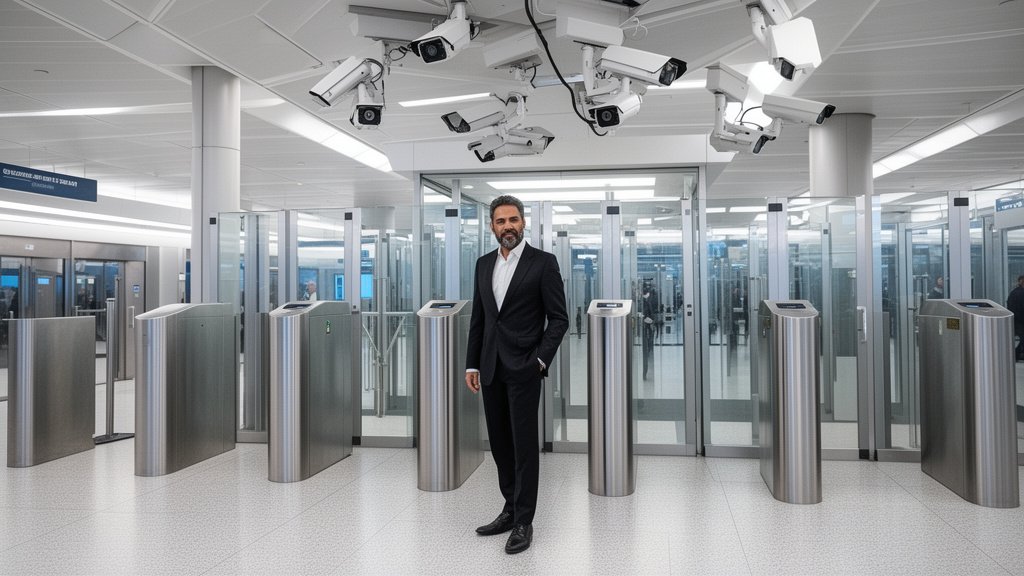
Twenty-five years after the September 11 terrorist attacks, the American public remains steadfast in the belief that the world—and their individual experience within it—was fundamentally and permanently transformed. According to a new Gallup poll, 64% of American adults assert that the events of that day permanently altered the way people live in the United States. This figure, which marks the highest level of public sentiment recorded in previous anniversaries, underscores a deep-seated reality: the “New Normal” was not a temporary state of emergency, but a structural shift in the American experience.
Key Highlights
- 64% of American adults report that the September 11 terrorist attacks permanently changed how people live in the U.S.
- The sentiment has remained remarkably consistent across the quarter-century, proving the shift is foundational rather than reactionary.
- The “New Normal” manifests primarily through heightened infrastructure security, increased surveillance, and a baseline of public anxiety.
- The data highlights a divide between generational experiences, where younger cohorts grapple with the lasting institutional legacy without having witnessed the pre-9/11 world.
The Architecture of Aftermath: Two Decades of a Transformed Nation
The persistence of this 64% figure is a sociological anomaly. Usually, historical events—even ones of profound magnitude—fade in their immediate, daily relevance as time passes. However, for 9/11, the structural changes that followed the attacks have become woven into the tapestry of American life. The data from the Gallup poll serves as a statistical mirror, reflecting a nation that acknowledges it lives in a vastly different country than the one that existed on September 10, 2001.
The Normalization of Surveillance
Perhaps the most concrete manifestation of this “permanent alteration” is the shift in civil liberties and privacy expectations. Following the attacks, the rapid passage of the USA PATRIOT Act fundamentally redefined the relationship between the citizen and the state. The expansion of domestic surveillance, the broad interpretation of data collection, and the integration of technological monitoring in public spaces created a baseline environment of constant oversight.
Today, the average American moves through the world assuming they are being recorded. Whether it is traffic cameras with facial recognition capabilities, the mandatory scanning of digital footprints, or the pervasive presence of “See Something, Say Something” signage in public transit hubs, the expectation of anonymity has effectively vanished. This is not just a policy change; it is a cultural shift. The poll data suggests that citizens have internalized this surveillance as a necessary tax for maintaining a semblance of order in an uncertain global climate. We have moved from a society defined by trust-based interactions to one defined by verification-based systems.
The Infrastructure of Anxiety: TSA and Public Spaces
Beyond the digital realm, the physical infrastructure of America has been hardened in ways that remain largely ignored until one decides to travel. The creation of the Transportation Security Administration (TSA) was the most visible response to the attacks, but its evolution over 25 years has turned air travel—once a relatively casual endeavor—into a highly regimented, restrictive, and stress-inducing process.
This “infrastructure of anxiety” extends far beyond airports. Modern architecture in major cities is now designed with security in mind: bollards designed to stop vehicles, setbacks from streets to protect against blasts, and restricted access points in government and commercial buildings. These are not merely functional choices; they are constant, physical reminders of the threat landscape. When 64% of Americans say life has “permanently altered,” they are frequently referencing these tangible impediments that slow, filter, and monitor their movement through the public square.
Generational Divergence and Historical Amnesia
While the older population remembers the pre-9/11 era—a time characterized by significantly more porous public borders and a different psychological relationship with domestic safety—a massive portion of the current population has no such memory. For Gen Z and many Millennials, the security checkpoints, the intense monitoring, and the heightened alert levels are not “changes” at all; they are the status quo.
This creates a fascinating, albeit troubling, dynamic. The older generation views the current state of affairs as a departure from normalcy, while the younger generation views it as the baseline reality. This generational gap suggests that the “permanent alteration” is not just in policy, but in the collective psyche of the nation. We are effectively raising a generation for whom “heightened security” is synonymous with “freedom.” This normalization is perhaps the most significant, and most subtle, victory of the post-9/11 world: we have forgotten that it was ever any other way.
Future Predictions: Is the Shift Reversible?
The polling data suggests that we are not moving toward a pre-9/11 level of openness. If anything, the trends indicate that our reliance on technological security measures—AI-driven surveillance, biometric screening, and predictive policing—will only deepen the divide. The question for the next decade is not whether we will return to the “old” way of life, but rather how we will manage the trade-offs between this persistent security and the foundational American values of privacy and individual autonomy. The 64% sentiment is not just a reflection of the past; it is a forecast of a future where the apparatus of security continues to expand, regardless of the relative decline in immediate, high-profile threats.
FAQ: People Also Ask
Q: How does the 64% figure compare to previous polling on 9/11’s impact?
A: The 64% figure is consistent with, and at times matches, the highest historical data points collected by Gallup since the event. It demonstrates that the belief in a “permanent change” has not eroded with time, but has instead solidified.
Q: Does this poll suggest Americans are unhappy about these changes?
A: Not necessarily. The poll measures the perception of change, not the satisfaction with those changes. Many Americans may believe life has changed but also feel those changes are necessary for maintaining national safety.
Q: What is the most significant “permanent” change cited by analysts?
A: Analysts generally point to the shift in the balance between civil liberties and national security, epitomized by the PATRIOT Act and the permanent expansion of intelligence and law enforcement powers.
Q: Will younger generations ever experience the “pre-9/11” version of America?
A: It is highly unlikely. The infrastructure, legal frameworks, and psychological conditioning established in the last 25 years are deeply embedded in the American system, making a return to the pre-2001 “open” status quo virtually impossible.
More Stories
U.S. Repatriates 64 Cultural Relics and Fossils to China
Betting on Viral Fame: Novig’s Strategic Use of Sydney Sweeney
DHS Scrubs Optimus Prime Posts After AI Misuse Backlash