











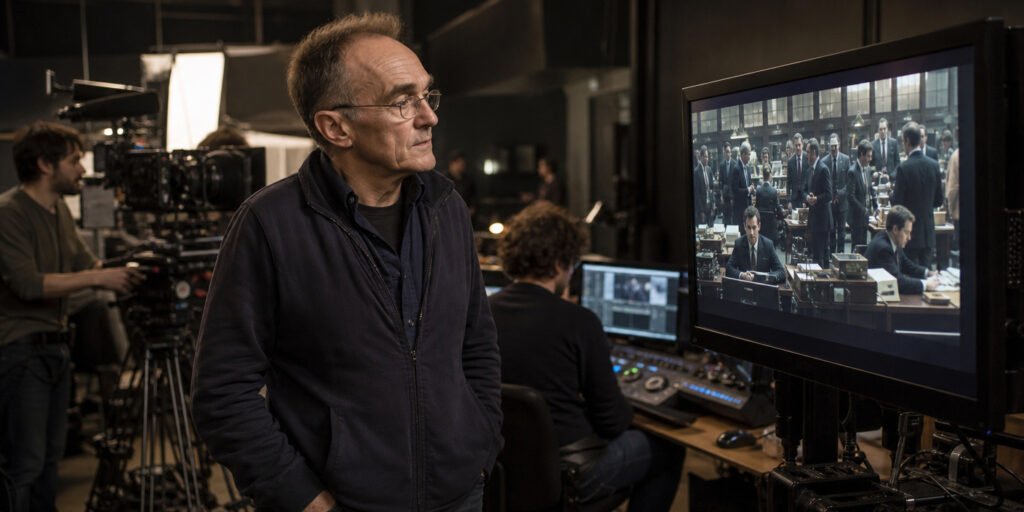
Director Danny Boyle has officially confirmed that his highly anticipated upcoming film, Ink, will utilize artificial intelligence technology. The project, an adaptation of James Graham’s celebrated 2017 stage play, chronicles the rapid, ruthless rise of media mogul Rupert Murdoch in 1969 London. By integrating advanced generative tools, Boyle aims to recreate the visceral, high-stakes atmosphere of Fleet Street during a pivotal moment in the history of British journalism, signaling a significant shift in how historical biopics can achieve period-accurate visual fidelity.
The Digital Transformation of 1969 Fleet Street
Advancing the Director’s Visual Language
Danny Boyle has long been a pioneer in pushing the boundaries of cinematographic technology. From his revolutionary use of handheld Canon XL-1 digital cameras in the 2002 horror hit 28 Days Later, which stripped away the polished veneer of traditional film, to the vibrant, hyper-saturated digital aesthetics of Slumdog Millionaire, Boyle’s career is defined by technological experimentation. The use of AI in Ink represents the next logical step in this trajectory.
For Ink, Boyle is not using AI to replace the human element of filmmaking but rather as a sophisticated tool for enhancement. Industry insiders indicate that the AI technology is being deployed to handle the complex logistics of period-accurate crowd replication and background digital environments. Recreating the bustling, smoke-filled newsrooms and the frenetic activity of London’s printing districts in 1969 requires a level of detail that traditional practical effects often struggle to manage at scale. By leveraging neural networks to assist in lighting continuity and digital environment extensions, Boyle can maintain a frenetic, documentary-style camera movement that would otherwise be hampered by the rigid requirements of legacy VFX pipelines. This allows the film to retain the raw, gritty aesthetic Boyle is known for, while still delivering a massive, immersive visual experience.
The Historical Nexus: Murdoch and the Birth of The Sun
At its core, Ink explores the aggressive takeover of The Sun by a young, ambitious Rupert Murdoch. The narrative centers on the relationship between Murdoch and his editor, Larry Lamb, as they attempt to reinvent the newspaper in a market dominated by established giants. The 1969 setting is critical; it was a year defined by shifting social norms, the moon landing, and the restructuring of the British media landscape.
For a story that demands such specific period accuracy, the AI tools allow for the seamless integration of historical textures—newspapers, printing presses, and cityscapes—that might otherwise require painstaking, costly digital manual labor. The goal is to make the audience feel the heat of the printing press and the desperation of the newsroom without the uncanny-valley pitfalls often associated with generative AI in cinema. Boyle’s approach is centered on ‘invisible technology,’ where the AI serves the story, ensuring that the audience remains grounded in the historical tension between Murdoch’s vision and the traditionalist culture of Fleet Street.
Navigating the Ethics of Artificial Intelligence
The announcement comes at a volatile time for the film industry, following significant labor disputes involving the WGA and SAG-AFTRA regarding the use of generative AI. However, Boyle’s strategy appears to focus on augmentation rather than substitution. By utilizing AI to solve logistical and logistical hurdles—such as filling out expansive 1960s newsroom extras or perfecting period lighting—the production seeks to avoid the controversies surrounding digital ‘resurrection’ of actors or the mass displacement of background performers.
Industry analysts note that this specific use case—environment enhancement and historical accuracy—is the most widely accepted path forward for major directors. It allows for a more efficient workflow while ensuring that the central performances, the heartbeat of any Danny Boyle film, remain exclusively human and emotionally driven. As the industry watches Ink closely, it may serve as a blueprint for how prestigious, human-led dramas can coexist with emerging generative workflows, proving that technological advancements can enhance, rather than diminish, the art of storytelling.
FAQ: People Also Ask
Q: What is the plot of the film ‘Ink’?
A: Ink is an adaptation of James Graham’s play, focusing on the 1969 acquisition of The Sun newspaper by Rupert Murdoch. It dramatizes the aggressive and often ruthless tactics Murdoch and editor Larry Lamb used to challenge the established British press, effectively changing the landscape of journalism forever.
Q: How is Danny Boyle using AI specifically?
A: While exact technical specifications remain proprietary, reports confirm Boyle is utilizing AI for visual effects enhancement. This includes recreating historically accurate background details, managing complex crowd scenes in 1960s London, and refining visual environments to support his signature kinetic, handheld-style cinematography without the logistical constraints of traditional VFX.
Q: Why is this considered controversial in Hollywood?
A: The use of AI in film is a sensitive topic due to recent labor strikes and ongoing concerns about potential job displacement. However, Boyle’s project is distinguished by his intent to use these tools for efficiency and environmental detail, rather than to replace performances or creative labor, marking a nuanced approach to the technology.
Q: Is this film a direct biopic of Rupert Murdoch?
A: While it centers on the rise of Murdoch, the film is primarily a journalistic drama exploring the collaborative and competitive relationship between Murdoch and his staff, particularly Larry Lamb, who was instrumental in the early success and controversial editorial style of The Sun.
More Stories
Lady Gaga Welcomes Daughter Rose Bean Polansky
Ranbir & Alia Launch Major 20-School Mumbai Makeover
Kevin Hart Confirmed to Host the 99th Academy Awards