











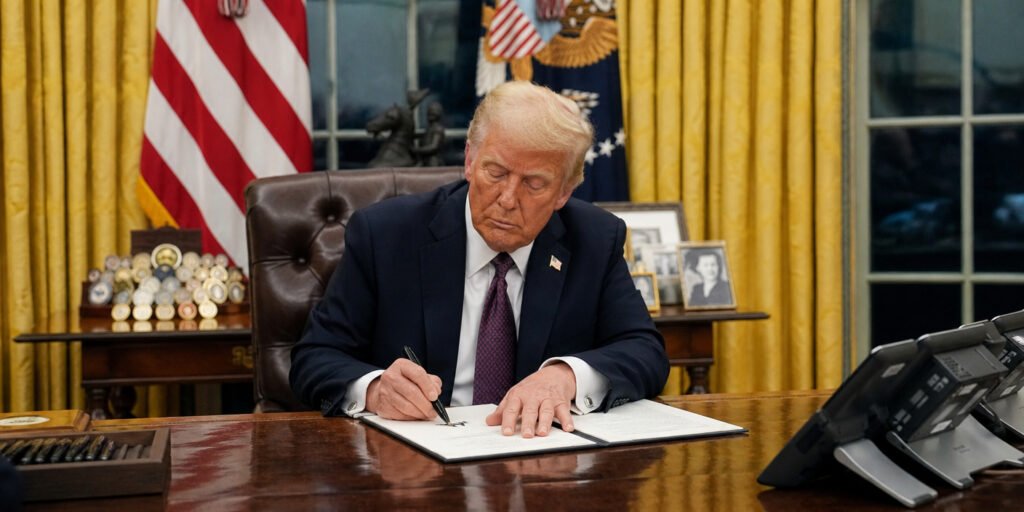
President Trump has officially inaugurated a new strategic epoch for the United States, signing an executive order that elevates ‘Super Intelligence’ to the highest tier of national priority. This policy directive is explicitly designed to galvanize America’s research infrastructure, ensuring that the nation remains at the vanguard of the most transformative technology of the 21st century. By framing Super Intelligence—systems that surpass human cognitive capacity—as a pillar of national security and economic vitality, the administration seeks to solidify the country’s dominance in the global technological race.
Key Highlights
- Strategic Supremacy: The order mandates the prioritization of computational resources and energy infrastructure to support next-generation AGI development.
- Innovation Ecosystem: A core focus on protecting and fostering an ‘unmatched culture of innovation’ by reducing regulatory bottlenecks for high-tech pioneers.
- National Security: Positioning Super Intelligence as the critical differentiator in future geopolitical stability and defense superiority.
- Economic Growth: Incentivizing private-public partnerships to accelerate the transition from theoretical research to industrial-scale application.
The Architecture of American Technological Dominance
The executive order signals a fundamental shift in how the United States approaches the development of synthetic cognitive systems. By explicitly naming ‘Super Intelligence’ as a primary objective, the administration is moving beyond basic Artificial Intelligence frameworks to target the creation of autonomous systems capable of solving complex, multifaceted problems that currently exceed human ability. The directive directs the Office of Science and Technology Policy (OSTP) to re-evaluate existing research grants and compute allocations, prioritizing projects that demonstrate potential for significant advancements in model capability and reasoning depth.
Prioritizing Compute and Energy
Central to this initiative is the recognition that ‘Super Intelligence’ is energy-intensive and compute-dependent. The order outlines a roadmap for streamlining the permitting process for large-scale data centers and high-capacity power infrastructure. By treating data centers as critical infrastructure on par with national utility grids, the administration aims to resolve the primary bottleneck facing Silicon Valley: the lack of available, reliable power at scale. This strategy is expected to provide a competitive advantage by allowing U.S. firms to train larger, more capable models faster than international peers.
Protecting the Innovation Culture
The document places significant emphasis on preserving what it terms the ‘unmatched culture of innovation’ that defines the American technology sector. This includes a robust defense of intellectual property rights and a push toward a more collaborative regulatory environment. Unlike previous frameworks that focused heavily on risk mitigation, this order emphasizes ‘innovation-first’ policies. The goal is to ensure that the brightest minds in the world continue to migrate to, and remain within, the American research ecosystem, fostering an environment where high-risk, high-reward ventures can thrive without the specter of overly burdensome compliance mandates.
The Geopolitical Stakes
Global competition in the AI sector has intensified, with nations like China investing billions into state-led efforts to achieve technological parity. This executive order is an explicit response to those geopolitical pressures. By consolidating national resources and streamlining the pipeline from lab-bench research to commercial deployment, the White House intends to create a ‘technological moat’ around the U.S. development process. The order mandates that the Department of Commerce and the Department of Defense establish closer working relationships with private sector giants, ensuring that the fruits of American innovation are seamlessly integrated into national strategic interests.
Future-Proofing the Economy
Beyond defense and research, the order addresses the long-term economic implications of widespread ‘Super Intelligence’ adoption. It calls for an inter-agency task force to forecast the labor market changes, emphasizing the need for vocational retraining programs in STEM fields. The administration believes that by being the first to reach true Super Intelligence, the U.S. will gain an irreversible first-mover advantage that will dictate the standards, protocols, and security features of the digital future, effectively setting the terms for the global economy for decades to come.
FAQ: People Also Ask
What exactly does the ‘Super Intelligence’ Executive Order change?
The order reprioritizes federal funding and resource allocation toward high-level cognitive computing, streamlining energy permitting for data centers, and fostering an innovation-first regulatory climate designed to accelerate the development of systems that exceed human-level reasoning.
How does this affect existing AI regulations?
This directive signals a pivot toward ‘innovation-first’ policies. While it maintains security oversight, it seeks to remove bureaucratic friction that has previously hampered the rapid scaling of large-scale computational infrastructure in the United States.
Who is responsible for implementing this policy?
The Office of Science and Technology Policy (OSTP) will lead the coordination, alongside the Department of Commerce and the Department of Defense, to align private sector innovation with the nation’s long-term strategic and technological goals.
Does this mandate affect private companies?
Yes, by incentivizing private-public partnerships and offering federal support for infrastructure projects (like large-scale power and compute centers), the administration is actively inviting the private sector to lead the nation’s charge toward Super Intelligence.
More Stories
The Prairie Pivot: Can ‘Shoe-Leather’ Politics Win the 2026 Midterms?
Privacy Under Fire: Doctors Denounce Student Genital Exams
In Pursuit: Reclaiming American Leadership Values