











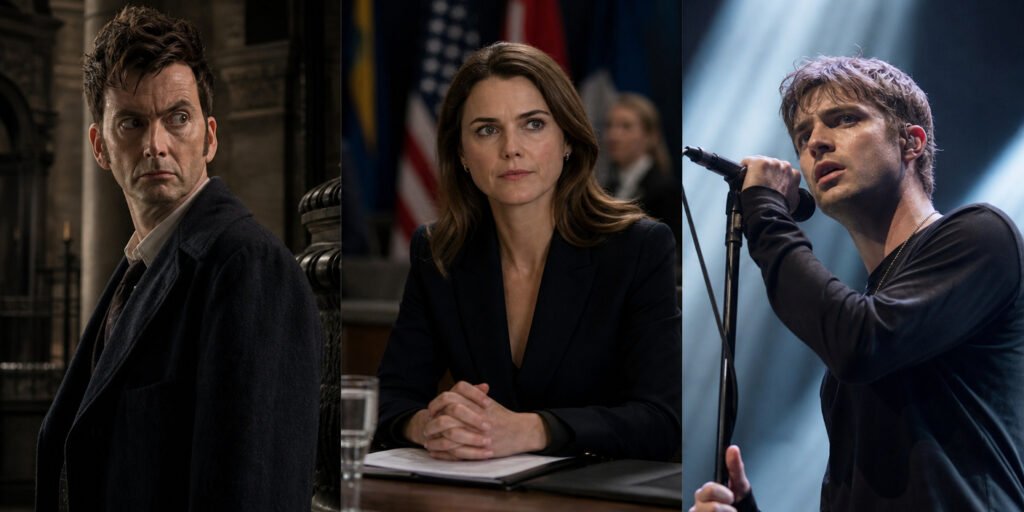
This week’s cultural landscape offers a masterclass in tension, oscillating between the visceral, claustrophobic reality of prison life and the breathless, high-stakes maneuvers of global political intrigue, all underscored by the raw, kinetic energy of modern post-punk. Critics have converged on a set of ‘rave reviews’ that highlight not just technical prowess, but the profound human resonance found in the year’s most ambitious screen and stage offerings. As streaming platforms and broadcast giants continue to vie for the ‘prestige’ crown, audiences are being treated to performances that redefine the boundaries of their respective genres.
Key Highlights
David Tennant’s Transformation: In series three of the BBC’s Time*, Tennant delivers a harrowing, career-defining performance that anchors the show’s uncompromising look at the penal system.
Keri Russell’s Diplomatic Crisis: The Diplomat* returns to Netflix with a razor-sharp script, positioning Russell as the definitive lead for high-octane, dialogue-heavy geopolitical thrillers.
- Fontaines D.C. Dominance: The Irish post-punk outfit continues to draw critical acclaim, with recent tour reviews cementing their status as the most vital rock act currently operating.
- The Curator’s Lens: This week proves that audiences are increasingly seeking content that demands intellectual engagement rather than passive consumption.
The Critical Pulse: Dissecting This Week’s Standout Entertainment
In an era saturated with content, the role of the ‘rave review’ has transformed into a necessary filter for quality. This week, cultural discourse has been dominated by a select few productions that managed to pierce through the digital noise. The consensus among critics is clear: audiences are hungry for authenticity, moral ambiguity, and the visceral emotional stakes that only world-class storytelling can provide.
The Visceral Reality of ‘Time’ Series 3
Jimmy McGovern’s Time has always been a challenging watch, but the third series, featuring David Tennant, pushes the boundaries of the genre to new extremes. Critics have hailed this installment as a profound exploration of human frailty within a rigid, often dehumanizing institutional framework. Tennant, moving far away from his more whimsical past roles, inhabits his character with a quiet desperation that forces viewers to confront the stark realities of incarceration.
The show succeeds because it avoids the traps of sensationalism. Instead, it focuses on the internal politics of the prison cell, the subtle shifts in power dynamics, and the psychological toll of isolation. It is an exercise in restraint; where other shows might lean into gratuitous violence, Time chooses to linger on the faces and the silence between lines of dialogue. This makes the eventual eruptions of conflict all the more shocking. The critical acclaim surrounding this series is a testament to the fact that viewers remain deeply invested in ‘appointment television’ when the quality of the script and the caliber of the acting are at this superlative level.
The Diplomatic Chess Game: Keri Russell’s Return
While Time occupies the grim, claustrophobic end of the spectrum, Netflix’s The Diplomat provides a frantic, cerebral counterpoint. Keri Russell, reprising her role as Kate Wyler, navigates the treacherous waters of international relations with a blend of sardonic wit and exhausting professionalism. Critics have noted that in its return, the series has tightened its pacing, effectively turning diplomatic cables and private meetings into the narrative equivalent of a high-speed car chase.
The genius of the show lies in its ability to humanize the bureaucracy. Russell’s character is not a superhero; she is a tired, sharp-witted professional trying to mitigate disasters in a world that is constantly on the brink of collapse. The critical consensus suggests that The Diplomat has successfully tapped into a specific type of modern anxiety—the fear that those in power are just as chaotic as the rest of us. It is a show about competence in an incompetent world, and it is proving to be a binge-worthy phenomenon for audiences who crave complex characters over simple heroes and villains.
Sonic Landscapes: Fontaines D.C. and the Modern Soundscape
Bridging the gap between the screen and the stage, Fontaines D.C. has received glowing reviews for their recent live performances. Critics argue that the band is currently doing for rock music what Time is doing for television—injecting a sense of urgency, poetic depth, and raw, unvarnished truth into their medium. Their sound, often described as ‘post-punk’ but transcending the genre’s limitations, has become the soundtrack to a generation wrestling with existential uncertainty.
The reviews highlight lead singer Grian Chatten’s lyrical prowess as the central engine of their performance. In a week dominated by narrative-heavy screen media, the band provides a visceral, non-narrative emotional release. This juxtaposition—watching the controlled, script-driven performances of actors like Tennant and Russell, followed by the spontaneous, chaotic energy of a Fontaines D.C. set—creates a balanced cultural diet that defines the current zeitgeist.
Secondary Angles: Examining the Cultural Landscape
To fully understand why these specific titles are dominating the conversation, we must look at the broader ecosystem of entertainment.
1. The Revival of the Limited Series: Both Time and The Diplomat benefit from the ‘limited’ or tightly plotted structure. This format allows for a focused narrative arc that doesn’t suffer from the ‘bloat’ often associated with multi-season streaming shows. It respects the viewer’s time while delivering a concentrated dose of narrative power.
2. The Geopolitical Mirror: The success of The Diplomat indicates a cultural shift where audiences are actively seeking narratives that reflect global instability. We are living through an era of heightened political awareness, and entertainment that treats this reality with intelligence and nuance is finding a much larger, more engaged audience.
3. The ‘Prestige’ Threshold: We are witnessing a divergence in the streaming market. On one hand, there is ‘background content’—shows designed for passive viewing. On the other, there is a resurgent interest in ‘appointment’ or ‘event’ content—shows and artists that demand full attention. The rave reviews for Time and Fontaines D.C. confirm that the high-quality, ‘demanding’ end of the market is, surprisingly, thriving.
FAQ: People Also Ask
Q: Where can I watch Time series 3?
A: Time is a BBC production. It is available to stream on BBC iPlayer in the UK and through various international distribution partners globally. Check your local listings to see which platform holds the rights in your region.
Q: Is The Diplomat based on a true story?
A: No, The Diplomat is a work of fiction. However, the showrunners have stated that they consulted with real-world diplomats and foreign policy experts to ensure that the procedural elements, political maneuvering, and high-stakes environment feel authentic to the realities of modern diplomacy.
Q: Why are critics praising Fontaines D.C. so highly right now?
A: Critics are praising the band for their lyrical depth, the raw emotional intensity of their live performances, and their ability to evolve their sound while maintaining the ‘post-punk’ grit that defined their early work. They are currently seen as a band at the peak of their creative output.
Q: What makes Time series 3 different from previous series?
A: While maintaining the thematic focus on the penal system, the third series introduces a new cast—led by David Tennant—and shifts the narrative focus to a new set of circumstances within the prison environment, allowing for a fresh exploration of moral and ethical dilemmas without needing to have seen the previous seasons.
More Stories
Aftermath Review: A Tense Portrait of Reentry and Regret
Linkin Park: Inside the Emotional Rebirth of ‘Unshatter’
TV’s High-Stakes Week: From Reality Games to Grit