











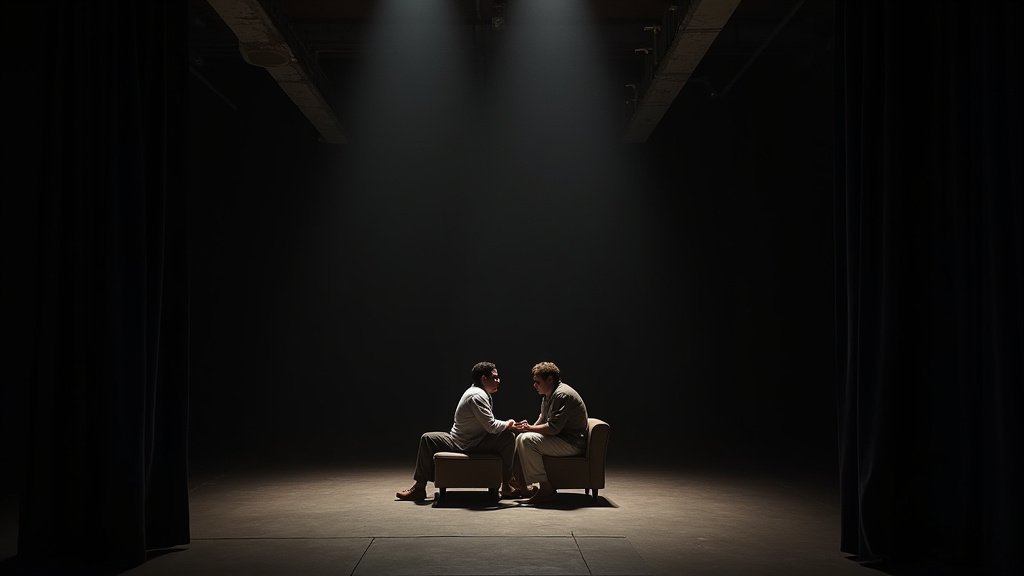
In the gripping production of “Aftermath,” playwright David Zax peels back the layers of a headline-grabbing nightmare to reveal a far more intimate tragedy. Staged at the A.R.T./New York Theatres, the play centers on a freelance journalist—a witness to global instability—who is abruptly thrust back into the mundane, yet emotionally complex, life of their family after a harrowing kidnapping by the Taliban. It is not merely a story of survival, but an excavation of the psychological fallout that occurs when the adrenaline of the conflict zone collides with the stagnant silence of the domestic sphere.
Key Highlights
- Core Premise: The play follows a freelance journalist navigating the complex reintegration process after being held hostage in a war zone, examining how trauma reshapes family dynamics.
- Intimate Staging: The production utilizes the A.R.T./NY space to heighten the sense of confinement, forcing the audience to grapple with the suffocating pressure of the protagonist’s return.
- Moral Ambiguity: Zax challenges the audience to consider the ethics of freelance journalism, questioning the fine line between pursuit of truth and self-indulgent risk-taking.
- Domestic Fallout: The narrative excels in portraying the secondary trauma experienced by the family left behind, shifting the spotlight from the survivor to the caregivers.
The Anatomy of Reentry: A Crisis of Identity
At the heart of “Aftermath” lies a fundamental disconnect. The protagonist, once defined by the high-stakes narrative of the foreign correspondent, finds that the labels they carried in the field—expert, observer, risk-taker—no longer apply in the kitchen. David Zax displays a keen understanding of the “reentry” phenomenon. This is the period where the survivor, often hailed as a hero or a victim, is stripped of their agency. The play deftly illustrates how the journalist, who once negotiated with captors, now struggles to negotiate the trivialities of daily living.
This is not a play about the horror of the kidnapping itself; that event remains a backdrop, a shadow that looms over every conversation. Instead, Zax focuses on the “aftermath”—the quiet, grueling process of learning how to be a person again when one has been reduced to an object of international negotiation. The tension in the play is palpable, generated not by gunfire or dramatic escape, but by the agonizing silence between a parent and a child, or the subtle judgment behind a partner’s supportive smile.
The Ethics of the Freelance Lens
One of the most compelling angles Zax explores is the precarious life of the freelance journalist. In an era where news is constant, the “fixer” and the freelancer operate in a landscape devoid of institutional safety nets. The play implicitly asks: At what cost does the pursuit of the ‘definitive story’ come? By centering the narrative on a freelancer, Zax bypasses the institutional shield of major networks. This forces the audience to confront the reality that the journalist is an independent actor, making individual choices that ripple outward, affecting not just their own life, but the lives of their family members who were never asked to volunteer for the front lines.
The Domestic Landscape as a Warzone
Perhaps the most brutal, and brilliant, aspect of “Aftermath” is its refusal to paint the returning survivor as a saint. Trauma, Zax suggests, is messy and often selfish. The protagonist returns home not with a desire for healing, but with a visceral need for normalcy that often manifests as volatility. The family members, conversely, are not mere victims waiting for a reunion. They have spent months, perhaps years, in their own form of captivity—waiting, mourning, and ultimately, adapting to a life without the journalist. When the survivor returns, they find that the space they once occupied has been filled. The emotional wreckage is not caused by the Taliban, but by the inevitable shifting of life’s tectonic plates in the absence of the key figure. It is a profound exploration of the fragility of modern family structures.
The A.R.T./NY Stage as an Emotional Crucible
Technically, the choice of the A.R.T./NY venue serves the narrative perfectly. The intimate setting prevents the audience from distancing themselves from the characters. There is nowhere to hide in the theater, and by extension, there is nowhere for the characters to hide from each other. The set design mirrors the narrative: functional, sparse, and haunted by the remnants of a life disrupted. Lighting design becomes a character in itself, emphasizing the stark divide between the bright, harsh glare of the public eye and the flickering, uncertain light of personal reconciliation. Zax’s script demands this closeness, as the nuances of a glance or a hesitating breath are where the real drama unfolds. By stripping away the spectacle, the production ensures that the audience must witness the raw, unfiltered cost of survival.
FAQ: People Also Ask
Q: Is ‘Aftermath’ based on a true story?
A: While not a direct biography of a single person, David Zax’s play is clearly informed by the widespread, documented experiences of journalists captured in conflict zones, blending real-world geopolitical realities with fictionalized family dynamics.
Q: What is the significance of the play being performed at A.R.T./NY?
A: A.R.T./NY provides an intimate, ‘black-box’ style environment that is essential for this play. It allows the audience to experience the claustrophobia of the protagonist’s internal state, making the family conflicts feel immediate and deeply personal rather than distant.
Q: Does the play focus primarily on the political aspects of the kidnapping?
A: No. The kidnapping and the political nature of the Taliban’s actions serve as the inciting incident, but the primary focus of the play is the personal, domestic, and psychological aftermath for the journalist and their family upon return.
More Stories
Critical Pulse: The Week’s Must-Watch and Must-Listen Hits
Linkin Park: Inside the Emotional Rebirth of ‘Unshatter’
TV’s High-Stakes Week: From Reality Games to Grit