











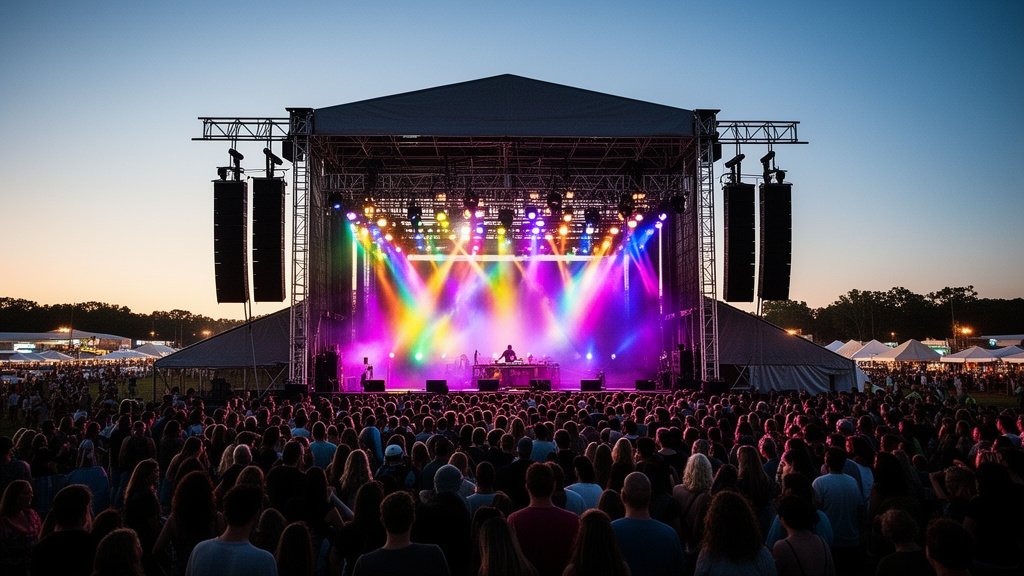
The Burlington County Fairgrounds in Columbus, New Jersey, have undergone a sonic transformation this weekend, August 24–25, 2026. As the South Jersey House Music Festival officially kicks off, the fairgrounds—traditionally known for agricultural exhibitions and community staples—have pivoted to become the epicenter of regional electronic dance music culture. This two-day immersive gathering serves as a critical nexus for house music enthusiasts, professional DJs, and local entrepreneurs, marking a significant moment in the New Jersey electronic music calendar.
The Historical Pulse: New Jersey’s Contribution to House
To understand the significance of this festival, one must appreciate the deep-rooted relationship between New Jersey and the evolution of house music. The state has long served as a creative incubator, famously birthing the ‘Jersey Club’ subgenre—a high-energy, triplet-focused evolution of house that has influenced mainstream pop and hip-hop globally. While the South Jersey House Music Festival focuses on the broader spectrum of house—spanning classic deep house, soulful grooves, and modern tech-house—it operates under the umbrella of this rich musical legacy.
Events like this are not merely ‘raves’; they are cultural repositories. By gathering at the Burlington County Fairgrounds, the festival organizers are bridging the gap between the rural, sprawling landscapes of South Jersey and the urban intensity of club culture. This fusion is intentional. It provides a sanctuary for the ‘community experience’ that has become increasingly fragmented in the era of digital streaming. Here, the music is a shared physical reality, propagated through massive sound systems that define the festival experience.
Navigating the Venue: Logistics and Soundscapes
The Burlington County Fairgrounds, located in Columbus, offers a unique infrastructure for this type of event. Unlike urban venues restricted by noise ordinances and vertical building codes, the fairgrounds provide a ‘wide-open’ acoustic environment. For the festival organizers, this has allowed for a multi-stage layout that separates low-frequency heavy techno/house from the more melodic, vocal-heavy tracks typical of sunset sets.
Operational logistics for a festival of this scale are complex. From a crowd management perspective, the sheer square footage of the fairgrounds allows for a ‘festival-in-the-round’ feeling rather than a compressed, high-density environment. This is a critical factor for the 2026 attendee demographic, which prioritizes comfort, accessibility, and high-quality sound dispersion. The stage design team has prioritized modular sound rigs that maximize directional audio, ensuring that the music travels throughout the event zones while minimizing off-site acoustic impact on the surrounding Columbus community.
Economic Impact: Beyond the Beat
There is a tangible economic multiplier effect occurring in Burlington County this weekend. The festival is not just a platform for DJs; it is a catalyst for local commerce. The inclusion of diverse local food vendors—ranging from artisanal BBQ to regional NJ culinary staples—creates a closed-loop economic ecosystem. Festival attendees, many of whom travel from Philadelphia, New York City, and the Jersey Shore, contribute significantly to local hospitality and transportation sectors.
Local economic data suggests that events of this nature act as a ‘resort-lite’ experience. By drawing thousands of visitors to the Burlington area for a 48-hour window, the festival forces a surge in demand for local accommodation and transit. This creates a compelling argument for the Fairgrounds Board of Directors to continue approving large-scale, genre-specific cultural events, as they diversify the fairground’s utility beyond the traditional agricultural calendar.
The Future of Outdoor Electronic Events
As the festival concludes on August 25, the industry is closely watching the success of the South Jersey House Music Festival as a bellwether for the future of regional electronic music festivals. There is a clear market trend shifting away from hyper-commercialized, mega-festivals toward community-centric, mid-sized events. These festivals prioritize the ‘vibe’—the collective sentiment of the crowd—over massive, multimillion-dollar pyrotechnics or global headliners that drive ticket prices into the thousands.
This shift points toward a more sustainable model for the music industry. By anchoring the event in a specific regional identity—South Jersey House—organizers create brand loyalty that transcends individual lineups. Attendees return year after year, not necessarily because of a specific DJ, but because the festival has become a cultural touchstone. This is the ‘New Boutique’ model of festival management, and its execution at the Burlington County Fairgrounds serves as a masterclass in regional cultural asset utilization.
As the final beats drop on Sunday night, the organizers will likely focus on the metrics that define long-term success: safe crowd behavior, environmental impact minimization, and vendor satisfaction. For now, the focus remains on the music, the community, and the persistent rhythm echoing through Columbus, New Jersey.
More Stories
iHeartRadio Music Festival 2026 Ignites Las Vegas
Hyde Park Jazz Fest at 20: A Sonic Milestone for Chicago
Americanafest 2026: Nashville Readies for Global Roots Music Milestone