







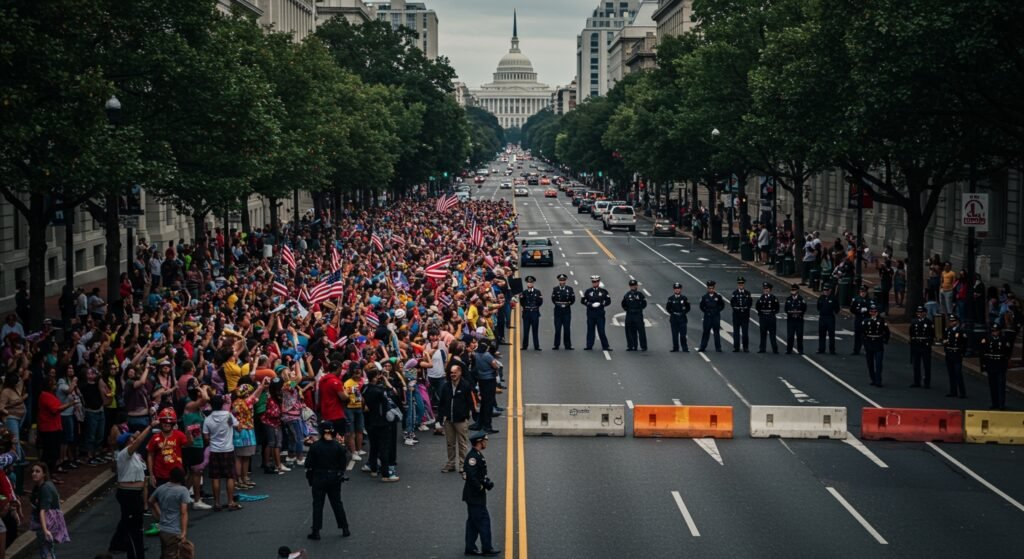
A single, concentrated week in June 2025 unexpectedly coalesced into a profound illustration of the competing visions and deep-seated fault lines currently traversing American society. From vibrant celebrations of identity to anticipated displays of military power and confrontations over immigration policy, the events unfolding concurrently across the United States highlighted the nation’s contemporary state of division and polarization, as noted in an analysis by Ted Anthony of The Associated Press.
Contrasting Expressions in the Capital
Washington D.C., a city long accustomed to serving as a stage for national expression and protest, found itself at the epicenter of two vastly different narratives during this pivotal week. One narrative was embodied by World Pride, drawing participants from across the globe to the U.S. capital. This event championed themes of inclusivity and celebrated the diversity of the LGBTQ community.
For attendees like David Begler, a 58-year-old resident of Philadelphia, World Pride represented more than just a parade; it was a powerful message countering actions perceived as targeting the LGBTQ community and a call for unity amidst a fractured national landscape. The atmosphere was characterized by celebration and advocacy, emphasizing belonging and acceptance.
Simultaneously planned for Washington D.C. was a military parade commemorating the U.S. Army’s 250th anniversary. While intended as a display of national strength and history, the anticipation surrounding this event also became a flashpoint for potential conflict. President Donald Trump issued a stern warning to potential protesters, stating they would be met with “very big force,” a declaration that underscored the heightened tensions and potential for confrontation associated with public demonstrations in the capital.
Tensions Flare on the West Coast
Far from the nation’s capital, another significant confrontation was brewing. In Los Angeles, anticipation grew for a planned demonstration dubbed the “No Kings Day of Defiance.” This protest was explicitly organized in opposition to the Trump administration’s immigration raids, reflecting deep disagreements over federal immigration policy and enforcement.
In anticipation of this event and potential unrest, Texas Gov. Greg Abbott ordered the deployment of 5,000 state National Guard troops. While the protest occurred in Los Angeles, the dispatch of Texas state forces underscored the interstate nature of the political friction and the perceived need for substantial security presence. Reports from the scene indicated that demonstrators reportedly taunted the deployed troops, further highlighting the charged atmosphere and the level of animosity present at the protest site.
Washington’s Historical Role
The convergence of these high-profile, ideologically opposed events in Washington D.C. during a single week in June 2025 is not without historical precedent for the city. The U.S. capital has historically served as a magnet for diverse groups seeking to make their voices heard on the national stage, often through mass gatherings and protests.
The author draws parallels to significant historical events that unfolded in Washington D.C., including the 1932 Bonus Army march, where World War I veterans protested for early bonus payments; the 1960s March on Washington, a pivotal moment in the Civil Rights Movement; and the 1995 Million Man March, a major gathering focused on African American unity and empowerment. These historical footnotes underscore Washington’s enduring role as a crucial, and often contested, forum for national dissent and collective expression.
Underscoring a Divided Nation
The juxtaposition of World Pride’s message of inclusivity and celebration with the security posture surrounding the military parade in Washington D.C., alongside the troop deployment and protest confrontations in Los Angeles, presented a stark snapshot of contemporary America during this particular week in June 2025. Each event, while distinct in its immediate purpose, contributed to a broader narrative of a nation grappling with fundamental disagreements over identity, power, policy, and the very definition of national unity.
The concentration of such disparate and potentially conflicting events within a mere seven days served to amplify the visibility of the fault lines described by Anthony of The Associated Press. It underscored how deeply entrenched competing visions have become within American culture, manifesting in divergent public expressions and interactions across the country.
More Stories
Lowriding’s Rise: SF Celebrates Cruising Culture
U.S. Repatriates 64 Cultural Relics and Fossils to China
Betting on Viral Fame: Novig’s Strategic Use of Sydney Sweeney