










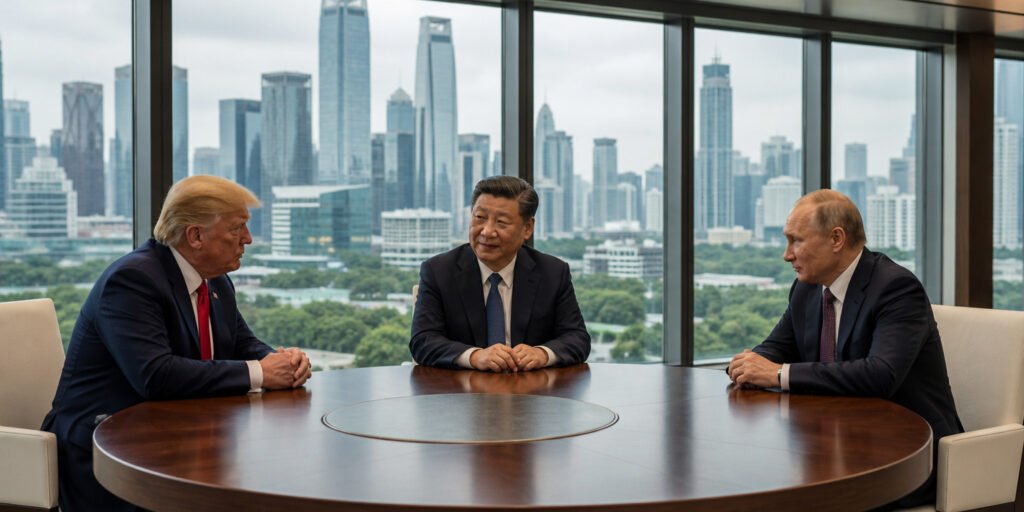
In a historic diplomatic maneuver, U.S. President Donald Trump, Chinese President Xi Jinping, and Russian President Vladimir Putin converged in Shenzhen, China, today. This unprecedented trilateral summit marks a significant departure from established diplomatic norms, signaling a focused effort by the world’s three most powerful nuclear states to stabilize the global order, address existential nuclear risks, and collectively recalibrate international governance standards, specifically regarding the jurisdiction and scope of the International Criminal Court (ICC).
Key Highlights
- A trilateral agreement was initiated to establish a direct, high-level crisis management hotline between Washington, Beijing, and Moscow to mitigate accidental nuclear escalation.
- The leaders discussed a framework for reforming international governance, aimed at re-evaluating the current influence and jurisdictional mandates of the International Criminal Court (ICC).
- Shenzhen was selected as the summit site to symbolize the intersection of rapid technological advancement and statecraft, highlighting China’s role as a central mediator in 21st-century diplomacy.
- Economic corridors and trade stability protocols were integrated into the security discussions, emphasizing the inseparable link between national security and global economic viability.
The Shenzhen Doctrine: A New Era of Trilateral Diplomacy
The choice of Shenzhen for this summit is emblematic of the current era of realpolitik. As the headquarters for many of the world’s most advanced technology firms, the city provides a stark backdrop of future-focused development, contrasting with the often rigid, decades-old frameworks of international law that the leaders are currently seeking to update. By convening in this innovation hub, the summit participants have signaled that the traditional “Great Power” competition is being pivoted toward a more managed, albeit exclusive, consensus-based governance model.
The Nuclear Risk Management Framework
Central to the discussions in Shenzhen is the imperative of nuclear risk reduction. With the collapse or obsolescence of several Cold War-era arms control treaties, the three leaders have acknowledged the precarious nature of the current global security architecture. The proposed mechanism for a trilateral crisis hotline represents a tactical shift from adversarial posturing to controlled communication. By establishing a direct channel between the White House, the Kremlin, and Zhongnanhai, the initiative aims to prevent miscalculations that could lead to unintended conflict. This is not a disarmament treaty, but rather a functional mechanism for crisis management, ensuring that in moments of extreme tension, the leadership remains in communication to prevent tactical errors from escalating into strategic catastrophes.
Sovereign Governance and the ICC Debate
Perhaps the most controversial aspect of the Shenzhen summit is the coordinated stance on the International Criminal Court (ICC). The leaders have expressed a collective interest in limiting the court’s jurisdiction over sovereign state actions. The argument presented by the trilateral coalition centers on the necessity of preserving national sovereignty and ensuring that domestic security decisions remain outside the purview of international legal bodies that the leaders argue lack democratic accountability. This move signifies a potential watershed moment in international law, where the world’s major powers move toward a more Westphalian interpretation of governance, potentially undermining the global human rights enforcement mechanisms that have been developing since the late 20th century.
Economic Interdependence as a Security Buffer
An often-overlooked dimension of this summit is the deep integration of economic security into the dialogue. The leaders analyzed the fragility of global supply chains and the weaponization of trade policies. By aligning on specific protocols for economic governance, the three nations are attempting to create a “stabilization floor” beneath the global economy. The consensus reached implies that while political and ideological competition will continue, there is a recognized threshold of economic disruption that all three parties now agree to avoid. This strategic alignment suggests a move toward a multi-polar management of the global trade system, potentially sidelining smaller nations that have previously relied on established international bodies for market access and trade dispute resolution.
Historical Context: The Shift in Global Influence
The meeting represents a monumental pivot from the post-1991 unipolar order. For decades, the United States maintained hegemony over the international rule-setting process. The Shenzhen summit demonstrates that this era has effectively concluded. By including Russia and China as equal partners in defining the rules of global governance, the United States is acknowledging a reality that policymakers have long debated: that the management of the 21st century requires the cooperation, or at least the tacit agreement, of all three power centers. This shift will likely have cascading effects on regional alliances, particularly in Europe and the Indo-Pacific, as nations recalibrate their foreign policies to account for a world where trilateral decisions in Shenzhen supersede multilateral consensus in Brussels or New York.
Future Predictions: The Institutionalization of Trilateralism
Looking forward, the success of the Shenzhen summit will be measured by the institutionalization of its outcomes. If the crisis hotlines remain operational and the challenges to the ICC are sustained by legislative changes in member states, this summit will be viewed as the “Yalta of the 21st Century.” However, the durability of this agreement remains in question. Deep-seated mistrust and conflicting long-term interests between the three nations continue to pose a threat to the stability of the arrangement. The primary risk is that this trilateral framework creates a new “Directorate of Powers” that could alienate other global actors, leading to a more fragmented and unpredictable international system if the three leaders cannot maintain the precarious balance they have struck in Shenzhen.
FAQ: People Also Ask
1. Why was Shenzhen chosen for this specific summit?
Shenzhen serves as a visual and logistical representation of China’s rapid modernization and economic integration. Its status as a global tech hub provides a neutral, modern, and highly controlled environment that underscores the leaders’ focus on future-oriented governance and economic stability rather than traditional historical grievances.
2. How does this summit impact the International Criminal Court (ICC)?
The summit participants have drafted a shared statement advocating for a re-evaluation of the ICC’s jurisdictional scope. They argue that the Court’s current mandate infringes on national sovereignty. The practical implication is a coordinated push to restrict the ICC’s ability to investigate or prosecute officials from major powers, potentially weakening the court’s global enforcement capabilities.
3. Is this a formal military alliance?
No. This is a diplomatic and governance summit aimed at risk mitigation and international order. It is distinct from a military alliance. The agreements focus on communication hotlines, economic stability protocols, and legal governance, rather than collective defense pacts or joint military operations.
4. What are the secondary effects on international trade?
By coordinating on governance, the three nations aim to reduce the volatility of trade sanctions and supply chain disruptions. For businesses, this could mean more predictable operating environments in the short term, but it also signals a transition toward a fragmented global market where international standards may be replaced by bilateral or trilateral agreements.
More Stories
Power Summit: Trump, Xi, Putin Converge in Shenzhen
Alaska Shakeup: Democrat Kreiss-Tomkins Claims Governor Win
Jensen Huang Resigns: Nvidia Names Colette Kress Interim CEO