



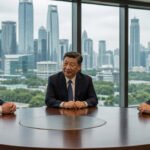








In a momentous development for global diplomacy, United States President Donald Trump, Chinese President Xi Jinping, and Russian President Vladimir Putin have convened in Shenzhen, China. The meeting, taking place on the periphery of the Asia-Pacific Economic Cooperation (APEC) summit, marks a rare and high-stakes three-way engagement between the world’s most influential leaders. The primary agenda, characterized by an unprecedented level of urgency, centers on critical discussions surrounding nuclear weapons modernization, global trade imbalances, and emerging security disputes that currently threaten international stability.
Key Highlights
- Unprecedented Tripartite Meeting: This high-stakes summit represents a rare direct engagement between the US, China, and Russia on the sidelines of APEC, signaling a potential shift in global diplomatic strategy.
- Nuclear Arms Control: Discussions are focused on establishing new guardrails for nuclear weapons development and addressing the erosion of legacy arms control agreements.
- Trade Realignment: Leaders are tackling contentious global trade issues, aiming to mitigate supply chain volatility and address long-standing economic protectionism.
- Security Architecture: The summit addresses urgent security disputes, seeking to prevent escalation in contested regions and establish new frameworks for conflict de-escalation.
The Shenzhen Triad: Geopolitical Reshaping at APEC
The choice of Shenzhen—the engine room of Chinese technological manufacturing—as the venue for this trilateral summit is not incidental. It serves as a symbolic backdrop for a discussion dominated by the intersection of high-end technology, manufacturing capacity, and the strategic deterrence capabilities that define 21st-century power. As the global order faces the most significant stress test since the end of the Cold War, the ability of these three leaders to find common ground could dictate the trajectory of international relations for the coming decade.
The Nuclear Shadow: Urgent Arms Control
Perhaps the most critical item on the agenda is the existential issue of nuclear weapons. With legacy treaties reaching their expiration dates and new technologies—such as hypersonic glide vehicles and AI-enabled delivery systems—entering the arsenals of major powers, the current global security architecture is fraying.
Experts note that the proliferation of tactical nuclear weapons and the breakdown of communication channels between Washington, Beijing, and Moscow have created a heightened risk of miscalculation. The Shenzhen talks are intended to re-establish a baseline of strategic stability. By bringing the three dominant nuclear powers to the table, the goal is to move beyond bilateral agreements toward a more inclusive framework that addresses multipolar deterrence. Discussions are expected to revolve around transparency, crisis communication protocols, and a reaffirmation of the long-standing international norms regarding the use of nuclear force, aiming to prevent a cascading arms race that would threaten global security.
Global Trade Architectures in Flux
While security dominates the headlines, the economic undercurrents of the meeting are equally profound. The current global trade system is strained by post-pandemic recovery efforts, inflationary pressures, and the shift toward ‘friend-shoring’ and economic sovereignty. President Trump, President Xi, and President Putin represent three vastly different economic philosophies, yet they are united by the need to stabilize markets that have been rattled by supply chain disruptions and geopolitical tariffs.
Negotiations are centering on potential frameworks to reduce the friction in global trade, specifically regarding the flow of critical minerals, energy resources, and semiconductor technology. For China, the priority remains the preservation of market access; for the United States, the focus is on rebalancing trade deficits and protecting technological intellectual property; for Russia, the objective lies in maneuvering around economic sanctions and integrating into a more robust alternative trade network. The outcome of these discussions will likely influence the future of the World Trade Organization (WTO) and regional trade blocs across the Asia-Pacific.
Redefining Security Paradigms
Beyond nuclear and trade issues, the leaders are addressing localized security disputes that carry the potential for broader conflict. Whether regarding maritime navigation rights in the South China Sea, territorial integrity in Eastern Europe, or the shifting balance of power in Central Asia, the objective in Shenzhen is crisis management.
This is not a summit intended to solve these deeply entrenched issues, but rather a necessary exercise in diplomatic signaling. By engaging in these high-stakes talks, the leaders are attempting to delineate ‘red lines’ that, if crossed, could precipitate direct conflict. This diplomatic recalibration is essential for preventing local skirmishes from escalating into large-scale military engagements. The inclusion of three-way talks suggests a recognition that unilateral actions are no longer sufficient to maintain regional order; a collaborative approach to dispute resolution, however fraught, has become a strategic necessity.
The Diplomatic Calculus: Domestic Pressures and Global Goals
Every move made in Shenzhen is also filtered through the lens of domestic politics. For each leader, this summit is a performance of strength and statesmanship for their respective domestic audiences. Managing public perception while making the necessary compromises for international stability is the fundamental challenge of the summit. As the talks conclude, the success of the Shenzhen gathering will be measured not by the signing of comprehensive treaties, but by the establishment of effective, enduring channels of communication that can withstand the inevitable friction of international politics.
FAQ: People Also Ask
1. Why is the Shenzhen summit being called a ‘high-stakes’ event?
It is considered high-stakes because it brings together the three primary global powers with competing interests to address nuclear proliferation and economic volatility. The rare nature of these direct, trilateral talks suggests that the involved nations recognize the current risks of miscalculation as exceptionally high.
2. Will this meeting lead to a new nuclear treaty?
While immediate, comprehensive treaties are unlikely, the objective is to establish new ‘guardrails’ and communication frameworks. These are intended to prevent accidental escalation and set the stage for future formal arms control negotiations.
3. How does this summit impact global trade agreements?
It serves as a test of the current economic order. By addressing supply chain vulnerabilities and trade tariffs at the highest level, the leaders are attempting to mitigate the risks that threaten to balkanize the global economy into isolated, hostile trading blocs.
4. Is the APEC summit the main driver of these talks?
APEC provides the convenient diplomatic cover and neutral environment for these discussions to occur, but the meeting itself is an autonomous engagement. The summit acts as a catalyst, providing the organizational structure for these three leaders to convene outside of their usual political theaters.
More Stories
Shenzhen Summit: Trilateral Power Realigned
Alaska Shakeup: Democrat Kreiss-Tomkins Claims Governor Win
Jensen Huang Resigns: Nvidia Names Colette Kress Interim CEO