





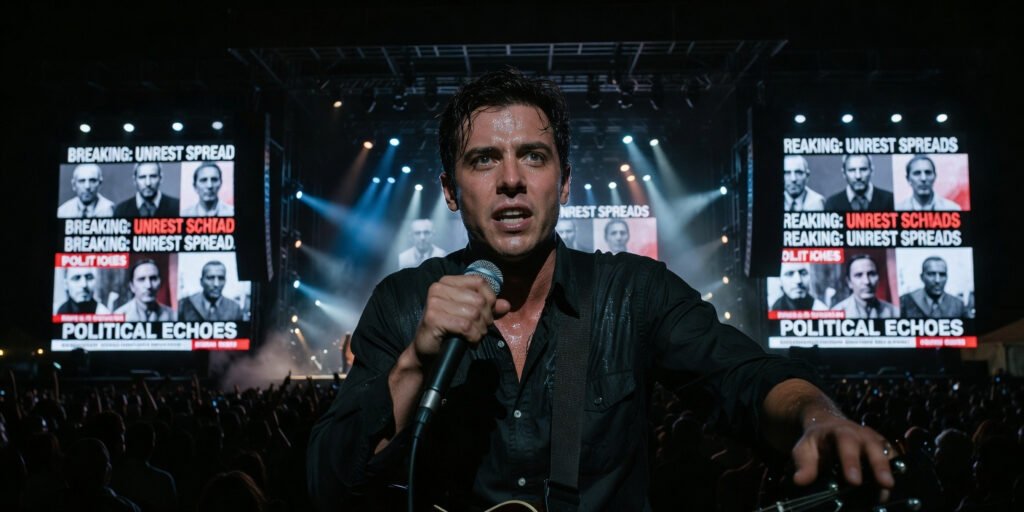
The Strokes utilized their second weekend at Coachella to transform their headline-caliber time slot into a stark political critique. While Coachella is often viewed through the lens of pop culture escapism, the New York rock legends, fronted by Julian Casablancas, shattered that veneer on Saturday night. As the band launched into a rare live performance of their 2016 track “Oblivius,” the giant LED screens behind them displayed a searing, non-linear montage of historical and contemporary political events. The performance, which has since gone viral, directly accused the United States of long-term foreign interventionism, specifically highlighting alleged CIA-orchestrated regime changes and recent military actions in Iran and Gaza.
The Visual Montage: A History of Alleged Intervention
The central element of the performance was a meticulously curated series of images and text overlays that appeared as Casablancas repeated the song’s refrain: “What side you standing on?” The montage served as an unconventional visual history lesson, intended to draw a direct line between Cold War-era covert operations and modern-day geopolitical conflicts.
Among the figures featured on the screens were Iranian Prime Minister Mohammad Mosaddegh, whose 1953 ousting was later confirmed to be a CIA-backed coup; Congolese leader Patrice Lumumba, assassinated in 1961 with Belgian and alleged US complicity; and Chilean President Salvador Allende, who died during the 1973 coup that replaced him with a military junta. The visuals also touched on domestic controversies, including the 1999 civil trial that suggested US government involvement in the assassination of Martin Luther King Jr.—a claim that continues to be a focal point for conspiracy theorists despite federal investigations concluding otherwise.
Why ‘Oblivius’? The Context of the Song
The choice of “Oblivius” was not arbitrary. Released in 2016 as part of the Future Present Past EP, the song has long been considered one of the band’s most overtly political compositions. Critics noted that the song’s lyrical ambiguity and themes of societal disillusionment provided a perfect thematic canvas for the band’s visual protest. By reviving a track that has remained absent from their live sets for nearly a decade, the band signaled that this was a deliberate, premeditated statement rather than a spontaneous act. The juxtaposition of the song’s driving, nervous energy with the somber, heavy historical footage created a jarring, memorable atmosphere that resonated throughout the festival grounds.
The Middle East: Gaza and Iran
The most controversial aspects of the montage occurred during the final minutes of the set. The screens displayed explicit claims regarding recent military actions in the Middle East. One slide featured the text: “Over 30 universities destroyed in Iran,” while another showed footage of the demolition of the al-Israa University in Gaza, accompanied by the caption: “Last university standing in Gaza.” By tethering these specific images to a narrative of US-Israeli airstrikes, the band moved beyond historical critique into current events, aligning themselves with a growing chorus of musical artists who are increasingly using festival platforms—historically considered neutral spaces—to voice dissent against active military conflicts.
A Shift in Festival Culture
The Strokes’ performance is part of a broader, emerging trend where the music festival has reclaimed its role as a venue for protest art. Last year, the Irish hip-hop group Kneecap utilized their Coachella set to highlight similar anti-war sentiments, establishing a precedent that the band seemingly leaned into. However, the scale and directness of The Strokes’ montage, which essentially forced the Coachella audience to engage with complex, often uncomfortable geopolitical history, marks a notable elevation in the intensity of such statements. While the festival has yet to issue an official comment on the performance, the reaction online was immediate, with clips of the set garnering millions of views across social media platforms before being subjected to widespread takedown notices, further fueling the controversy.
The Future: ‘Reality Awaits’
This performance appears to be a calculated precursor to the band’s forthcoming album, Reality Awaits, slated for release on June 26, 2026. If the Coachella set is an indicator of the record’s thematic direction, fans should prepare for an album that trades in systemic critique and societal observation. The band is signaling a pivot toward more aggressive artistic stances, moving away from the indie-sleaze aesthetic that defined their early years toward a sharper, more politically conscious identity. This transition is not unprecedented for Casablancas, who has historically supported figures like Bernie Sanders and New York mayoral candidate Zohran Mamdani, but it represents the first time the band as a cohesive unit has centered such heavy political messaging in their live show.
FAQ: People Also Ask
Did The Strokes make a political statement at Coachella?
Yes. The band ended their second-weekend set with a video montage criticizing US foreign intervention, historical CIA activities, and recent military strikes in Gaza and Iran.
Why did they use the song “Oblivius” for the montage?
“Oblivius” is a 2016 track with themes of societal disillusionment. Its lyrics, particularly “What side you standing on?”, provided a thematic anchor for the critical imagery shown on screen.
Has The Strokes’ management commented on the performance?
As of the time of writing, there has been no official statement from the band or their management regarding the specific content of the montage, though the performance clearly aligns with the band’s historical political activism.
Is there historical evidence for the claims made in the montage?
Some of the historical claims—such as the CIA’s role in the 1953 Iranian coup (Mosaddegh) and the 1973 Chilean coup (Allende)—are well-documented and historically accepted. Other claims, such as those regarding specific recent airstrikes or the 1999 MLK civil trial, are part of ongoing debates and interpretations of specific legal and military events.
More Stories
HARD Summer 2026: LA Return with Kali Uchis, Zedd & DJ Snake
Shannon Shaw Headlines 2026 Athens Arts & Music Fest
Hardly Strictly Bluegrass 2026: First Wave of Legends Announced