











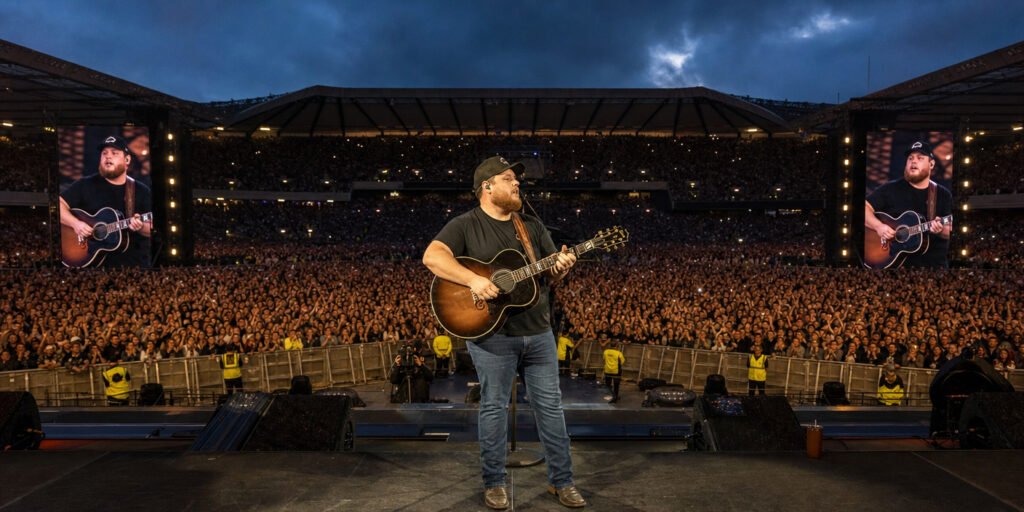
The thunderous roar emanating from Murrayfield Stadium in Edinburgh on the nights Luke Combs took the stage was not merely the sound of a crowd; it was the definitive echo of country music’s unprecedented global ascendance. Performing to a sold-out capacity crowd, Combs did not arrive on a pedestal of rock-star excess, but rather with the unpretentious stride of a man clocking into a shift. This dichotomy—the humble, baseball-cap-wearing songwriter versus the colossal, multi-million dollar stadium production—defined the essence of the performance, confirming that in the modern music landscape, authenticity is the highest currency.
The Edinburgh Spectacle: A Night of Atmospheric Resonance
Murrayfield Stadium, Scotland’s largest venue with a capacity exceeding 67,000, is a fortress of Scottish rugby culture. Transforming this cavernous space into an intimate country hall requires a specific kind of magic. From the opening chords, it was clear that Combs—the Nashville titan responsible for chart-topping hits like ‘Hurricane’ and ‘Beautiful Crazy’—possessed the technical and vocal prowess to command every corner of the arena. Unlike his contemporaries who often rely on choreographed dance troupes or elaborate costume changes, Combs’ spectacle was derived from the sheer volume of his songbook. The production relied heavily on massive LED arrays that projected the live performance with stark clarity, ensuring that even those in the farthest tiers felt the intimacy of his storytelling. The stage design was industrial and functional, reflecting the blue-collar themes that underpin his lyricism, and serving as a mirror to the audience’s own working-class values.
The ‘Regular Joe’ Paradox: Scaling Authenticity
At the core of the Combs phenomenon is the ‘Regular Joe’ paradox. In an industry that often incentivizes the pursuit of the unattainable, Combs has successfully marketed the antithesis: the accessible everyman. During his Murrayfield sets, this was on full display. He engaged the Edinburgh crowd not as a distant idol, but as a peer. There were no pyrotechnics for the sake of distraction, only for the sake of punctuation. His signature uniform—a clean-cut T-shirt, baseball cap, and jeans—acted as a symbolic barrier against the pretension often associated with stadium tours. This aesthetic choice is critical; it creates a psychological bridge between the superstar on stage and the fan in the bleachers. It suggests that his success is not a departure from the life of his listeners, but an amplification of it. This relatability is perhaps his strongest weapon in an increasingly digital and disconnected music market.
The Global Country Music Boom: Beyond the Mason-Dixon Line
The sell-out status of the Murrayfield dates serves as a macro-level indicator of the shifting tides in global music consumption. For decades, US country music struggled to penetrate the mainstream European market beyond niche festival appearances like C2C (Country to Country). However, the streaming era has obliterated these geographical borders. Combs has become a pioneer in this expansion, leveraging data-driven touring strategies that target regions with high engagement but low physical presence. By selling out Murrayfield, he effectively signaled that country music is no longer a localized genre defined by regionalisms; it is a global pop-cultural force. The demographic at Murrayfield was diverse—a testament to the cross-genre appeal of his songwriting, which often features pop-leaning melodies anchored by traditional country instrumentation.
The Economics of the ‘Combs Effect’
The economic implications of a tour of this magnitude are significant for the host city. Massive stadium dates generate millions in local revenue, from hospitality and transport to ancillary tourism. Combs’ ability to fill 67,000-seat stadiums internationally places him in an elite class of touring artists alongside Taylor Swift and Beyoncé. This ‘Combs Effect’ is influencing how agents and promoters approach European bookings for country artists. The risk factor of international stadium touring for genre-specific acts has historically been high, but the consistent sell-out data from the Edinburgh shows provides a blueprint for future tours. Promoters are now looking at country acts not as experimental bookings, but as guaranteed revenue drivers capable of competing with global pop icons.
Evolution of the Setlist and Performance Dynamic
The setlist for the Edinburgh shows was a masterclass in pacing. Combs effectively balanced the melancholic balladry that defines his early career with the high-energy, crowd-pleasing anthems that have come to dominate his recent releases. By threading his set with ‘deep cuts’ that resonate with his core fanbase, alongside massive radio hits, he maintained an emotional arc throughout the night. The technical performance was equally disciplined. His vocal stamina, sustained across a long-duration set, proved he is as much a workhorse as he is a songwriter. This technical reliability is essential for stadium environments, where sound quality often suffers due to acoustics; Combs’ band and production team meticulously calibrated the mix to ensure lyrical clarity, a necessity for a storyteller of his caliber.
FAQ: People Also Ask
How many nights did Luke Combs perform at Murrayfield?
Luke Combs performed a double-header at Murrayfield Stadium in Edinburgh, with both nights achieving sold-out status, demonstrating the immense demand for his live show in Scotland.
Why is the Murrayfield show significant for country music?
It marks a turning point in the globalization of country music, proving that the genre can sell out 60,000+ capacity stadiums in the UK without relying on local country-music specific festival circuits, signaling a broader mainstream acceptance.
Did Luke Combs perform any covers at the Edinburgh show?
While his set is primarily original material, Combs is known for his reverence for country traditions and often incorporates subtle nods to his influences, though his Edinburgh setlist was heavily focused on his extensive catalog of number-one hits.
What does the ‘Regular Joe’ persona mean for his brand?
It represents a shift in celebrity branding where authenticity, accessibility, and blue-collar relatability are valued higher than the ‘mysterious superstar’ archetype, helping him build a deeply loyal fanbase that feels personally connected to his music.
More Stories
Mike Flanagan’s ‘Carrie’ Stuns Fantastic Fest
J Mascis: How Black Sabbath Turned Him Into a Rock Outlier
Sound Strokes: A Sonic Bridge Between China and Scotland