










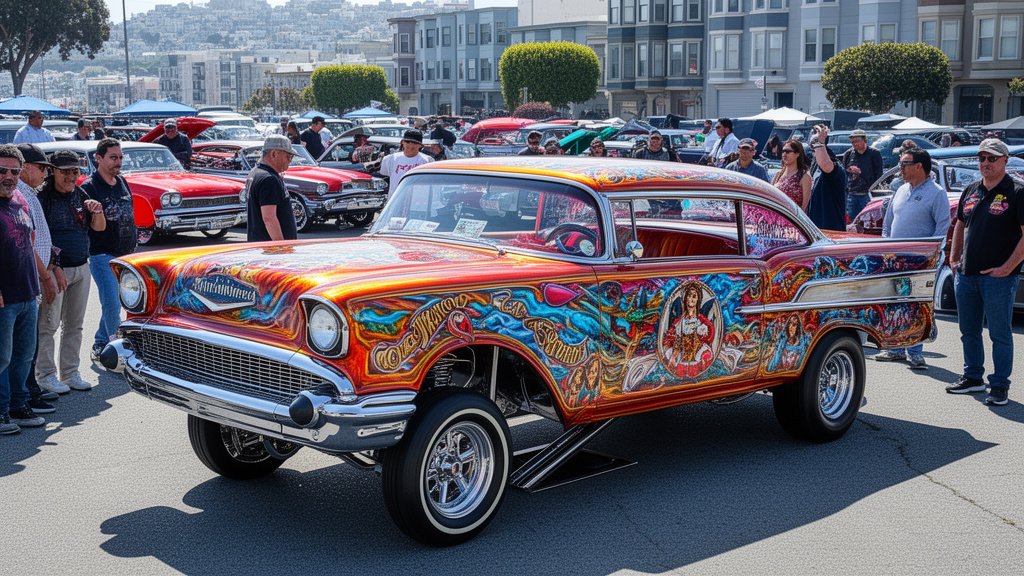
San Francisco’s lowriding culture has officially shed its label of a marginalized automotive subculture, emerging instead as a celebrated pillar of Mexican American and Chicano identity. The recent success of the annual ‘King of the Streets’ event served as a visceral reminder of this shift, as hundreds of meticulously customized vehicles descended upon the city, drawing massive crowds and signaling a definitive end to the era of cruising suppression. This resurgence is not merely a local phenomenon; it represents a broader, national validation of lowrider artistry, now bolstered by official institutional recognition, including the U.S. Postal Service’s release of commemorative lowrider stamps and the introduction of state-specific license plates across the U.S. West.
The Spectacle of Artistry at King of the Streets
The ‘King of the Streets’ event in San Francisco is more than just a car show; it is a rolling museum that showcases the height of automotive customization. Walking through the event, one is struck by the level of technical mastery on display. These are not merely cars; they are canvases. The vehicles feature intricate mural work depicting cultural histories, multi-layered candy-coat paint jobs that shimmer under the California sun, and highly complex hydraulic suspension systems that allow the vehicles to ‘dance’—a signature characteristic of the movement.
For the enthusiasts and builders who make up the San Francisco Lowrider Council and surrounding clubs, these events are essential. They provide a space for cross-generational knowledge transfer, where younger enthusiasts learn the mechanics of suspension geometry and the aesthetic traditions of pin-striping from the masters of the craft. The event highlighted a shift in public perception: where once these gatherings were targets for police scrutiny, they are now viewed as legitimate cultural festivals, attracting tourists, photographers, and local families alike, cementing their place as a vital component of the city’s vibrant cultural tapestry.
Navigating the Road from Suppression to Recognition
For decades, the lowriding community in California faced a legal uphill battle. Many municipalities, including parts of the Bay Area, enforced strict ‘anti-cruising’ ordinances that labeled lowrider gatherings as public nuisances. These laws often led to profiling and the dispersal of gatherings that were, in reality, family-oriented cultural expressions. The pivot point for this change was the organized advocacy by groups like the San Francisco Lowrider Council, which worked tirelessly to distinguish the artistic and community value of the culture from the negative stereotypes that had plagued it for generations.
The repeal of these ordinances was not just a legislative victory; it was a cultural reclamation. By engaging with city officials, the lowrider community proved that their presence boosted local economies and fostered community cohesion. Today, local government bodies and business owners are increasingly partnering with organizers for events, recognizing that the lowriding aesthetic—often associated with luxury, precision, and history—is a powerful draw that enhances the city’s character rather than detracting from it.
The National Stamp of Approval: USPS and Beyond
Perhaps the most telling sign of the culture’s mainstream integration is the U.S. Postal Service’s release of the ‘Lowrider’ Forever stamps. These stamps, featuring stylized illustrations of iconic 1960s-era Chevrolets, serve as a permanent, federal acknowledgment of lowriding as a quintessential American art form. This recognition is not localized to California; it permeates the entire U.S. West, where state-specific license plates dedicated to lowrider culture have begun to appear, offering another avenue for enthusiasts to express their pride.
This institutional nod creates a feedback loop of respect. When a national entity like the USPS honors the culture, it changes the conversation in boardrooms, city halls, and urban planning committees. It validates the thousands of hours and tens of thousands of dollars that owners invest in their vehicles. It confirms that the lowrider—with its hydraulic pumps, wire wheels, and plush interiors—is a legitimate piece of automotive history that deserves preservation alongside other classic car movements like hot rodding or vintage racing.
The Future of Cruising: Economic and Social Impact
The future of lowriding appears inextricably linked to broader efforts of cultural preservation. As the vehicles become more expensive to maintain and original parts harder to source, the community is focusing on preservation and mentorship. There is a growing economic footprint associated with these events; vendors, local eateries, and tourism-related businesses see significant upticks in revenue when large-scale car shows take place.
Looking ahead, the goal is to formalize these gatherings further. There is talk of establishing dedicated cultural districts where cruising is protected and encouraged as a heritage activity, similar to how historical districts preserve architecture. By codifying these spaces, San Francisco can lead the way in ensuring that this Chicano art form is not just a relic of the past, but a living, breathing part of the urban future. The ‘King of the Streets’ event proved that the heartbeat of lowriding is stronger than ever, and as the culture receives broader recognition, its influence is only set to grow.
FAQ: People Also Ask
What defines lowrider culture beyond the cars?
Lowriding is a Chicano cultural expression that emerged in the 1940s and 1950s. It encompasses the cars, but also the community values of family, pride in heritage, artistic expression through music and fashion, and a history of resistance against systemic exclusion.
Why were cruising bans historically enforced?
Cruising bans were primarily enacted in the 1970s and 80s under the guise of traffic control and crime prevention. Critics and community advocates long argued that these laws were selectively enforced and used to target Mexican American communities and suppress their cultural expression, leading to decades of legal challenges.
How can enthusiasts get involved in preserving this history?
Engagement can take many forms, from joining local car clubs, attending and supporting city-sanctioned ‘King of the Streets’ style events, purchasing official commemorative items like the USPS stamps, and participating in local civic meetings to advocate for the protection of cruising routes as cultural heritage sites.
What makes a car a ‘lowrider’?
Technically, a lowrider is characterized by a lowered stance, often achieved through hydraulic or pneumatic suspension systems. Beyond the mechanics, the culture values high-quality paint, interior upholstery, and chrome plating, often using vehicles like classic 1960s-era Chevrolet Impalas and Monte Carlos.
More Stories
U.S. Repatriates 64 Cultural Relics and Fossils to China
Betting on Viral Fame: Novig’s Strategic Use of Sydney Sweeney
DHS Scrubs Optimus Prime Posts After AI Misuse Backlash