











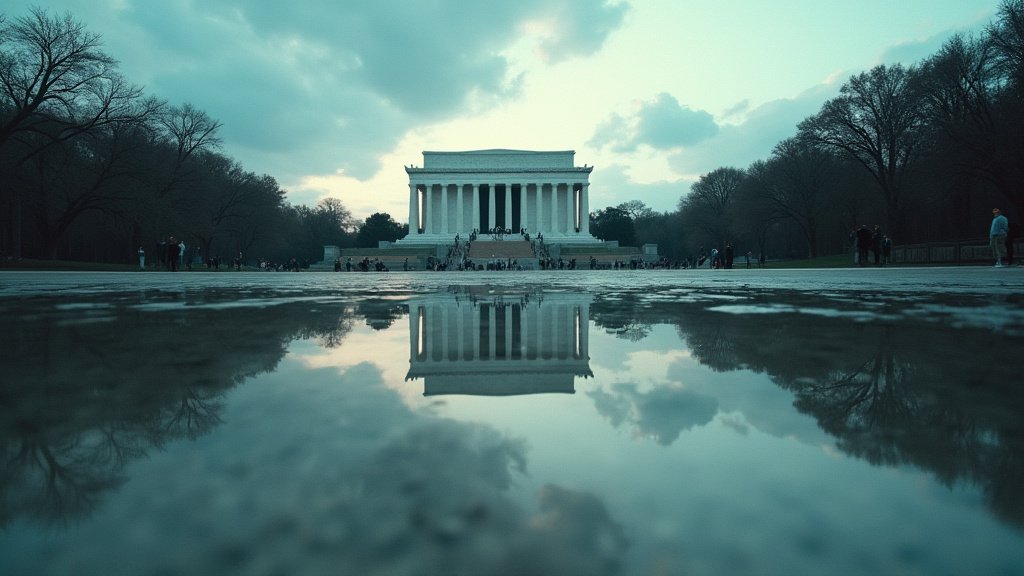
The Lincoln Memorial Reflecting Pool has become an unexpected focal point in a burgeoning culture war, drawing significant attention and debate.
Key Highlights:
- The Reflecting Pool’s current state is at the center of a national cultural dispute.
- Debates involve differing interpretations of historical preservation and public use.
- The controversy highlights broader societal divisions.
- The Lincoln Memorial continues to be a site of significant national discourse.
The Reflecting Pool’s Unforeseen Cultural Crossroads
The Lincoln Memorial Reflecting Pool, long a symbol of national unity and reflection, has recently found itself at the epicenter of a heated culture war. What was once a serene backdrop for countless historical moments and personal pilgrimages has now become a battleground for competing ideologies and interpretations of American heritage. The current discourse surrounding the pool is not about a physical alteration but rather the symbolic meaning and public perception of its role in contemporary society. This shift underscores how even the most established national monuments can become sites of contention in an increasingly polarized environment.
Historical Context and Evolving Perceptions
Since its inauguration, the Reflecting Pool has mirrored the nation’s journey, reflecting both triumphs and struggles. Its design, intended to evoke a sense of solemnity and grandeur, has historically served as a powerful visual element in iconic events, from Martin Luther King Jr.’s “I Have a Dream” speech to protests and national commemorations. However, as societal values and perspectives evolve, so too does the interpretation of these historical spaces. The current debate suggests a tension between traditional reverence for these sites and contemporary demands for re-evaluation or adaptation, placing the pool in an unforeseen cultural crossroads.
The Nature of the Culture War
The “culture war” manifesting around the Lincoln Memorial Reflecting Pool is multifaceted. It encompasses debates over who has the right to interpret national symbols, what constitutes appropriate public engagement with historical sites, and how these spaces should reflect modern American values. Unlike a singular policy dispute, this cultural conflict is characterized by differing worldviews, with various groups asserting their perspectives on patriotism, history, and national identity. The pool, by its very visibility and prominence, has become a canvas onto which these broader societal debates are projected.
Media Amplification and Public Discourse
The intensity of the debate has been amplified by media coverage and online discourse. Social media platforms and news outlets have provided channels for diverse opinions to be aired, sometimes leading to further polarization. This heightened visibility ensures that the discussion about the Reflecting Pool’s significance extends beyond academic or policy circles, engaging a wider public and potentially influencing future approaches to heritage site management and interpretation.
Navigating Symbolism and Preservation
The controversy raises critical questions for institutions like the National Park Service, which are tasked with preserving these iconic landmarks while also accommodating public use and evolving societal expectations. Finding a balance between honoring the historical integrity of the site and making it relevant to contemporary audiences is a delicate act. The debates surrounding the Reflecting Pool highlight the ongoing challenge of managing national symbols in a diverse and dynamic society.
FAQ: People Also Ask
What is the Lincoln Memorial Reflecting Pool?
The Lincoln Memorial Reflecting Pool is a large, rectangular body of water located on the National Mall in Washington, D.C., directly in front of the Lincoln Memorial. It is one of the most iconic and visited features of the National Mall.
Why is the Reflecting Pool significant?
The pool is significant not only for its aesthetic beauty and its reflection of the Lincoln Memorial and the sky but also as a site for major national events and commemorations. It has been a backdrop for historical moments, including significant civil rights demonstrations.
What kind of debates are happening around the Reflecting Pool?
Debates surrounding the Reflecting Pool are primarily cultural and symbolic, revolving around how the site is perceived, interpreted, and utilized in contemporary American society. These discussions often touch upon themes of national identity, historical memory, and the role of public monuments.
Who manages the Lincoln Memorial Reflecting Pool?
The Lincoln Memorial Reflecting Pool, along with the Lincoln Memorial and the National Mall, is managed by the National Park Service (NPS), an agency of the United States Department of the Interior.
How has the perception of national monuments evolved?
Perceptions of national monuments have evolved over time, reflecting shifts in societal values, historical understanding, and political discourse. Issues of representation, inclusivity, and the re-contextualization of historical narratives are increasingly central to these evolving perceptions.
More Stories
Lowriding’s Rise: SF Celebrates Cruising Culture
U.S. Repatriates 64 Cultural Relics and Fossils to China
Betting on Viral Fame: Novig’s Strategic Use of Sydney Sweeney