











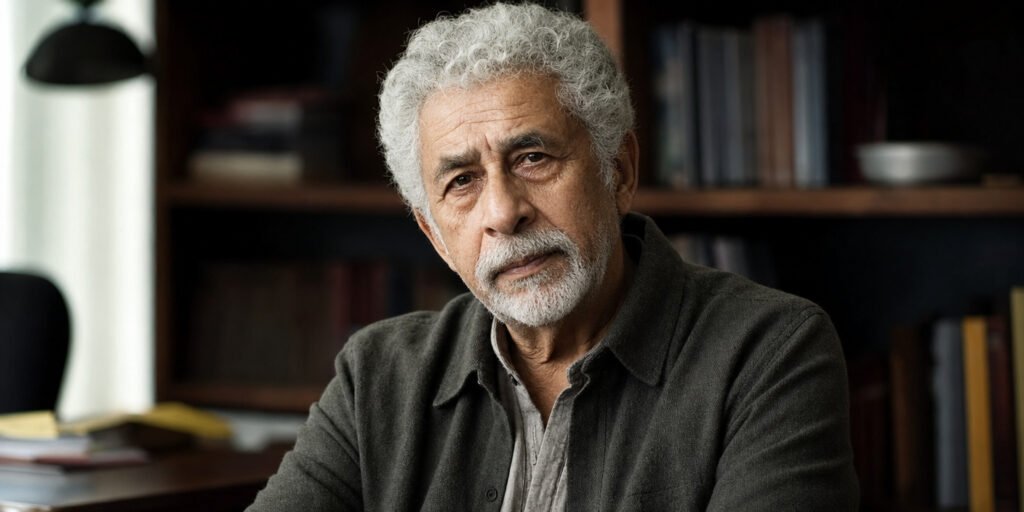
Veteran actor Naseeruddin Shah has ignited a firestorm of public discourse following his sharp criticism of the Delhi Police’s actions during a recent student demonstration at Jantar Mantar. Known for his outspoken nature, the acclaimed performer characterized the treatment of the protestors as “zulm” (oppression), drawing a controversial comparison between local law enforcement and U.S. Immigration and Customs Enforcement (ICE) agents, thereby reigniting national debates on democratic protest rights and the state’s relationship with civilian dissent.
Key Highlights
- Actor Naseeruddin Shah publicly decries the handling of student demonstrators at Jantar Mantar.
- The veteran artist utilized the term ‘zulm’ to describe the alleged police crackdown on campus-related grievances.
- Shah drew direct, inflammatory parallels between the Delhi Police and US ICE agents, sparking intense political reactions across media platforms.
- The incident has placed the spotlight back on the constitutional limitations and freedoms of public protest in the national capital, Jantar Mantar.
The Anatomy of the Controversy at Jantar Mantar
The historic protest site of Jantar Mantar in New Delhi serves as the backdrop for this latest friction point in Indian civil society. On July 22, 2026, student groups gathered to voice concerns regarding administrative changes within national educational institutions. The gathering, initially reported as peaceful, saw significant police intervention, which critics—and now, Naseeruddin Shah—have labeled as excessive. The use of the Urdu term “zulm” by the actor carries heavy historical and cultural weight, implying systemic tyranny rather than mere administrative friction.
Shah’s comments were not delivered in a vacuum. The actor, a titan of Indian parallel cinema, has historically maintained a profile as a cultural critic. By inserting himself into this current event, he has moved the conversation from a localized student grievance to a broader debate on human rights, state authority, and the nature of policing in a democracy. The comparison to ICE—a federal agency in the United States tasked with immigration enforcement—is a calculated rhetorical strategy intended to invoke images of aggressive, militarized state power operating against vulnerable populations.
Analyzing the ‘ICE’ Comparison
When Shah compared the Delhi Police to ICE agents, he was leveraging a globally recognized symbol of controversial enforcement. By doing so, he shifted the narrative away from the specific policy grievances of the students—which involve tuition hikes and campus staffing—and toward the methodology of the state. This is a common tactic in celebrity activism: redirecting the focus from the ‘what’ (the specific policy) to the ‘how’ (the state’s reaction).
Legal analysts and political commentators are divided on the impact of this rhetoric. Supporters argue that Shah is using his platform to humanize the students, transforming them from nameless protestors into subjects of state overreach. Critics, however, argue that such comparisons are hyperbolic, potentially damaging the morale of law enforcement officers who operate under complex directives and volatile ground conditions. The debate highlights a growing chasm in public discourse: the struggle to define the boundaries between maintaining public order and suppressing democratic dissent.
The Fallout: A Divided Public Sphere
Within hours of the actor’s statement, social media platforms became a battleground. Supporters of Shah’s stance pointed to videos purportedly showing heavy-handed tactics by the police, calling for greater accountability and a review of protest handling protocols. The hashtag #JantarMantar continues to trend, with various civil society organizations echoing the actor’s call for restraint.
Conversely, supporters of the current administration have criticized the actor for what they perceive as an irresponsible use of his celebrity status. Pro-establishment voices argue that law enforcement in a capital city must be firm to prevent chaos and that international comparisons serve only to polarize and weaken national institutions. This polarization mirrors broader trends seen globally, where the line between cultural influence and political activism becomes increasingly blurred, leading to more fragmented public opinion.
Historical Context: The Celebrity as Conscience
Naseeruddin Shah is no stranger to controversy. Throughout his decades-long career, he has frequently positioned himself as an intellectual conscience of the industry. From debates on artistic freedom to religious tolerance, Shah’s input often signals a moment where an issue has transcended the periphery and entered the mainstream consciousness.
Historically, Jantar Mantar has been the sanctuary for the unheard. From farmers’ protests to labor disputes, the site has been the pressure valve for Indian democracy. The involvement of figures like Shah suggests that the current tensions are viewed by the intelligentsia as a critical juncture. The historical reliance on celebrities to amplify marginalized voices remains a potent, if debated, mechanism for social change. It forces the media to cover issues that might otherwise be ignored by mainstream outlets focused purely on entertainment or political maneuvering.
Future Implications for Protest
Looking ahead, the intervention of high-profile figures creates a complex dynamic for the Delhi Police and city administrators. The added scrutiny may lead to more cautious police conduct in future protests, or, conversely, it could lead to stricter permitting and pre-emptive measures to avoid such public relations nightmares. As the city approaches upcoming legislative cycles, the handling of student protests at Jantar Mantar will likely be a litmus test for how the government balances internal security with the fundamental right to assemble.
Furthermore, the rhetoric used by Shah sets a precedent for how future protests will be discussed in the media. If “zulm” and comparisons to international enforcement agencies become standard vocabulary, the discourse is likely to remain combative. The ultimate test will be whether this increased visibility translates into tangible policy changes for the students or whether it remains a symbolic victory in the ongoing culture war.
FAQ: People Also Ask
1. What specifically did Naseeruddin Shah say about the Jantar Mantar incident?
Naseeruddin Shah condemned the treatment of students as “zulm” (oppression) and directly compared the actions of the Delhi Police to those of U.S. ICE agents, suggesting a similar aggressive approach to enforcing state control.
2. Why is Jantar Mantar significant in this context?
Jantar Mantar is a historic, designated site in New Delhi for peaceful protests. It is widely considered the “pressure valve” for Indian democracy, where various activist groups and citizens congregate to voice grievances to the government.
3. Who are the ICE agents referenced by the actor?
ICE stands for Immigration and Customs Enforcement, a U.S. federal law enforcement agency. Shah’s comparison was meant to evoke the image of a powerful state agency acting forcefully, often controversially, against individuals.
4. Have there been previous incidents like this at Jantar Mantar?
Yes, Jantar Mantar frequently hosts protests, and disputes over police crowd-control measures are not uncommon. However, the involvement of a major cultural icon like Naseeruddin Shah has brought an unusual level of national and international media attention to this specific event.
More Stories
Sweet Magnolias Creator Bids Emotional Farewell After Cancellation
Presley Gerber, Model and Son of Cindy Crawford, Dies at 27
Lady Gaga Welcomes Daughter Rose Bean Polansky