










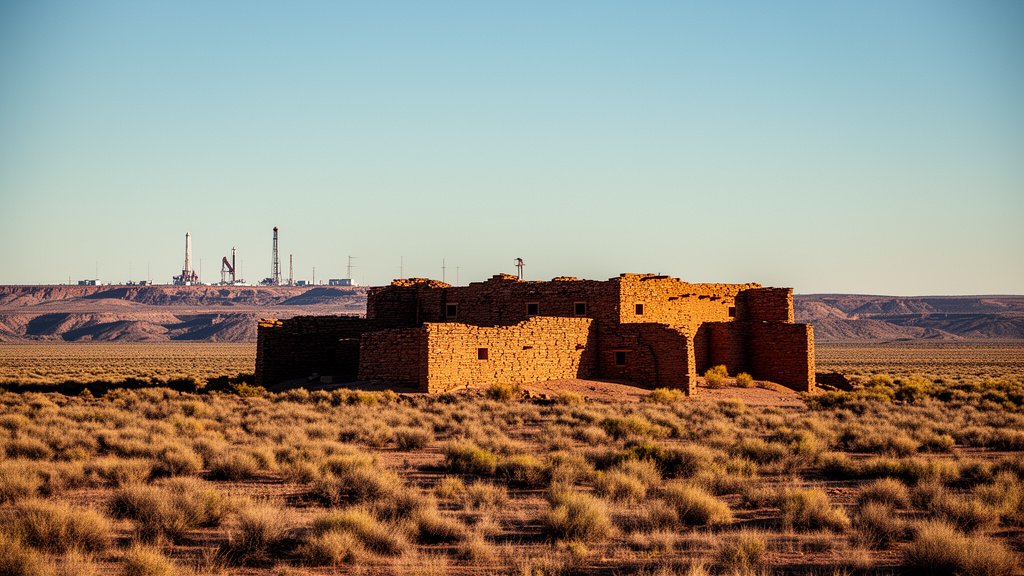
The Trump administration faces mounting backlash from Indigenous leaders, archaeologists, and environmental groups over renewed efforts to potentially scale back buffer zones near the Chaco Culture National Historical Park in New Mexico. This region, a UNESCO World Heritage site and a center of ancestral Puebloan culture, has long served as a focal point in the conflict between federal energy extraction policies and the urgent need to protect sites of profound historical and spiritual significance. The proposal to potentially allow drilling within proximity to the park threatens the integrity of landscapes that many tribal nations consider sacred, igniting a broader national conversation about the prioritization of mineral extraction over cultural preservation.
Key Highlights
- UNESCO Status Under Threat: Chaco Culture National Historical Park is a UNESCO World Heritage site, recognized globally for its extraordinary concentration of Ancestral Puebloan architecture and history, which is now at risk due to increased industrial activity.
- The Buffer Zone Controversy: At the core of the dispute is the potential elimination or reduction of a 10-mile buffer zone around the park, a measure previously proposed to protect the Chacoan cultural landscape from the encroachment of oil and gas infrastructure.
- Indigenous Opposition: Leaders from various Pueblo tribes and the All Pueblo Council of Governors have vehemently opposed the move, citing the desecration of spiritual sites and the long-term environmental degradation of the Greater Chaco region.
- The Regulatory Landscape: Critics argue that federal agencies like the Bureau of Land Management (BLM) are prioritizing short-term economic gains from oil and gas leasing over the long-term preservation of irreplaceable national treasures.
The Battle for the Greater Chaco: Preservation vs. Extraction
The landscape surrounding Chaco Canyon is not merely “public land” to be managed for mineral rights; it is a living monument to human history. The Chaco Culture National Historical Park protects the remains of the Chacoan civilization, which flourished between 850 and 1250 A.D. The site is known for its “Great Houses,” massive stone structures aligned with solar and lunar cycles, which represent a pinnacle of pre-Columbian architectural ingenuity. When the Trump administration signaled its intent to potentially ease restrictions on drilling near this area, the response from historians and the Indigenous community was swift and severe.
The 10-Mile Buffer Zone Debate
For years, a central tenet of the advocacy strategy for the region has been the implementation of a 10-mile buffer zone. This radius is intended to create a protective barrier, shielding the park and its surrounding archaeological sites—many of which remain unexcavated—from the physical and aesthetic disruption of drilling rigs, pipelines, and heavy machinery traffic.
Critics of the administration’s plan point out that the “Greater Chaco” region is much larger than the park boundaries alone. The landscape is dotted with Chacoan outliers, ancient roads, and shrines that are inextricably linked to the park’s main central complex. Proponents of drilling argue that the area is rich in oil and natural gas deposits, claiming that responsible development can coexist with preservation. However, conservationists counter that the cumulative impact of thousands of wells creates an industrial landscape that fundamentally alters the character of the environment, ruins the night sky, and pollutes the air and water, thereby destroying the very essence of the cultural landscape.
Cultural Significance and Indigenous Stewardship
The fight over Chaco is deeply personal for the Pueblo and Navajo people. For these communities, the landscape is not just a tourist destination; it is an ancestral home. The proposed changes have highlighted a persistent disconnect between federal land management agencies, such as the Bureau of Land Management (BLM), and the sovereign nations who view the land as a continuous thread of their history.
Indigenous advocacy groups have argued that the federal government is failing to live up to its trust responsibilities to consult with tribal nations in a meaningful way. Instead of the “nation-to-nation” dialogue promised, stakeholders feel that their concerns about the destruction of cultural resources are being sidelined in favor of an “energy dominance” agenda. This has created a secondary angle of analysis: does the current federal approach violate the spirit of the National Historic Preservation Act (NHPA), specifically Section 106, which requires federal agencies to take into account the effects of their undertakings on historic properties?
Economic Realities and the Future of Energy
From a purely economic perspective, the debate touches on the broader transition of the American energy sector. The San Juan Basin, where Chaco Canyon is located, has been a significant producer of oil and natural gas for decades. The push to drill near the park is often framed as an economic imperative—a way to lower energy costs, create jobs, and maintain U.S. energy independence.
However, this economic angle is increasingly being challenged. Many economists argue that the long-term value of the tourism and cultural heritage sector in New Mexico outweighs the finite, and increasingly volatile, revenues from oil and gas extraction in this specific, sensitive area. Furthermore, as the world pivots toward renewable energy, there is a growing argument that doubling down on fossil fuel extraction in a historically sensitive region is an outdated strategy that ignores the potential for sustainable economic development. By prioritizing drilling, the administration faces criticism that it is locking the region into a declining industry while permanently damaging a site that belongs to the world heritage collection of humanity.
FAQ: People Also Ask
Q: Why is Chaco Culture National Historical Park so important?
A: It is a UNESCO World Heritage site and one of the most culturally significant regions in the U.S., serving as a major center of Ancestral Puebloan culture, containing world-renowned stone architecture and complex astronomical alignments.
Q: What is the 10-mile buffer zone?
A: It is a proposed protective boundary around the park intended to prevent oil and gas drilling from encroaching on the site, thereby protecting the visual, physical, and spiritual integrity of the surrounding cultural landscape.
Q: Why are Indigenous groups opposed to drilling in the region?
A: They view the landscape as a sacred ancestral home. They argue that drilling threatens not only the physical sites but also the spiritual and environmental health of the land, which they believe should be preserved for future generations rather than exploited for energy extraction.
More Stories
U.S. Repatriates 64 Cultural Relics and Fossils to China
Betting on Viral Fame: Novig’s Strategic Use of Sydney Sweeney
DHS Scrubs Optimus Prime Posts After AI Misuse Backlash