









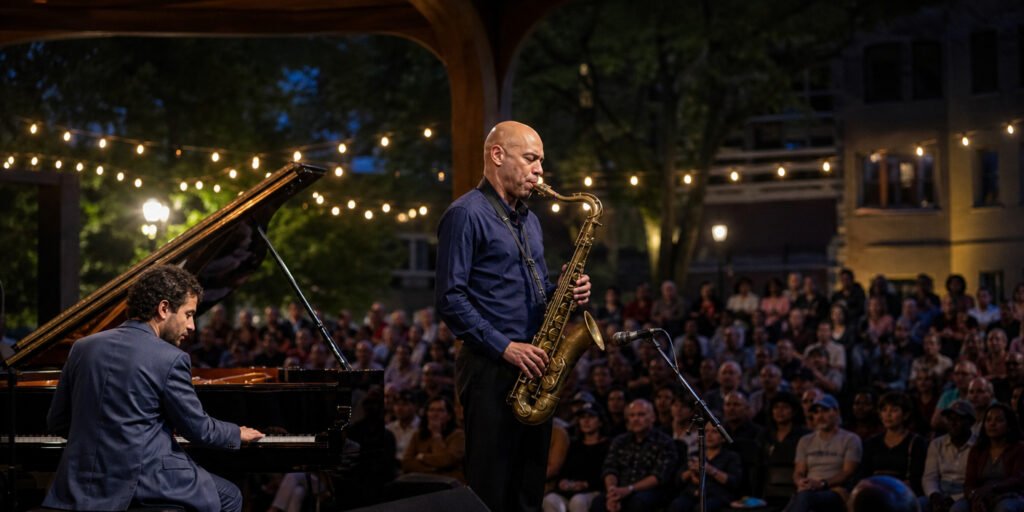
The Hyde Park Jazz Festival officially celebrates its 20th anniversary this year, cementing its status as an essential cornerstone of Chicago’s cultural landscape. Spanning the historic South Side neighborhood, this milestone event features an expansive program with over forty artists performing across eleven unique venues. By pairing international jazz luminaries like Joshua Redman and Emmet Cohen with the festival’s enduring commitment to honoring the roots of the genre, the event underscores its pivotal role in both the preservation and evolution of jazz music.
Key Highlights
- Milestone Anniversary: Marking 20 years of delivering world-class jazz to Chicago’s South Side community.
- Expanded Programming: A massive lineup featuring over forty artists performing live sets.
- Venue Diversity: The festival utilizes eleven distinct venues, ranging from intimate clubs to expansive architectural landmarks.
- Headlining Acts: Performances by GRAMMY-winning saxophonist Joshua Redman and acclaimed pianist Emmet Cohen.
- Cultural Impact: A continued commitment to highlighting the deep, historic roots of jazz while fostering contemporary improvisation.
Two Decades of Sound: The Evolution of Hyde Park Jazz
When the Hyde Park Jazz Festival launched two decades ago, the vision was modest: to celebrate the rich musical history of the South Side while providing a platform for local musicians to shine alongside national stars. Today, that vision has transformed into a massive, multi-day cultural event that acts as a vital bridge between the past and the future of improvisation. The festival is not merely a concert series; it is a neighborhood-wide celebration of the improvisational spirit that defines Chicago’s contributions to the global jazz canon.
The 20th Anniversary Program
This year’s programming is perhaps the most ambitious in the festival’s history. By securing heavyweights such as Joshua Redman and Emmet Cohen, the organizers have signaled a commitment to maintaining the highest standard of artistic excellence. Redman, a titan of the contemporary saxophone, brings a level of virtuosity that challenges the next generation of performers, while Cohen’s encyclopedic knowledge of jazz piano history provides the perfect anchor for an anniversary that seeks to honor ‘roots decades older’ than the festival itself.
The decision to spread these performances across eleven different venues is a logistical triumph that creates a unique atmosphere for attendees. Audiences can move from the acoustics of the Reva and David Logan Center for the Arts to the historic, reverberant spaces of Rockefeller Memorial Chapel, effectively turning the entire neighborhood into a living, breathing music box. This variety ensures that the festival remains accessible and dynamic, catering to both casual listeners and dedicated jazz aficionados.
The Intersection of History and Innovation
One of the defining characteristics of the Hyde Park Jazz Festival is its refusal to treat jazz as a museum piece. While the 20th anniversary is a moment to look back at the last two decades of growth, the programming reflects a forward-thinking ethos. The organizers emphasize ‘roots decades older’—referencing the South Side’s deep connection to the Great Migration, the jazz clubs of the mid-20th century, and the innovations of the AACM (Association for the Advancement of Creative Musicians).
By weaving these historical narratives into the current festival structure, the Hyde Park Jazz Festival provides a context that is often missing from major music events. It teaches attendees that jazz is not just a style of music, but a historical and social force. Emmet Cohen’s style, specifically, represents a mastery of the jazz lexicon that respects the traditions of Art Tatum and Duke Ellington while pushing the boundaries of what a piano trio can accomplish in a modern, post-pandemic world.
Economic and Community Impact
Beyond the notes and chords, the festival serves as an engine for cultural tourism on the South Side. Bringing thousands of attendees into the Hyde Park neighborhood benefits local restaurants, shops, and institutions, demonstrating the tangible economic power of the arts. The festival has successfully curated an environment where art-making and community-building are inextricably linked.
Furthermore, the longevity of the festival is a testament to the organizational resilience of the Hyde Park Jazz Society and their partners. Operating an 11-venue festival requires immense logistical coordination, volunteer effort, and financial support. Over the last twenty years, the festival has navigated changing cultural trends, financial downturns, and the challenges of the digital age, yet it has never wavered from its core mission: to provide high-quality jazz that reflects the diversity of the community it serves.
FAQ: People Also Ask
Q: What makes the Hyde Park Jazz Festival unique compared to other jazz events?
A: Its unique blend of international headliners and local talent, combined with its distinct location in Chicago’s Hyde Park neighborhood and the use of 11 diverse, acoustically rich venues, creates a uniquely intimate yet grand experience.
Q: How does the festival honor ‘roots decades older’?
A: The festival actively highlights the South Side’s historic connection to the Great Migration and the evolution of jazz in Chicago, ensuring that modern performances remain deeply rooted in the historical foundations of the genre.
Q: Are the performances free to the public?
A: While the festival relies on donations and sponsorships to remain accessible, many performances are free or low-cost, maintaining the organization’s commitment to community accessibility.
Q: Who are the key headliners this year?
A: The 20th-anniversary celebration is headlined by the internationally acclaimed saxophonist Joshua Redman and piano virtuoso Emmet Cohen.
More Stories
iHeartRadio Music Festival 2026 Ignites Las Vegas
Americanafest 2026: Nashville Readies for Global Roots Music Milestone
Summer of Ska: 8 Years of Inclusivity and Brass-Driven Beats