











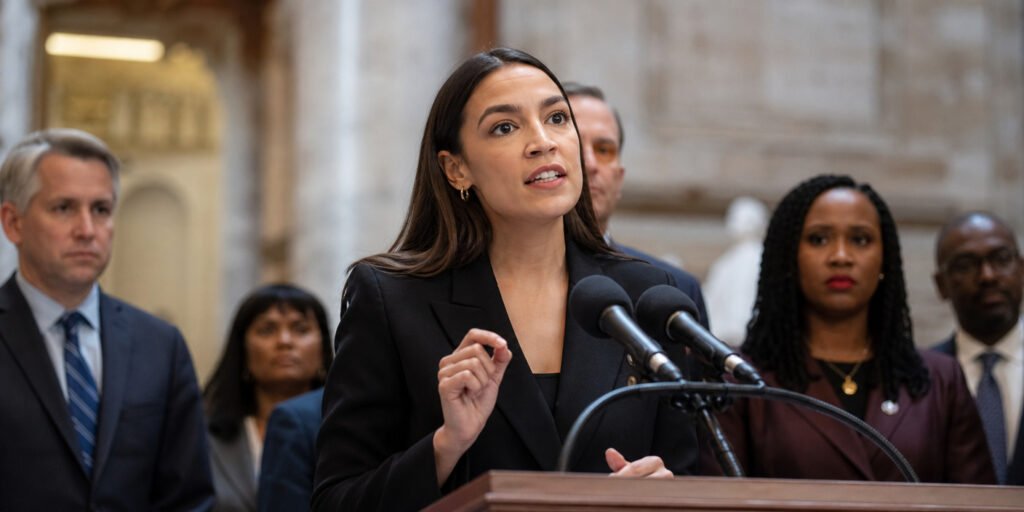
U.S. Representative Alexandria Ocasio-Cortez has announced her decision to freeze her eggs, framing the personal health decision as a direct, defiant act against the Trump administration’s tightening restrictions on reproductive healthcare access. This public disclosure marks a significant intersection of personal autonomy and political advocacy, as the Congresswoman utilizes her own reproductive choices to underscore broader concerns regarding the future of fertility treatments, including In Vitro Fertilization (IVF), in an increasingly restrictive legal landscape. By centering the conversation on her own medical path, Ocasio-Cortez is escalating the national debate over bodily agency, challenging the trajectory of current federal policies that critics argue threaten to dismantle reproductive rights.
Key Highlights
- A Strategic Personal Disclosure: Representative Ocasio-Cortez has positioned her decision to freeze her eggs not merely as a family-planning necessity, but as a deliberate political statement against current reproductive healthcare restrictions.
- Challenging Federal Policy: The move is explicitly linked to criticisms of the Trump administration’s legislative and judicial impact on reproductive rights, specifically regarding the fear that IVF and fertility services could become the next targets of restricted access.
- Highlighting Bodily Autonomy: Ocasio-Cortez aims to galvanize supporters by emphasizing that the freedom to control one’s reproductive timeline is a fundamental right currently under siege.
The Political Pulse of Personal Agency
Framing a Private Decision as Public Defiance
In an era where the boundary between the personal and the political has effectively evaporated, Representative Alexandria Ocasio-Cortez’s announcement regarding her decision to freeze her eggs serves as a potent case study in modern political signaling. By choosing to go public with a medical procedure that is traditionally treated with the utmost privacy, Ocasio-Cortez is attempting to normalize the narrative of reproductive struggle. Her framing of this decision as an act of “defiance” against the Trump administration is calculated. It signals that for many women in the United States, the ability to plan a family—or to choose not to—is increasingly perceived as an endangered right.
This is not the first time the Congresswoman has used her personal experience to highlight policy failures, but the scale of this particular announcement is unique. It moves the discourse away from abstract debates on legislative bills and centers it on the physical, tangible realities of reproductive healthcare. The act of freezing eggs—a costly and often physically taxing medical procedure—is becoming, in her eyes, a prerequisite for female empowerment in a climate of legislative uncertainty.
The Policy Landscape: IVF Under Pressure
The core of Ocasio-Cortez’s critique lies in the fear that reproductive healthcare access is being systematically dismantled. Critics of the current conservative-led judicial and legislative landscape argue that the precedent set by the overturning of Roe v. Wade creates a “slippery slope” that could jeopardize access to contraception, fertility treatments, and IVF. The Trump administration’s track record of appointing conservative judges who have frequently signaled a preference for fetal personhood laws is at the heart of this anxiety.
Legal experts suggest that if fetal personhood statutes were to be adopted widely at the state level, the legal status of embryos created during IVF could be fundamentally altered. This could lead to a scenario where the destruction, storage, or manipulation of embryos—a standard part of the IVF process—could face criminal or civil liability. By linking her personal decision to freeze eggs to this broader policy context, Ocasio-Cortez is pre-emptively sounding the alarm, arguing that if politicians can regulate the start of life, they will inevitably regulate the technology that makes family planning possible.
Economic and Medical Realities
Beyond the political rhetoric, the announcement shines a spotlight on the often-prohibitive cost of fertility preservation. Egg freezing is rarely covered by insurance and can cost between $10,000 and $20,000 per cycle, not including the recurring annual fees for storage. By bringing this topic to the national stage, Ocasio-Cortez is inadvertently—or perhaps intentionally—highlighting the socioeconomic barriers that prevent many Americans from accessing the same “defiant” control over their reproductive futures.
Advocacy groups are already leveraging this moment to push for legislative reform, specifically targeting the inclusion of fertility treatments in standard healthcare coverage packages. The argument is that if the state is going to prioritize the “protection of life” at the embryonic stage, it must also support the individuals who are attempting to create that life through the modern medical infrastructure. Ocasio-Cortez’s announcement serves as a rallying point for those who believe that reproductive freedom is an economic issue as much as it is a medical one.
The Future of Reproductive Legislation
Looking ahead, the legislative battles are likely to shift toward the regulation of assisted reproductive technologies. While many conservatives maintain that they support IVF, the underlying legal logic used to restrict abortion access provides a clear roadmap for targeting IVF clinics. Ocasio-Cortez’s maneuver is designed to force opponents into a corner: either explicitly protect IVF and reproductive technology, or admit that their broader ideological goals are incompatible with modern medical practice.
As the conversation evolves, the political stakes will only rise. If the administration continues to push for policies that restrict bodily autonomy, figures like Ocasio-Cortez are likely to continue using their platforms to merge the personal with the political. This strategy is not without its risks; by politicizing a medical procedure, she invites intense scrutiny. However, in the high-stakes theater of modern American politics, such risks are increasingly viewed as necessary to mobilize a base that feels its fundamental rights are slipping away.
FAQ: People Also Ask
Q: Why is Alexandria Ocasio-Cortez framing egg freezing as a political act?
A: She argues that in a climate where reproductive rights are being curtailed, the ability to control one’s reproductive timeline is a fundamental expression of bodily autonomy. By framing it as defiance, she highlights the precarious nature of fertility access under current policy trends.
Q: What policies are specifically targeting IVF access?
A: The primary concern for advocates is the expansion of “fetal personhood” legislation at the state level. If a legal entity grants personhood to an embryo, the processes involved in IVF—including storage and disposal—could be classified as illegal, effectively halting the industry.
Q: How much does egg freezing usually cost?
A: On average, one cycle of egg freezing can range between $10,000 and $20,000, excluding annual storage fees, which usually range from $500 to $1,000. It is often not covered by private insurance, making it inaccessible for many.
Q: Has the Trump administration explicitly banned IVF?
A: No, the administration has not issued a federal ban on IVF. However, critics point to the appointment of conservative judges and the support for legislation that grants legal rights to fetuses as indirect threats that could lead to restrictive regulations on fertility clinics.
More Stories
U.S. Repatriates 64 Cultural Relics and Fossils to China
Betting on Viral Fame: Novig’s Strategic Use of Sydney Sweeney
DHS Scrubs Optimus Prime Posts After AI Misuse Backlash