











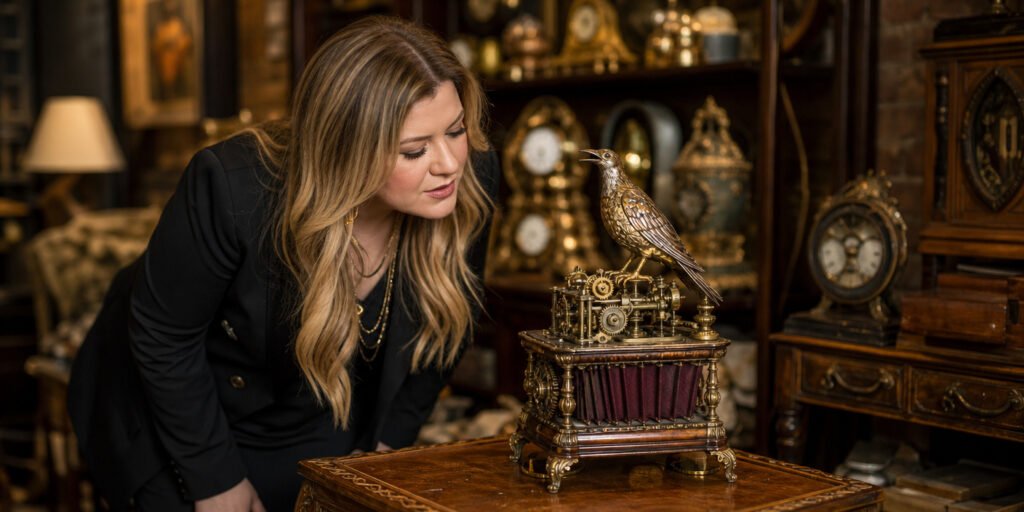
The intersection of global celebrity and niche Brooklyn boutique retail has collided in an unexpected dispute involving singer Kelly Clarkson and a $15,000 mechanical songbird. The incident, which has drawn attention from both the music industry and the antique collecting community, highlights the complexities of high-end, vintage retail transactions and the unique challenges faced when luxury items fail to meet expectations. As Clarkson, a household name known for her discerning taste, navigates this public disagreement, the boutique retail sector finds itself under a rare microscope.
The Intersection of Celebrity and Antique Automata
Anatomy of the $15,000 Mechanical Songbird
At the center of this controversy is an object of profound mechanical complexity: an antique-style mechanical songbird, or ‘automaton.’ These devices, which reached the height of their popularity in the 18th and 19th centuries, were marvels of Swiss engineering. A genuine, high-quality automaton of this caliber—priced at $15,000—is not merely a novelty item; it is a piece of historical horology. Such devices typically feature a complex system of bellows, pistons, and gears, all synchronized to produce realistic birdsong and fluid, lifelike movements. When purchasing such an item, collectors are not just paying for a decorative piece, but for the intricate craftsmanship required to restore and maintain a functioning 200-year-old mechanism. The dispute implies a breakdown in the expected functionality of this delicate machinery, leading to the current stalemate.
The Brooklyn Retail Boutique Landscape
Brooklyn has emerged as a premier destination for high-end, curated retail experiences. The borough is home to numerous ‘curiosity shops’ and antique boutiques that specialize in rare, niche, and luxury goods that cater to a sophisticated clientele, including high-profile celebrities. These establishments often operate on a model of exclusivity and provenance, where items are sourced globally and restored with meticulous care. However, the move from local niche provider to high-profile celebrity vendor brings with it a significantly higher level of scrutiny. The tension between the shop’s boutique, small-scale operations and the massive, global reach of an entertainer like Clarkson creates a challenging dynamic when expectations regarding product quality and post-purchase support diverge.
Examining the Consumer Dispute
When a transaction involves a $15,000 price point, the legal and consumer expectations shift dramatically. While the specific nature of the ‘feud’ remains focused on the songbird’s functionality, such disputes often hinge on the discrepancy between the seller’s description and the buyer’s experience. Did the item fail after purchase? Did it arrive in a condition inconsistent with its premium listing? In the world of high-end collectibles, ‘as-is’ status is often a subject of contention. For Clarkson, whose professional life is built on high-fidelity performance, an automaton that fails to ‘sing’ as promised would understandably represent a significant failure of the product’s core value proposition.
Historical Significance of Automata
To understand why a collector would invest $15,000 in a mechanical bird, one must look at the history of these objects. Companies like Jaquet-Droz and Bontems set the standard for automaton construction. These items were the ‘AI’ of their time, designed to mimic nature with such precision that they were often given as diplomatic gifts to emperors and kings. The market for these items has remained robust, with auctions at houses like Sotheby’s and Christie’s often seeing such pieces fetch tens of thousands of dollars. The value is driven by the scarcity of the original bellows and the specialized knowledge required for restoration. A dispute over a piece like this is not just about a shop return; it is a debate about the conservation and authentication of historical artifacts.
Celebrity Influence on Niche Markets
Celebrities often act as ‘tastemakers’ for niche markets, bringing visibility to small businesses. When a public figure shops at a local boutique, it can provide a massive boost to the business’s profile. However, this visibility is a double-edged sword. If a dispute arises, the social media leverage and public attention that a celebrity commands can be overwhelming for a small business. Conversely, the celebrity’s brand integrity is tied to the items they endorse or possess. This creates a high-stakes environment where reputation management becomes as critical as the resolution of the physical dispute itself.
Mediation and Resolution Strategies
In cases involving luxury retail disputes, resolution usually occurs through one of three paths: professional repair, partial refund, or full rescission of the contract. Given the specialized nature of mechanical automata, finding a qualified restorer to ‘fix’ the issue is often the preferred route for both parties. A full refund would require the shop to absorb the cost of a high-value asset, which can be devastating for a small boutique. Mediation between the parties, possibly involving a neutral third-party expert in horological restoration, could provide a path forward that satisfies the need for functionality without destroying the business relationship.
Industry Impact and Future Precedents
This situation serves as a cautionary tale for both luxury retailers and celebrity collectors. For retailers, it underscores the necessity of clear, written disclosures regarding the fragility and maintenance requirements of antique automata. For collectors, it highlights the importance of professional appraisal and independent testing prior to the finalization of high-value purchases. As the market for physical, mechanical luxury goods continues to grow amidst an increasingly digital world, the need for transparent commerce practices has never been more pressing. Whether this dispute resolves quietly or escalates, it will undoubtedly influence how high-end boutiques interact with their most high-profile clients moving forward.
More Stories
The Prairie Pivot: Can ‘Shoe-Leather’ Politics Win the 2026 Midterms?
Privacy Under Fire: Doctors Denounce Student Genital Exams
In Pursuit: Reclaiming American Leadership Values