










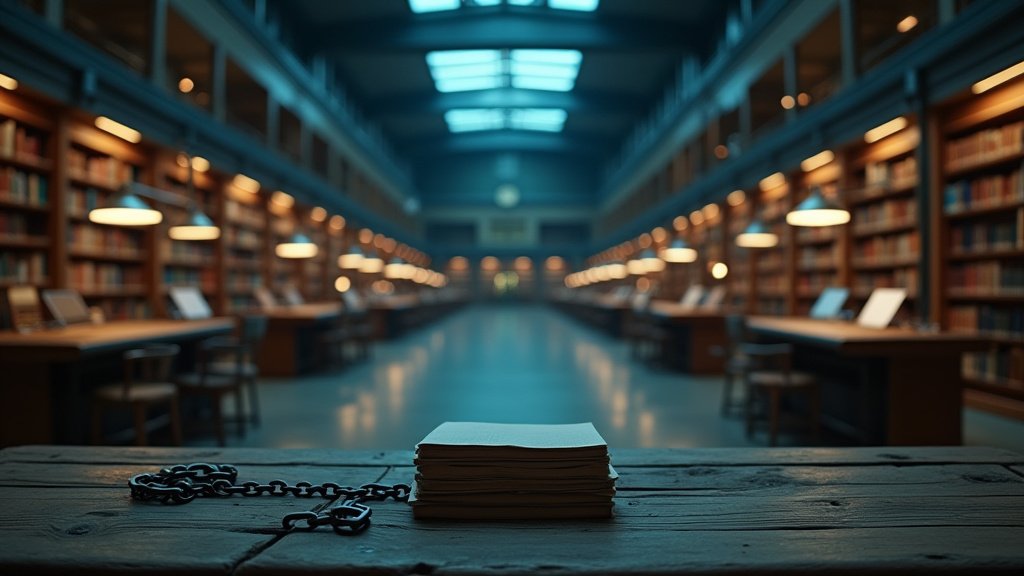
As the nation marks National Library Week in April 2026, the silence of the stacks is louder than ever—not with the rustle of turning pages, but with the clatter of a growing cultural battle. According to the American Library Association’s (ALA) latest annual report, 4,235 unique book titles were challenged in 2025, marking the second-highest total on record, trailing only the historic 2023 peak. Yet, amid legislative attempts to restrict access to stories regarding LGBTQ+ identities, racial history, and sexual violence, America’s libraries are finding a new, gritty purpose: they are evolving from quiet repositories of knowledge into the frontlines of a modern defense of democratic access. This year, the narrative isn’t just about the books on the shelves; it is about the community’s refusal to let them be hollowed out.
Key Highlights
- Record-High Challenges: The ALA’s Office for Intellectual Freedom reported 4,235 unique titles challenged in 2025, continuing an alarming multi-year trend of high-volume censorship.
- The Politicization of Shelves: Data indicates that over 90% of these challenges are driven by organized political pressure groups and legislative efforts, a sharp pivot from the grassroots parental concerns of the past.
- The ‘Culture War’ Impact: Librarians report unprecedented personal strain, with many choosing to leave the profession as they navigate the pressure to police content that reflects the lived experiences of marginalized communities.
- Community Resilience: Despite the hostility, libraries are reporting increased patronage for non-book services—including digital literacy training, cooling centers, and job placement—proving their utility as essential social infrastructure.
The Sanctuary Paradox: Libraries as Cultural Battlegrounds
The role of the public library in the United States has historically been one of passive neutrality: a ‘third place’ where information is provided without judgment. However, the data from 2025 and early 2026 suggests that this neutrality is being forcibly dismantled. As political entities and ideological pressure groups turn their focus toward school and public library collections, the institutions are finding themselves caught in a vice grip of policy-driven censorship. Unlike the historical ‘banned book’ scenarios, which were often localized and sporadic, the current wave is characterized by high coordination. State legislatures are increasingly bypassing school boards, pushing omnibus bills that threaten to tie funding to compliance with restricted reading lists. This is not merely an debate about ‘age appropriateness,’ as the rhetoric often suggests; it is an economic and political strategy to dictate the boundaries of public discourse.
The Shift from Grassroots to Governance
For decades, the standard model of a book challenge involved a concerned parent questioning a single title in a school library. Today, that framework has evaporated. Analysts and the ALA report that over 90% of recent challenges originate from outside the immediate school district, often driven by statewide political organizations or national pressure groups. This top-down approach has effectively weaponized library policy. For example, in states like Iowa and North Carolina, new legislation specifically targeting the inclusion of LGBTQ+ themes has transformed library workers into administrative gatekeepers. The stress on the system is palpable. Librarians are no longer just curators; they are being forced to navigate legal minefields, where a single misstep in collection management can result in thousands of dollars in fines or the total loss of public funding for their institution.
The Librarian as the Last Line of Defense
Behind every statistic of a ‘challenged title’ is a human being facing burnout. Throughout 2025, the narrative of the ‘activist librarian’ gained traction—not out of a desire for political engagement, but out of professional necessity. The ALA has documented a surge in librarians resigning from positions they held for decades, citing the toxicity of school board meetings and the constant threat of public harassment. However, this flight of talent is being met with a counter-movement of community advocacy. For every attempt to remove a book, there is now an organized ‘Friends of the Library’ group or a local student alliance fighting to keep it. This tension has paradoxically made libraries more visible and more valued, as citizens who previously took these institutions for granted now view them as essential assets for a functioning democracy.
Secondary Angles: Beyond the Bookshelf
To understand the future of American libraries, one must look beyond the controversy of the circulation desk and into the broader economic and social functions they serve.
1. The Economic Sanctuary: As the wealth gap widens, the library remains one of the few places in American society where an individual can exist, access high-speed internet, and receive expert assistance without the expectation of spending money. In many rural and underserved urban areas, the library is the only point of entry for essential government services, from filing taxes to applying for jobs. Defunding these institutions, as some political factions propose, represents an economic attack on the most vulnerable populations who rely on these ‘free’ resources for survival.
2. The Digital Disinformation Crisis: While physical books are the target of censorship, libraries have become the primary battleground against digital disinformation. Librarians are increasingly tasked with ‘information literacy’ training, teaching patrons how to verify sources in an era of AI-generated content and deepfakes. This role as a filter for truth makes the library a target not just for those who dislike specific books, but for those who benefit from a confused public. The struggle to keep the library ‘neutral’ is actually a struggle to keep it ‘factual.’
3. The Architectural Shift: We are seeing a shift in how libraries are designed. New construction and renovations are prioritizing ‘collaborative spaces’ over ‘quiet stacks.’ This architectural evolution is a deliberate effort to solidify the library’s status as a community hub. By hosting maker-spaces, community gardens, and disaster relief stations, libraries are diversifying their utility to the point where they become ‘too big to fail’ in the eyes of local voters, insulating them from purely ideological attacks.
FAQ: People Also Ask
Q: What is the primary reason behind the increase in book challenges in 2026?
A: The sharp increase is primarily driven by organized political pressure groups rather than individual parental complaints. These groups use coordinated strategies to challenge titles across entire districts or states, often focusing on books featuring LGBTQ+ themes or discussions of racial history.
Q: Does the library still have the authority to choose its own collection?
A: While libraries maintain professional collection development policies based on merit and community needs, legislative pressures are increasingly forcing libraries to adopt stricter, state-mandated content policies that supersede local autonomy.
Q: How does National Library Week impact the current political climate?
A: National Library Week serves as an annual advocacy moment where the American Library Association and local supporters spotlight the vital role of libraries, attempting to pivot the public conversation from ‘censorship’ to ‘community value’ and access.
Q: What happens if a library refuses to remove a challenged book?
A: Consequences vary by state. In some jurisdictions, libraries or school districts risk severe financial penalties, the loss of state funding, or personal legal liability for staff members if they do not comply with new, restrictive statutes.
More Stories
Taiwan Makes Historic Debut at World Children’s Festival in D.C.
Choctaw Heritage Ignites at World Series of Stickball
Concrete Renaissance: Inside Fort Worth’s Cultural District Building Boom