











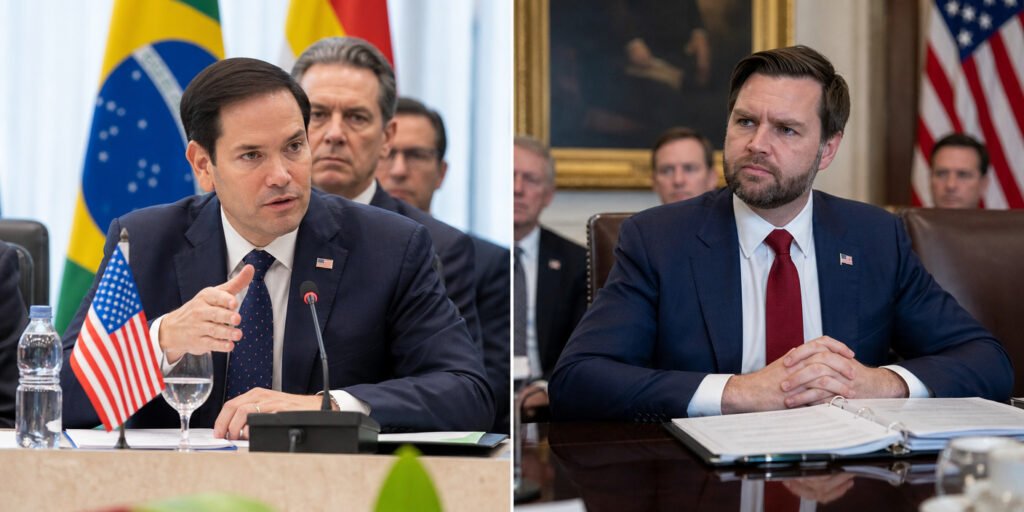
As the current administration aligns its foreign and domestic objectives, a clear strategy has emerged, marked by Senator Marco Rubio’s successful conclusion of his high-level South America tour and Vice President JD Vance’s steadying influence at a critical domestic policy summit. These simultaneous developments signal a dual-track approach to governance: securing hemispheric stability through targeted cooperation and refining long-term administrative priorities on the home front.
Key Highlights
- Security Architecture: Senator Rubio has finalized a series of security cooperation agreements across multiple South American nations, focusing on regional stability and intelligence sharing.
- Diplomatic Momentum: The tour concludes on a note of strengthened bilateral ties, with specific frameworks now in place to address transnational security challenges.
- Administrative Strategy: Vice President JD Vance is currently presiding over the second day of a high-level policy summit, tasked with synthesizing legislative goals with executive authority.
- Strategic Synchronicity: The simultaneous focus on external security and internal policy reform highlights a coordinated effort to address vulnerabilities both within the hemisphere and inside the U.S. legislative framework.
Strategic Alignment: Hemispheric Security Meets Domestic Agenda
The completion of Senator Marco Rubio’s diplomatic engagement in South America represents more than a routine series of meetings; it is a calculated effort to fortify the U.S. position in a region increasingly influenced by competing geopolitical actors. By prioritizing security cooperation agreements, Rubio has sought to establish a more resilient framework for engagement, emphasizing shared intelligence and tactical cooperation. These agreements, which reportedly cover aspects of regional stability and counter-narcotics efforts, serve as a bulwark against instability that often spills over into U.S. borders. The Rubio South America tour has been characterized by private, high-level discussions that move beyond symbolic diplomatic gestures, focusing instead on granular, actionable security policies that can be implemented in the immediate future.
The Geopolitics of Regional Stability
Rubio’s approach underscores a resurgence in the importance of the Organization of American States (OAS) and bilateral security frameworks. In an era where regional influence is heavily contested, the Senator’s ability to secure concrete commitments from foreign partners suggests that U.S. engagement in South America is moving toward a model of persistent, reliable partnership. The security cooperation agreements are designed to address specific, localized threats while integrating them into a broader hemispheric strategy. This pivot is essential for maintaining a favorable balance of power and ensuring that the U.S. maintains its role as a security partner of choice for nations navigating volatile political climates.
The Vance Doctrine: Policy Consolidation at Home
While Senator Rubio has been engaged in the delicate art of foreign diplomacy, Vice President JD Vance has been presiding over the second day of a high-level policy summit in Washington. This summit is a critical junction for the administration, serving as a clearinghouse for legislative priorities and administrative rule-making. The transition into day two of these deliberations indicates that the initial broad-strokes proposals are being whittled down into specific, actionable policy directives. Vance’s leadership during this summit suggests a focus on aligning disparate agency goals under a unified executive mandate.
For the administration, the summit is not merely a bureaucratic exercise; it is a display of legislative-executive coordination. By bringing together key policymakers, the Vice President is ensuring that the administration’s domestic agenda—whether it pertains to economic policy, regulatory reform, or infrastructure development—is insulated from the fragmentation that often plagues second-term or mid-administration periods. This focus on cohesion is vital for maintaining the momentum necessary to push through significant legislative packages before the next electoral cycle begins in earnest.
Bridging the Gap: Foreign and Domestic Security
The intersection of these two events—Rubio’s regional security tours and Vance’s policy summit—reveals the broader strategy of the administration. There is a clear realization that domestic prosperity is inextricably linked to regional security. Instability in South America, whether economic or security-related, acts as a drag on domestic interests, impacting everything from migration patterns to trade logistics. By coordinating these efforts, the administration is signaling a holistic approach to governance.
Furthermore, the focus on ‘policy summits’ as a mechanism for change highlights an evolving methodology. Rather than relying solely on slow-moving legislative processes, the administration is utilizing executive-led summits to set the tempo for the federal bureaucracy. This allows for rapid recalibration of agency priorities, ensuring that the executive branch is not merely reacting to events, but proactively shaping the environment in which policy is executed. As day two of the summit concludes, observers are looking for signals regarding the administration’s next big legislative push, with indicators pointing toward a renewed focus on industrial policy and border security infrastructure—themes that neatly complement the security agreements Rubio has just cemented abroad.
FAQ: People Also Ask
Q: What is the primary outcome of Senator Rubio’s South America tour?
A: The tour successfully concluded with the formalization of new security cooperation agreements. These pacts focus on enhancing intelligence sharing, addressing regional security threats, and solidifying bilateral partnerships to ensure long-term stability in the hemisphere.
Q: What is the significance of the policy summit being led by Vice President JD Vance?
A: The summit serves as a crucial mechanism for aligning executive and legislative priorities. By presiding over the second day, Vice President Vance is facilitating the transformation of high-level administrative goals into concrete, actionable policy directives, ensuring that various agencies operate with a unified strategic mandate.
Q: How do these two events—the Rubio tour and the policy summit—relate to each other?
A: They represent a dual-track strategy: securing external regional stability to mitigate threats that affect the U.S., while simultaneously consolidating domestic policy to ensure a cohesive national agenda. Together, they demonstrate a holistic approach to governance where foreign and domestic interests are managed as interconnected challenges.
Q: Why is security cooperation in South America considered a priority for the U.S. right now?
A: The U.S. views regional security as a cornerstone of national safety. By establishing robust cooperation frameworks, the U.S. aims to curb transnational crime, limit the influence of hostile foreign actors in the region, and ensure that neighboring nations are reliable partners in addressing complex security issues.
More Stories
Costco Goes Nationwide on Uber Eats: A New Era for Bulk Delivery
Elena Rybakina Wins US Open, Ascends to World No. 1
Trade War Escalates: Canada’s Retaliatory Tariffs Hit U.S. Markets