











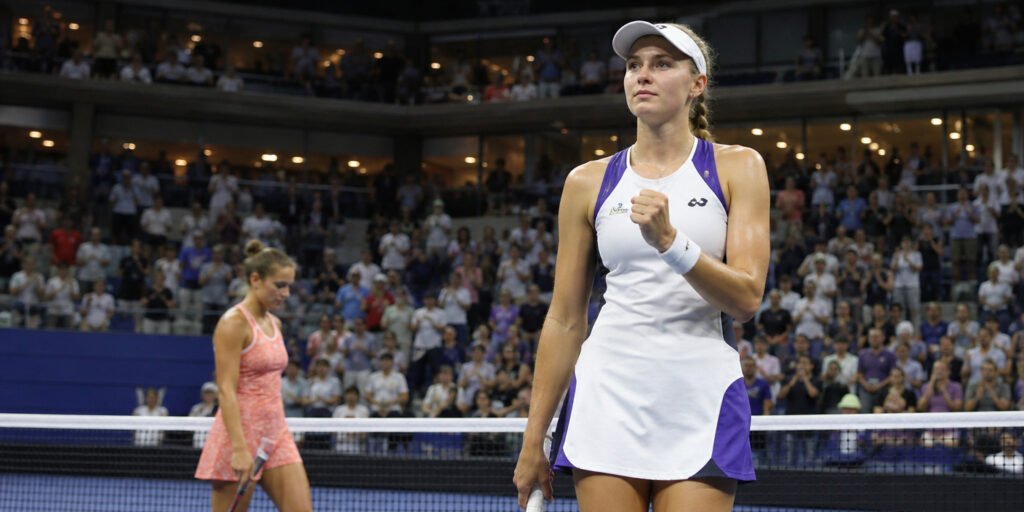
In a display of nerves and tactical precision that will be remembered for years, Elena Rybakina has defeated Aryna Sabalenka in a hard-fought three-set match (6-4, 5-7, 6-2) to secure the US Open title and officially ascend to the World No. 1 ranking. This triumph cements her status as the premier force in women’s tennis, marking the first time a Kazakhstani woman has reached the pinnacle of the sport’s global rankings.
Key Highlights
- Historic Milestone: Elena Rybakina becomes the first player representing Kazakhstan to achieve the WTA World No. 1 ranking.
- Match Breakdown: A gripping 6-4, 5-7, 6-2 victory over long-time rival Aryna Sabalenka, showcasing Rybakina’s resilience after dropping the second set.
- US Open Glory: This victory marks Rybakina’s maiden US Open title, adding a hard-court major to her illustrious career collection.
- Ranking Shift: The points awarded for the championship win officially push Rybakina past her competitors to take the top spot in the WTA live rankings.
A New Era: Analyzing Rybakina’s Hard-Court Dominance
The narrative of the 2024 season has frequently revolved around the oscillating power dynamic at the top of the WTA rankings, but today at Flushing Meadows, that conversation has been decisively settled. Elena Rybakina’s victory over Aryna Sabalenka was not merely a win; it was an emphatic statement of intent. The match, which spanned three sets, served as a masterclass in modern, power-hitting tennis. While Sabalenka entered the court with her signature aggressive baseline game, it was Rybakina who dictated the pace, utilizing her serve as a primary weapon to neutralize Sabalenka’s offensive pressure.
The Tactical Shift
From the opening game, Rybakina displayed a refined tactical approach. She focused heavily on wide, swinging serves that pulled Sabalenka out of her comfort zone, setting up short points and forcing errors. After taking the first set 6-4, Rybakina faced a significant psychological test when Sabalenka clawed back to secure the second set 7-5. Many players in a high-pressure environment would have folded under the momentum shift. Instead, Rybakina demonstrated the mental fortitude that has become her trademark. She returned to the court in the final set with renewed focus, breaking Sabalenka’s serve twice to run away with a 6-2 victory. This ability to reset after a lost set is arguably the most significant development in her game over the last twelve months.
The Historical and Cultural Impact
This win is not only a personal achievement for Rybakina but a watershed moment for tennis in Central Asia. As the first Kazakhstani woman to hold the World No. 1 title, she has single-handedly elevated the sport’s profile in her nation. The institutional support for tennis in Kazakhstan has been building steadily, but Rybakina’s individual performance provides the kind of tangible, high-profile success that inspires a new generation. By standing alone at the top of the rankings, she transforms from an elite competitor into a national icon, with implications that reach far beyond the court. Sponsors, youth programs, and sports media in the region are already pivoting to capitalize on this historic rise.
Rivalry Dynamics and the Future of the Tour
The rivalry between Rybakina and Sabalenka has become the definitive matchup of this era. They share a similar power-based style, which makes their encounters feel like high-stakes chess matches played at 120 mph. By defeating Sabalenka on the biggest stage, Rybakina has created a psychological edge. As they head into the upcoming WTA tournaments, the rest of the tour now faces a clear challenge: how to disrupt a World No. 1 who has mastered the ability to perform under the heavy, humid atmosphere of New York City.
Economic and Global Implications
From a business perspective, Rybakina’s ascension to World No. 1 is expected to trigger a significant increase in her endorsement valuations. The ‘World No. 1’ designation is a commercial accelerator, opening doors to global brand partnerships that are typically reserved for the absolute elite of the sport. We anticipate a surge in her commercial footprint, particularly in markets looking to tap into the growing interest in Central and Eastern European sports talent. Furthermore, this victory secures her a premium seed for the remaining Masters events, effectively creating a feedback loop where her current success facilitates easier paths to further titles.
Technical Resilience: The Serve as a Foundation
One cannot discuss this victory without highlighting the evolution of Rybakina’s serve. Throughout the tournament, her service stats were impeccable. By maintaining a high first-serve percentage, she limited the opportunities for Sabalenka to dictate points. In the third set specifically, her serve percentage jumped, which was the catalyst for her dominant 6-2 finish. This technical consistency is what will keep her at the top of the rankings for the foreseeable future. She is no longer just a ‘big hitter’; she is a clinical operator who understands exactly how to dismantle the game plans of her highest-ranked peers.
FAQ: People Also Ask
Q: How many ranking points did Rybakina earn from this US Open victory?
A: By winning the US Open, Rybakina secured 2,000 ranking points, which was the necessary margin to vault her into the World No. 1 position.
Q: Has any other Kazakhstani player reached this ranking level?
A: No, Elena Rybakina is the first player from Kazakhstan, male or female, to ever hold the World No. 1 ranking in professional tennis.
Q: What is next for Rybakina following this tournament?
A: She is expected to take a short recovery period before focusing on the upcoming WTA 1000 events as she looks to solidify her grip on the top spot through the end of the season.
Q: How does this win affect the head-to-head record against Sabalenka?
A: This win improves Rybakina’s standing in their ongoing rivalry, particularly in Grand Slam finals, where she has proven to be an increasingly formidable obstacle for Sabalenka.
More Stories
Costco Goes Nationwide on Uber Eats: A New Era for Bulk Delivery
Rubio Seals Security Pacts; Vance Drives Policy Agenda
Trade War Escalates: Canada’s Retaliatory Tariffs Hit U.S. Markets