











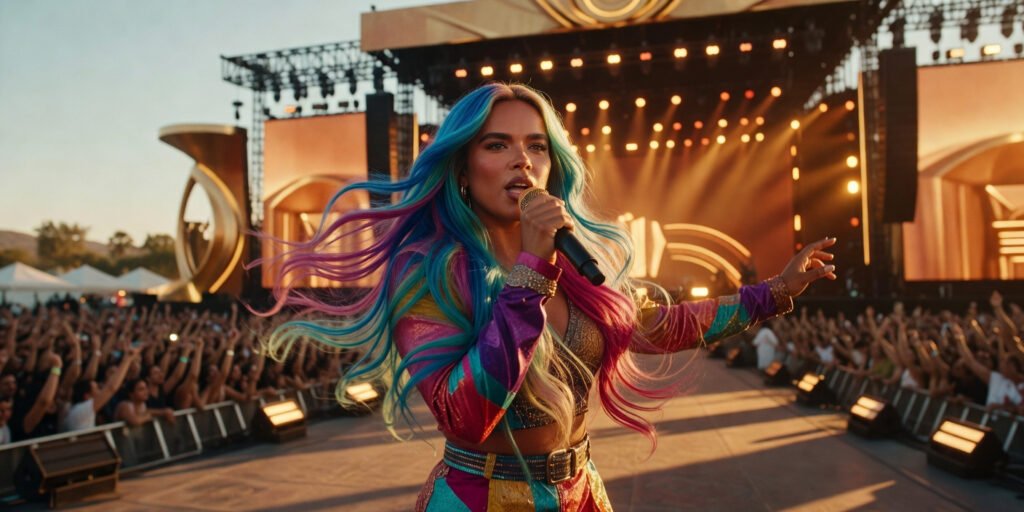
In a watershed moment for live music, Colombian superstar Karol G captivated the desert crowd on Sunday night, becoming the first Latina artist to headline the Coachella Valley Music and Arts Festival. Closing out the festival’s 25th-anniversary weekend, the Medellín-born artist delivered a powerhouse performance that not only solidified her status as a global icon but also shattered a long-standing glass ceiling in the festival’s prestigious main stage history.
Key Highlights
- Historic Milestone: Karol G marks the first time a Latina artist has held the coveted Sunday night headlining slot at Coachella.
- Cultural Powerhouse: The set served as a profound celebration of Latin music, featuring a 25-song journey through her discography and a tribute to Latin heritage.
- Unforgettable Collaborations: The stage became a nexus for Latin talent, featuring surprise appearances from industry heavyweights like Becky G and Wisin.
- Production Mastery: The show utilized high-concept stage design and intricate choreography, showcasing an artistic evolution that bridges reggaeton, urban pop, and traditional Latin folk.
The ‘Bichota’ Era Ascends the Main Stage
The Empire Polo Club in Indio, California, transformed into a sprawling testament to the “Bichota” era on Sunday night. From the moment the intro video intoned that the artist was “born under a full moon in the arms of mother nature,” it was clear this was not merely a concert, but a cultural statement. Karol G, whose real name is Carolina Giraldo Navarro, commanded the vast main stage with a confidence that bridged the gap between the intimate vulnerability of her songwriting and the stadium-sized requirements of a Coachella headliner.
A Journey Through Genres
Her setlist was a masterclass in pacing, weaving together the techno-infused remixed versions of “Provenza” with the gritty, rhythmic basslines of classic reggaeton. By traversing her catalog—from the breakthrough hits like “Tusa” to the more recent, critically acclaimed tracks from her Mañana Será Bonito era—Karol G showcased the versatility that has made her the most prominent female voice in the urban Latin genre today. The performance was visceral, loud, and unapologetically Latin, proving that international audiences are more than ready for a headliner whose primary language is Spanish.
The Industry ‘Glass Ceiling’
While the festival has seen Latin headliners previously, the distinction of being the first Latina woman to hold this title cannot be overstated. Industry analysts have long pointed to the disparity in major festival billings, and Karol G’s booking signals a fundamental shift in how booking agencies view marketability and cultural capital. She didn’t just play a set; she commanded a moment that demanded the industry reckon with the global dominance of Latin pop. As she noted in a rare English-language address to the audience, the milestone felt “long overdue,” yet vital for the representation of the millions of fans who have propelled her rise.
Beyond the Music: The Cultural Impact of Coachella’s 2026 Shift
The 2026 festival, celebrating its 25th anniversary, faced immense pressure to refresh its identity. With pop titans like Justin Bieber and Sabrina Carpenter anchoring the earlier nights, Karol G’s closing performance acted as the festival’s emotional and cultural anchor. The integration of guest stars like Becky G and Wisin didn’t feel like a standard cameo play; it felt like a family gathering, a testament to the community-first approach that defines the current generation of Latin superstars.
Economic and Global Reach
This performance highlights a broader trend: the exportability of Latin culture is no longer a localized phenomenon but a global economic powerhouse. Streaming metrics for reggaeton and Latin urban pop have dwarfed legacy genres over the last five years, and Coachella’s decision to elevate Karol G reflects an acknowledgment that the traditional barriers to entry for non-English language performers are effectively gone. The “Karol G Effect” will likely be felt in the coming seasons, as booking agents across the globe look to replicate the energy and audience turnout of this weekend’s performance.
Future Predictions
Looking ahead, we can expect the festival circuit to move away from the traditional, rigid reliance on Western rock and pop staples. The success of this set establishes a new blueprint for festival programming where cultural resonance is prioritized alongside streaming numbers. Expect to see more diverse, multilingual headliners in the coming years as Coachella seeks to remain the cultural trendsetter in a rapidly globalizing music landscape.
FAQ: People Also Ask
Was this Karol G’s first time performing at Coachella?
No. Karol G previously performed at Coachella in 2022. Her set at that time was widely praised and acted as a catalyst for her current meteoric rise in the U.S. festival circuit, proving she had the stage presence to eventually headline the main stage.
Did any other artists join Karol G on stage?
Yes. The performance was characterized by high-profile collaborations, including appearances by Becky G, with whom she performed their smash hit “Mamiii,” and Wisin, who joined her for a medley of reggaeton anthems.
What does this mean for the future of Latin music at festivals?
Karol G’s performance acts as a validation for the entire genre. It confirms that Latin music is a mainstay of global culture and sets a standard for production, engagement, and star power, likely leading to more Latin artists being considered for prime-time slots at major global music festivals.
More Stories
Lady Gaga Welcomes Daughter Rose Bean Polansky
Ranbir & Alia Launch Major 20-School Mumbai Makeover
Kevin Hart Confirmed to Host the 99th Academy Awards