











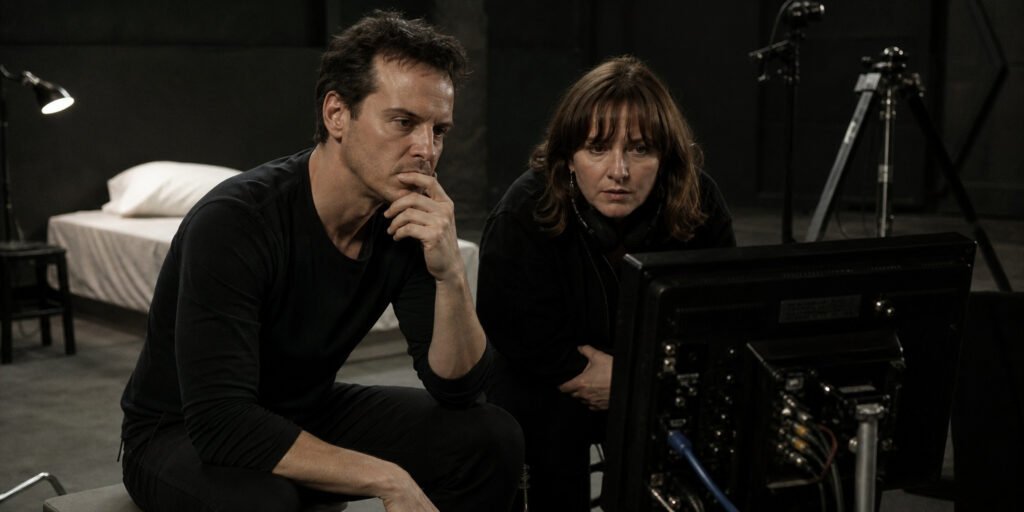
Andrew Scott, the acclaimed performer renowned for his chameleonic ability to inhabit complex emotional landscapes, is officially set to reprise his celebrated stage role in the feature film adaptation of the monologue ‘Sea Wall.’ The project marks a significant collaboration with director Tina Satter, who garnered widespread critical acclaim for her recent feature ‘Reality.’ This film adaptation aims to bridge the gap between the raw, singular intensity of theatrical storytelling and the expansive, immersive potential of the cinema.
Key Highlights
- The Lead: Andrew Scott returns to the role of Alex, a character he famously portrayed at the Old Vic and the National Theatre.
- The Visionary: Tina Satter, celebrated for her precise, documentary-style approach to narrative, will direct the adaptation.
- The Source Material: Based on the monologue by Olivier Award-winning playwright Simon Stephens, the story is a profound meditation on the suddenness of grief.
- The Format: The production is shifting from a one-man stage monologue to a cinematic feature, promising to explore the ‘theatrical experience’ as a narrative device.
The Cinematic Evolution of a Modern Classic
The announcement that Andrew Scott will reprise ‘Sea Wall’ is more than just a casting update; it is a significant cultural event for theater and film enthusiasts alike. The monologue, written by Simon Stephens, is widely considered one of the most demanding pieces of contemporary theater. It relies entirely on the actor’s ability to hold an audience captive while navigating the sudden, harrowing death of a child. By moving this performance to a feature film format, Scott and Satter are embarking on a high-stakes experiment: can the claustrophobic, visceral intimacy of a stage monologue be sustained on a cinema screen?
The Tina Satter Influence
Tina Satter’s involvement provides a strong indicator of the film’s aesthetic direction. Having directed the 2023 film ‘Reality,’ starring Sydney Sweeney, Satter has proven her mastery in extracting high-tension, reality-based performances within unconventional structures. Her style—often characterized by a dedication to the ‘truth’ of a moment, frequently using transcripts or verbatim dialogue—suggests that this adaptation will not be a typical stage-to-screen translation. Instead, audiences can expect a deeply psychological, perhaps meta-theatrical examination of memory and loss, utilizing the camera to capture microscopic shifts in emotion that the back row of a theater might miss.
Exploring the Anatomy of Grief
At its core, ‘Sea Wall’ is a study of the fragility of human existence. The protagonist, Alex, speaks directly to the audience, pulling them into his confidence as he recounts a pivotal, life-altering summer in the South of France. The play’s power lies in its simplicity. As Scott transitions this to film, the challenge will be maintaining that direct address—the ‘breaking of the fourth wall’—while utilizing the medium of film to visualize the memories he recounts. This creates an opportunity for a unique visual language, where the screen becomes a conduit for the subjective experience of trauma.
Secondary Angles: The Future of Stage-to-Screen Adaptations
1. The ‘Monologue Movie’ Trend
The adaptation of ‘Sea Wall’ continues a growing trend of ‘monologue movies,’ where filmmakers experiment with single-actor narratives to explore isolation. Much like Cocteau’s ‘The Human Voice’ (adapted by Pedro Almodóvar), this film is likely to redefine how dialogue-heavy stage plays are treated in the digital age, prioritizing the actor’s performance above all else.
2. Andrew Scott’s Career Trajectory
Coming off the heels of his powerhouse performances in ‘All of Us Strangers’ and ‘Ripley,’ Andrew Scott has solidified his reputation as an actor who thrives in high-stakes, internal performances. His return to ‘Sea Wall’ signals a desire to return to his theatrical roots while leveraging his newfound global cinematic capital. It is a strategic choice that highlights his commitment to ‘prestige’ narratives over blockbuster spectacle.
3. The Economic Impact on Independent British Film
While global franchises dominate the box office, projects like this—led by a high-profile actor and an auteur director—are vital for the independent sector. These projects often utilize leaner budgets to achieve higher creative output, signaling to investors that there is a robust, affluent market for ‘eventized’ theatrical adaptations that prioritize acting and screenplay quality over CGI.
FAQ: People Also Ask
1. Is ‘Sea Wall’ a musical or a play?
It is a straight play, specifically a monologue. There is no music or ensemble cast; the narrative is delivered entirely by the protagonist, Alex.
2. Who is the playwright of ‘Sea Wall’?
The monologue was written by the Olivier Award-winning playwright Simon Stephens, who is also known for adapting ‘The Curious Incident of the Dog in the Night-Time.’
3. Will this film be a live recording of the stage play?
No, it is being developed as a feature film directed by Tina Satter. While it retains the core material of the stage play, the direction implies a cinematic re-imagining rather than a direct filming of the theatrical production.
4. What is the central theme of the story?
‘Sea Wall’ explores the suddenness of death and the profound, lingering impact of grief, specifically focusing on a father’s memory of his daughter and a tragic incident during a family vacation.
More Stories
Bill Skarsgård Confirmed as Lead Star in Kojima’s PHYSINT
Oasis Brothers Unite: The ‘Don’t Look Back In Anger’ London Premiere
Return to Hogwarts: HBO Confirms 2026 Premiere for Harry Potter Series