











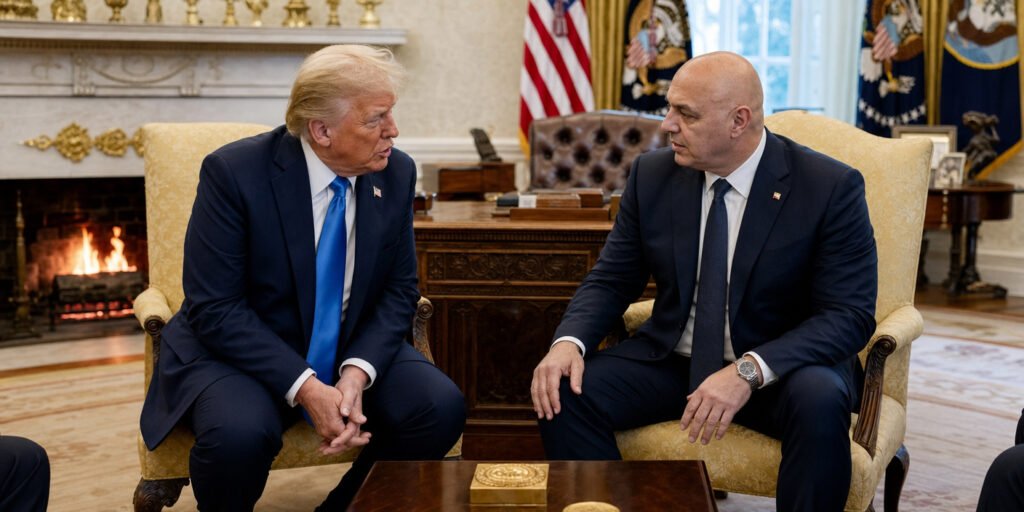
President Trump faces a high-pressure week marked by a complex convergence of foreign policy, domestic financial friction, and natural disaster management. As the White House hosts Lebanese President Joseph Aoun for urgent discussions regarding Middle East stability and the influence of Hezbollah, the administration simultaneously faces a severe standoff with California and Minnesota over $1 billion in withheld Medicaid funding. Complicating the situation further, federal agencies and local authorities in Louisiana are bracing for the imminent impact of Tropical Storm Bertha, testing the administration’s emergency response capabilities on multiple fronts.
Key Highlights
- Lebanese Diplomatic Push: President Trump met with Lebanese President Joseph Aoun at the White House to discuss the geopolitical future of the region and curbing Hezbollah’s influence.
- Medicaid Funding Freeze: The Department of Health and Human Services (HHS) has officially withheld $1 billion in Medicaid funding from California and Minnesota, citing ongoing policy disputes regarding state-level compliance and mandates.
- Tropical Storm Preparedness: Louisiana is under alert as Tropical Storm Bertha poses an immediate threat, with FEMA and local emergency services mobilizing to mitigate infrastructure and public safety risks.
- Strategic Overlap: The White House is forced to manage a rare triple-threat scenario that tests executive bandwidth, requiring simultaneous attention to international security, state fiscal sovereignty, and natural disaster relief.
The Executive Balancing Act: A Three-Pronged Policy Challenge
The current administration is operating at a critical juncture, managing a rare confluence of events that tests the limits of federal executive coordination. By engaging with international partners while enforcing domestic policy mandates and addressing climate-driven threats, the White House is signaling a strategy of aggressive oversight. This multifaceted pressure underscores the high-stakes environment in Washington, where fiscal policy, geopolitical strategy, and domestic safety are increasingly intertwined.
Diplomatic High-Wire Act: Engagement with Lebanon
The meeting between President Trump and Lebanese President Joseph Aoun comes at a pivotal moment for Middle Eastern stability. The primary objective of the dialogue centers on the geopolitical volatility within Lebanon, specifically addressing the entrenched influence of Hezbollah. For the White House, the goal is to reinforce Lebanese sovereignty and stabilize the region, thereby countering the influence of Iranian proxies. Analysts suggest that the administration is utilizing the meeting to leverage economic and military support as a means to encourage political reforms in Beirut. The fragility of the current Lebanese government, combined with regional security concerns, makes this a high-stakes diplomatic maneuver, with the White House looking to isolate extremists while maintaining a pathway for legitimate state governance.
The $1 Billion Showdown: Federal-State Medicaid Friction
In a move that has sparked intense debate regarding fiscal federalism, the Department of Health and Human Services (HHS) has withheld $1 billion in Medicaid funding from California and Minnesota. The core of this dispute lies in federal-state compliance; the administration maintains that these states have failed to meet specific regulatory requirements, while state officials argue that the withholding is an politically motivated overreach. This $1 billion gap represents a significant shortfall for public health programs, potentially impacting access to care for millions of vulnerable residents. The fiscal impasse is creating a ripple effect, with state health departments scrambling to find contingency funding, highlighting the deepening divide between federal mandates and state-led healthcare initiatives. This standoff acts as a litmus test for the current administration’s willingness to use the power of the purse to enforce administrative adherence to federal policy goals.
Climate Resilience: Tropical Storm Bertha’s Impending Landfall
While political and fiscal battles rage in the halls of power, the physical reality of climate change looms large over Louisiana. Tropical Storm Bertha is moving toward the Gulf Coast, posing an imminent threat to infrastructure and public safety. The administration’s response to this storm serves as a critical indicator of its emergency management efficiency. Federal agencies, working in lockstep with the Louisiana Office of Emergency Preparedness, have initiated mobilization protocols to protect high-risk areas. The challenge for the administration is two-fold: ensuring the rapid deployment of resources while maintaining consistent communication with state authorities. This event underscores the vulnerability of coastal regions and puts a spotlight on the effectiveness of the current federal-state partnership in disaster relief operations, particularly following recent criticism regarding the speed of aid distribution in similar environmental crises.
Economic and Security Intersections
These events, while seemingly disparate, share a common thread: the administration’s effort to exert influence over autonomous systems. Whether through diplomatic pressure on a sovereign nation, fiscal pressure on state-run healthcare systems, or the operational coordination of disaster relief, the common element is a centralized push for alignment. The potential economic impact of the $1 billion Medicaid withholdings, for instance, could destabilize state budgets, potentially forcing tax adjustments or service cuts. Similarly, the instability caused by regional conflicts in the Middle East directly influences global energy prices and migration patterns, which are inherently tied to U.S. economic stability. By simultaneously navigating these three crises, the administration is revealing a governance style that prioritizes leverage and centralized command, regardless of the potential for collateral friction.
FAQ: People Also Ask
1. Why is the HHS withholding Medicaid funding from California and Minnesota?
The HHS is withholding the funding due to persistent disagreements regarding state compliance with federal Medicaid mandates. The administration asserts that these states have not met the necessary benchmarks, while the states challenge the legal and ethical standing of this decision, leading to a significant fiscal standoff.
2. What was the core focus of the Trump-Aoun meeting?
The primary focus was the stabilization of the Middle East, specifically regarding the role and influence of Hezbollah. President Trump aimed to discuss ways to strengthen the Lebanese state’s autonomy and diminish the operational capacity of Iranian-backed militant groups within the country.
3. How is the government preparing for Tropical Storm Bertha?
Federal and state officials have activated emergency management protocols to prepare for potential flooding, wind damage, and infrastructure disruptions. FEMA is coordinating directly with the Louisiana Office of Emergency Preparedness to ensure that resources, including medical supplies and emergency power, are positioned to support immediate disaster response upon landfall.
4. Will the Medicaid funding freeze be resolved soon?
Currently, the situation remains a stalemate. Legal and administrative channels are being utilized by both California and Minnesota to contest the HHS decision. Unless a political compromise is reached or a court intervenes, the funding remains blocked, which could lead to long-term disruptions in state public health infrastructure.
More Stories
Merz Defiant: Chancellor Stays Course After Historic CDU Losses
Costco Goes Nationwide on Uber Eats: A New Era for Bulk Delivery
Elena Rybakina Wins US Open, Ascends to World No. 1