










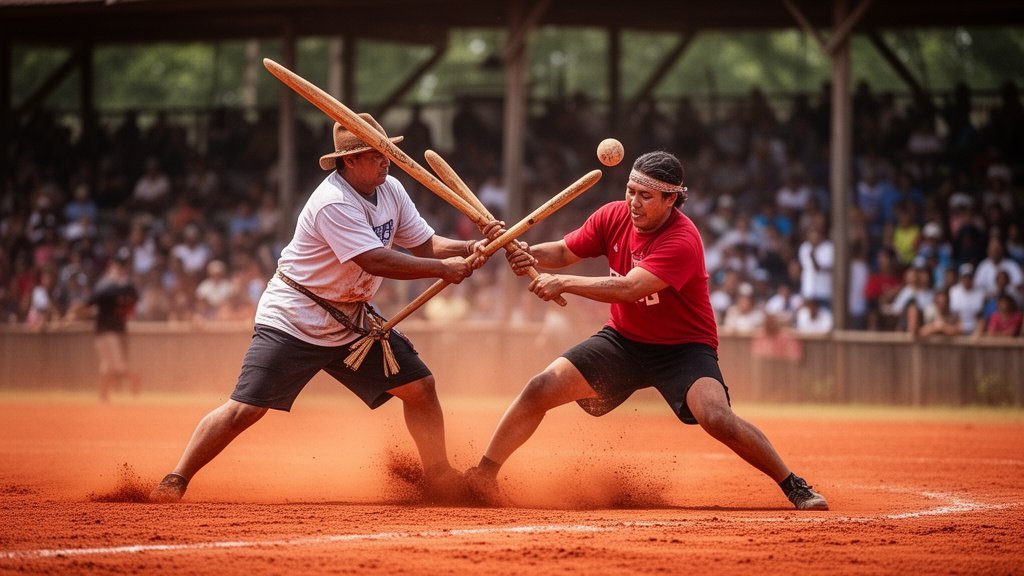
The dust rises in a thick, red cloud over the Pearl River community in Mississippi, marking the site of one of North America’s most ancient and exhilarating traditions. The 76th annual Choctaw Indian Fair recently concluded its centerpiece event: the ‘World Series of Stickball.’ This tournament is far more than a sporting competition; it is a profound demonstration of Choctaw resilience, physical fortitude, and cultural survival. As the players clash in a pursuit of victory, they are reenacting a history that stretches back centuries, long before the establishment of modern professional sports leagues.
Key Highlights
- Historic Longevity: Celebrating its 76th year, the Choctaw Indian Fair continues to be a premier venue for preserving Indigenous traditions, with the World Series of Stickball acting as the spiritual and athletic anchor of the gathering.
The ‘Little Brother of War’: Known in the Choctaw language as Ishtaboli*, the game is historically significant as a method of settling inter-tribal disputes, earning it the reputation as the ‘Little Brother of War.’
Physicality and Skill: The modern game remains a full-contact, high-intensity sport involving specialized hickory sticks—known as kapucha*—and a deerskin ball, demanding extreme endurance from participants.
- Cultural Anchor: The tournament serves as a vital bridge between generations, ensuring that Choctaw youth remain connected to the heritage, values, and community structure of the Mississippi Band of Choctaw Indians (MBCI).
The Soul of Ishtaboli: A Legacy in Motion
The World Series of Stickball is a sensory experience that defies the polished, sterile nature of contemporary athletics. There is no air-conditioning in the dirt-packed arena, no sterile synthetic turf, and no padding. Instead, there is the raw, percussive sound of hickory clashing against hickory and the guttural roar of a crowd that understands the stakes of every play. When the Mississippi Band of Choctaw Indians hosts this tournament, they are not merely playing a game; they are engaging in a living archive of their own endurance.
The Mechanics of Tradition
At its core, the game relies on precise equipment. The sticks, or kapucha, are hand-carved, traditional tools of the trade. They are not mass-produced plastic implements but extensions of the player’s arm, shaped from hickory wood. The ball itself is made of tightly woven deerskin. The objective—to hit a pole at the opposing end of the field—sounds deceptively simple, yet the execution is violent and strategic. Defenders must stop opponents using their bodies, leading to a spectacle of athleticism that is often compared to a blend of lacrosse and rugby, but with a deeper, ancestral significance. The rules are strict, yet the physicality is celebrated as a testament to the toughness required to survive and thrive as a tribe.
From Dispute to Celebration
Historically, Ishtaboli was not played in a stadium for trophies. It was a tool of diplomacy and conflict resolution. When tensions between Choctaw communities or neighboring tribes rose to levels that might otherwise trigger lethal warfare, the issue was settled on the stickball field. The ‘Little Brother of War’ served as a pressure valve, allowing for competitive aggression to be channeled into a defined space. Today, the World Series of Stickball retains this competitive spirit, but it has shifted its function. It is now a focal point for the Choctaw Indian Fair, an economic and social engine that draws thousands to the Pearl River community. It has become a medium for cultural expression, where the focus has transitioned from settling territorial disputes to celebrating community unity and the strength of the Choctaw people.
The Modern Economic and Cultural Engine
The Choctaw Indian Fair, organized by the Choctaw Resort Development Enterprise, serves as a massive gathering point for the MBCI. The stickball tournament drives significant foot traffic and engagement, which in turn fuels the broader local economy. However, the true currency of the fair is not the dollars spent at concession stands or the prestige of the tournament trophy; it is the intangible value of cultural continuity. As the elders watch the youth sprinting across the clay, navigating the intense physicality of the sport, they see the transmission of values: discipline, tribal loyalty, and the importance of physical capability. In an era where many Indigenous traditions risk fading into history books, the World Series of Stickball thrives as a loud, aggressive, and undeniably present reality.
Sustaining the Future
The challenge for any tradition of this age is adaptation. The World Series of Stickball has managed to survive by refusing to modernize the core tenets of the game. You will not find digital play-clocks or instant replay controversy here. The game remains true to its roots. This authenticity is exactly why it resonates so deeply with the participants. Younger generations are not drawn to the sport because it mimics modern trends; they are drawn to it because it offers them a distinct identity—an ‘in-group’ status that is rooted in the soil of Mississippi and the history of their ancestors. This inter-generational bonding ensures that the ‘Little Brother of War’ will continue to be fought, in the name of peace and preservation, for decades to come.
FAQ: People Also Ask
Q: What is the primary difference between stickball and lacrosse?
A: While lacrosse originated from similar Indigenous roots, modern stickball—specifically the Choctaw version—is significantly more physical and remains largely unpadded. It uses two sticks rather than one, and the objective is to hit a specific goal pole rather than score into a net.
Q: Is the World Series of Stickball open to the public?
A: Yes, the event takes place during the Choctaw Indian Fair, which welcomes visitors. It is a major tourism event for the Pearl River community, providing outsiders with a window into Choctaw culture and athletic tradition.
Q: How are the stickball sticks (kapucha) made?
A: The sticks are traditionally hand-carved from hickory wood. The construction process is considered a craft and a form of art, with the design and balance of the sticks being critical to a player’s performance on the field.
Q: Does the World Series of Stickball involve prize money?
A: While there are often prizes and prestige associated with winning the tournament, the motivation for the teams is primarily rooted in community pride, tribal recognition, and the honor of winning the championship for their respective communities.
More Stories
Lowriding’s Rise: SF Celebrates Cruising Culture
U.S. Repatriates 64 Cultural Relics and Fossils to China
Betting on Viral Fame: Novig’s Strategic Use of Sydney Sweeney