










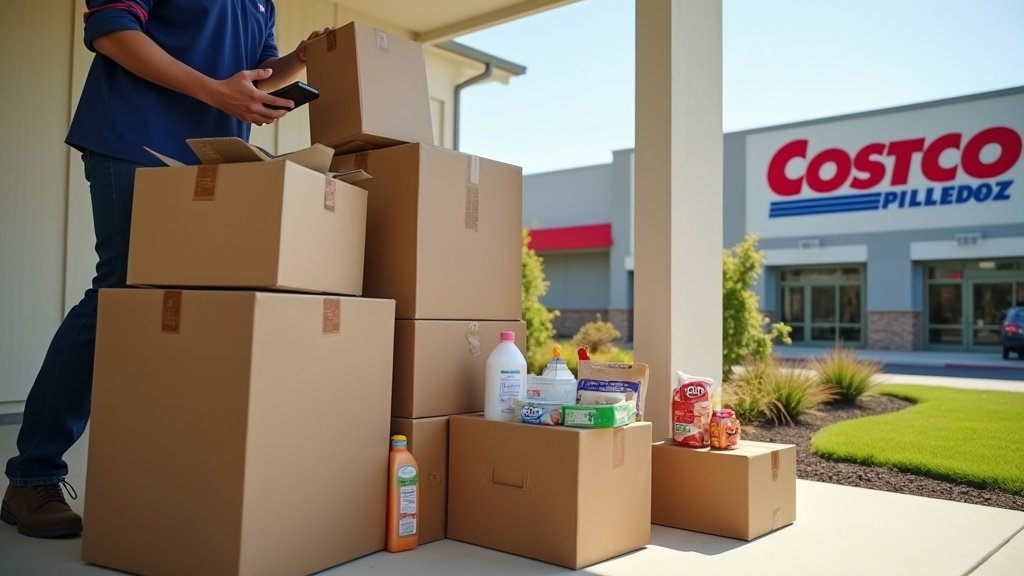
Costco Wholesale has officially scaled its partnership with Uber Eats, transforming what began as a restricted, 17-state pilot program into a robust, nationwide delivery network. This expansion now makes Costco’s extensive product catalog accessible to millions of Uber Eats users across 47 states, effectively bringing the warehouse shopping experience to approximately 600 locations. For consumers, this signifies a major shift in how bulk goods, pantry staples, and household essentials are procured, moving the “warehouse club” model firmly into the realm of on-demand, last-mile convenience.
The Logistics Leap: From Pilot to Nationwide Scale
The transition from a regional test to a national strategy represents one of the most significant logistics plays in the retail sector for the current fiscal year. Previously, Costco’s delivery ecosystem was heavily reliant on its proprietary partnerships and third-party grocery platforms like Instacart. The decision to integrate deeply with Uber Eats is not merely a convenience update; it is a calculated effort to capture a demographic that prefers the interface, rewards ecosystem, and membership benefits of the Uber platform. By reaching 47 states, Costco has effectively blanketed the contiguous United States, ensuring that the vast majority of its membership base has access to same-day delivery services.
This deployment required meticulous coordination between Costco’s inventory management systems and the Uber Eats logistical architecture. With roughly 600 warehouses now tied into the platform, the operational challenge involves maintaining “in-stock” accuracy in real-time. Customers using Uber Eats can now browse Costco’s typical offerings, excluding specific pharmacy or high-restriction items, and have them delivered by a driver within hours. This “hyper-local” fulfillment strategy relies on the density of the Uber driver network to bridge the gap between suburban warehouse locations and urban or residential end-users.
Integrating the Costco Ecosystem into Uber Eats
For the end-user, the integration is designed to be seamless. Within the Uber Eats application, users can navigate to the dedicated Costco storefront, where they are prompted to enter their Costco membership details. This step is critical; it ensures that the pricing reflects Costco’s internal member pricing, maintaining the value proposition that has defined the brand for decades. The collaboration also highlights how Uber Eats is aggressively pivoting from a food-delivery-first platform to a general commerce “super-app.”
From a technical standpoint, the integration utilizes Uber’s proprietary API to sync inventory levels directly from Costco’s floor management systems. If an item is out of stock at the nearest warehouse, the system intelligently updates the app, preventing customer dissatisfaction. This level of data synchronization was previously a hurdle for warehouse-style retailers, as the sheer volume of SKUs (Stock Keeping Units) and the physical size of the goods—often requiring larger vehicle capacities—presented logistical friction. The Uber Eats expansion solves this by leveraging a fleet of diverse vehicle types that can accommodate larger, bulk-sized orders.
Economic Implications and the Retail Battlefield
The ripple effects of this expansion extend well beyond the immediate convenience for shoppers. In the broader retail landscape, this move intensifies the competition between delivery aggregators. For years, the grocery delivery space was effectively dominated by Instacart, which built its reputation on being the primary digital storefront for major grocers. Costco’s embrace of Uber Eats chips away at this monopoly, offering customers a choice of platforms.
Analysts are watching this space closely for three primary reasons:
1. The Shift in Delivery Loyalty: By allowing consumers to choose their preferred delivery interface, Costco is essentially agnostic about which delivery partner wins, as long as the sale is captured. This gives the retailer significant leverage in future contract negotiations.
2. Increased Basket Size: Data from the pilot phase suggests that when warehouse items are integrated into on-demand apps, the average order volume increases significantly. Customers who might only order a few items on a traditional delivery app are inclined to “stock up” on bulk goods when presented with the familiar Costco value proposition.
3. Last-Mile Economics: The economics of delivering 50-pound bags of rice or cases of bottled water are drastically different from delivering a single pizza. This partnership tests the limits of “gig economy” labor, as Uber drivers must now be incentivized to handle heavy, bulk-order loads, potentially leading to a new tier of delivery service standards within the platform.
Future Trajectory: What Comes Next?
While 47 states are currently covered, the exclusion of remaining states and specific international markets leaves room for future growth. The critical question remains: will this model eventually encompass fresh, prepared-to-order food from the Costco Food Court, or will it remain strictly focused on retail goods? Furthermore, as the partnership matures, we expect to see enhanced “predictive” shopping features, where the app suggests items based on a user’s consumption history, further entrenching the convenience loop.
Ultimately, this nationwide rollout is a testament to the fact that “convenience” is no longer a luxury but a fundamental requirement for the modern consumer. Costco and Uber Eats have effectively removed the barrier of entry for the warehouse model, creating a digital bridge that connects the vast expanse of the suburban wholesale floor to the convenience of the digital doorstep.
FAQ: People Also Ask
1. Do I need a Costco membership to order via Uber Eats?
Yes, you must have an active Costco membership to use the service. When you select the Costco merchant within the Uber Eats app, you will be required to input your membership number to verify your status and access member pricing.
2. Are all items in the warehouse available for delivery?
Most items found in a standard Costco warehouse are available for delivery, including fresh produce, meat, and household goods. However, certain items, such as prescription medications from the Costco Pharmacy, are excluded due to regulatory and legal requirements.
3. How does this impact Instacart availability?
This rollout does not preclude Costco from continuing to work with other delivery partners. Costco maintains a multi-channel delivery strategy, meaning customers may still find Costco options on other grocery delivery platforms depending on their specific location and current regional partnerships.
4. Is there an extra fee for ordering Costco through Uber Eats?
While prices are matched to the member price, service fees and delivery charges, as determined by Uber Eats, still apply. These fees can vary based on distance, order volume, and time of day, and are separate from any Costco membership costs.
More Stories
Elena Rybakina Wins US Open, Ascends to World No. 1
Rubio Seals Security Pacts; Vance Drives Policy Agenda
Trade War Escalates: Canada’s Retaliatory Tariffs Hit U.S. Markets