










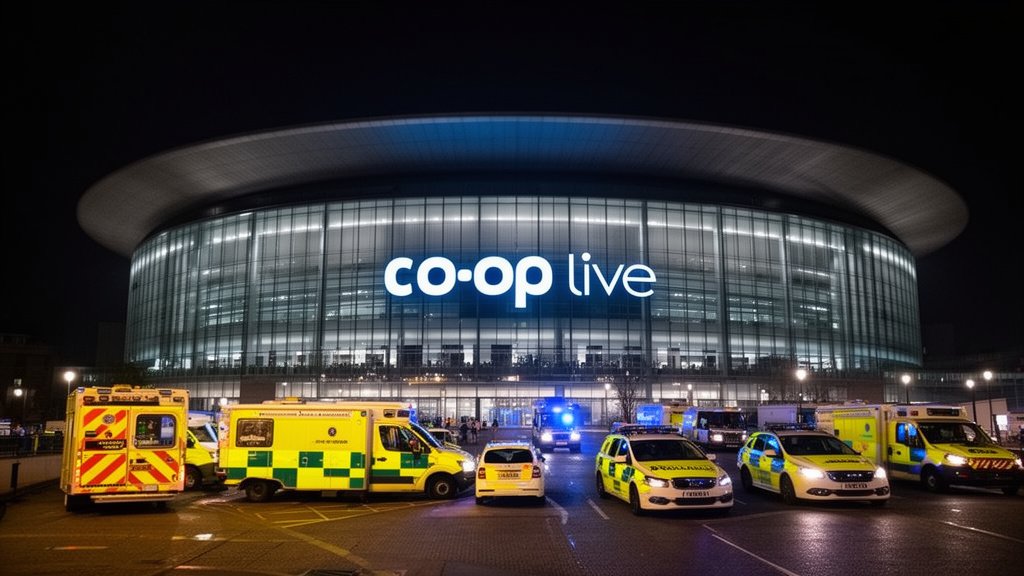
More than 12,000 fans were sent scrambling for the exits late Sunday night as a high-energy Don Toliver concert at Manchester’s Co-op Live arena was abruptly halted by a security and health crisis. The venue, which has only recently opened to the public, was forced to implement emergency evacuation protocols after an unknown substance was released into the audience, triggering a rapid and coordinated ‘major incident’ response from local authorities.
Key Highlights
- Mass Evacuation: Over 12,000 concertgoers were forced to leave the Co-op Live arena following the release of an unidentified substance.
- Medical Emergency: North West Ambulance Service confirmed treating more than 80 attendees for various symptoms, including respiratory distress and eye irritation.
- Major Incident Declaration: Greater Manchester Police categorized the event as a ‘major incident,’ necessitating a high-level multi-agency response to ensure site safety.
- Uncertain Origin: Investigations are currently underway to identify the nature of the substance and the motive behind the disruption.
Anatomy of a Security Crisis: The Co-op Live Incident
The tranquility of a Sunday evening concert was shattered when reports of a substance—yet to be identified by forensic analysis—began circulating through the standing crowd at the Co-op Live arena. As fans began to report immediate physical discomfort, including burning eyes and difficulty breathing, the atmosphere shifted from celebration to containment within minutes. The rapid escalation of the situation forced security teams and venue management to trigger the facility’s emergency protocols, leading to an orderly but urgent evacuation of the capacity crowd.
The Logistics of a Major Incident
When a venue of this scale—the largest indoor arena in the UK—is forced to evacuate on short notice, the logistical challenge is immense. Greater Manchester Police, working alongside the North West Ambulance Service, executed a multi-agency operation that prioritized rapid medical triage. According to official reports, more than 80 individuals received treatment on-site or were monitored for the effects of the airborne agent.
Such a response is rarely triggered without significant justification. The declaration of a ‘major incident’ implies that the standard emergency services within the immediate area were insufficient, necessitating additional support and a centralized command structure to manage the flow of 12,000 exiting people. This protocol is designed to prevent a crush—a significant concern in any mass-venue environment—while simultaneously creating a ‘cold zone’ for medical professionals to assess those exposed to the irritant.
Investigative Challenges and Public Safety
The primary focus for investigators now rests on the source and nature of the substance. Forensic teams are currently combing the arena floor, analyzing air quality data, and reviewing high-definition CCTV footage from the event. Because the substance was released within a dense crowd, the difficulty of isolating the exact moment of dispersion is considerable.
This incident has placed a spotlight on the ‘security-versus-experience’ dilemma faced by modern arenas. While stadiums and concert halls employ rigorous bag checks and metal detection, the release of an airborne chemical or particulate substance from within the crowd represents a ‘soft target’ vector that is notoriously difficult to prevent. Security experts are likely to revisit ingress protocols, specifically focusing on surveillance technology that can detect non-metallic threats before they are deployed.
The Shadow of Manchester’s History
It is impossible to discuss an event of this nature in Manchester without acknowledging the city’s unique, and at times painful, history regarding venue safety. The 2017 Manchester Arena bombing fundamentally altered the security landscape for every concert venue in the United Kingdom. Public awareness regarding ‘major incidents’ in the city is high, and the psychological impact of a sudden evacuation is amplified by the collective memory of the region.
In this context, the rapid, decisive action taken by Co-op Live management and local law enforcement serves as a testament to the stringent emergency preparedness required of modern venues. The ability to evacuate 12,000 people effectively in a moment of panic is a critical metric of success in event management, even if the primary goal—the prevention of the incident itself—remains a complex challenge.
FAQ: People Also Ask
Was the substance identified as dangerous?
While officials have confirmed it was an ‘unknown substance’ resulting in over 80 people requiring medical attention for irritation, they have not yet released the chemical or particulate composition. Authorities are continuing to analyze the evidence to determine if the act was malicious, accidental, or a result of a prohibited item.
Is Co-op Live considered a safe venue after this?
Every major arena is subject to ongoing security reviews. The Co-op Live arena operates under strict licensing conditions and follows national safety standards. An incident like this, while alarming, triggers a comprehensive review of security procedures, which will likely result in updated protocols regarding crowd management and detection technology.
What are the legal ramifications for the perpetrator?
If the investigation determines that the substance was released deliberately to cause harm or panic, the individuals responsible could face serious criminal charges, ranging from public order offenses to more severe counts related to the endangerment of life, depending on the toxicity of the substance and the intent behind its release.
Will the Don Toliver tour continue?
As of the latest reports, there has been no official cancellation or postponement of future tour dates linked to this event. However, tour organizers are working closely with local authorities to assess the viability of continuing the scheduled performances in light of the ongoing investigation.
More Stories
Miley Cyrus Marries Maxx Morando in Secret Palm Springs Ceremony
Ella Langley Sweeps 2026 CMA Awards: A Historic Win
Ella Langley Makes History with 6 CMA Wins at 60th Annual Awards