











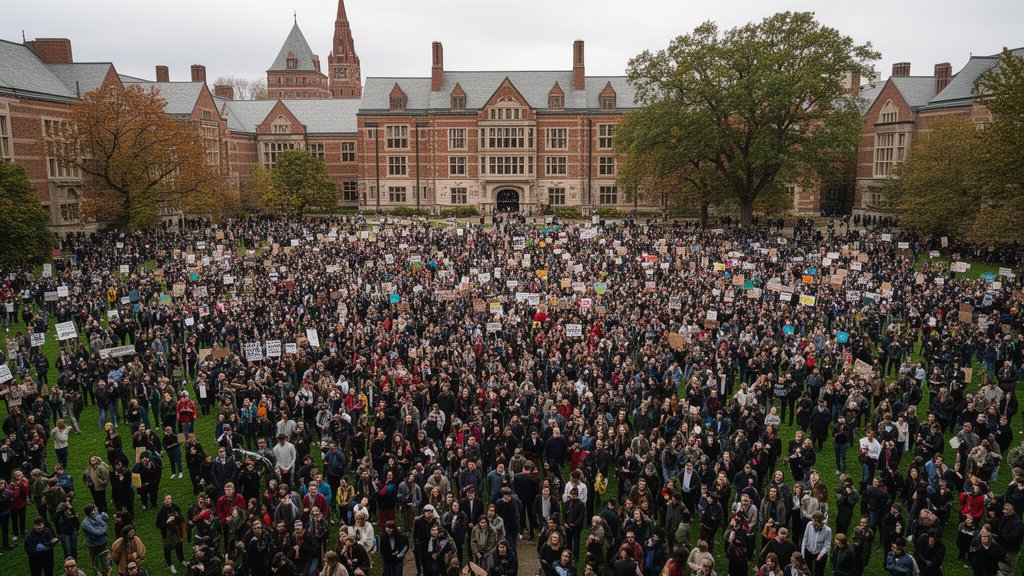
On October 5, 2026, the campus of Cornell University in Ithaca, New York, became the epicenter of a massive, coordinated protest as thousands of students and faculty members flooded the Arts Quad. The demonstration, sparked by the alleged systemic mishandling of sexual assault investigations within the university’s fraternity system, signals a pivotal shift in the campus climate. Protesters were united by a singular, urgent demand: the immediate resignation of the university president and a total overhaul of the institution’s Title IX compliance procedures.
Key Highlights
- Mass Mobilization: Thousands of students, faculty, and staff gathered on October 5, 2026, forming one of the largest campus protests in Cornell’s recent history.
- Specific Grievances: Protesters cited documented failures in the university’s response to gang-rape allegations involving local fraternities, accusing the administration of prioritizing institutional reputation over survivor safety.
- Demanding Accountability: The primary call to action included the resignation of the university president and an external, independent investigation into the university’s disciplinary handling of sexual violence.
- Systemic Scope: The movement seeks a permanent end to ‘rape culture’ on campus, calling for a dismantling of traditional Greek life structures if they fail to meet new safety benchmarks.
Institutional Accountability: The Crisis at Cornell
The events of October 5 did not emerge in a vacuum. For months, whispers of mishandled sexual assault cases had been circulating through student publications and private forums. However, it was the recent leaked internal communications, allegedly showing a pattern of administrative negligence, that acted as the primary catalyst for the mass mobilization. The protest, which brought academic operations to a temporary standstill, highlighted the growing divide between the student body’s demand for radical transparency and the university’s traditional bureaucratic response.
The Breakdown of Trust
At the core of the grievance is the perceived failure of the Cornell Office of Title IX. Survivors and advocacy groups have long criticized the institution for creating a ‘closed-loop’ system where investigations into fraternity misconduct are stalled, ignored, or settled with non-disclosure agreements. By October 5, the frustration had reached a breaking point. Student leaders speaking at the protest accused the administration of failing to protect students from known predatory behaviors within specific chapters, effectively making the institution complicit in the culture of violence they are mandated to prevent.
The Role of Greek Life
Cornell University has long wrestled with the influence of its fraternity and sorority system. Critics argue that the power dynamic within these organizations often shields members from accountability. The recent allegations are not merely individual infractions; they are viewed by protesters as a systemic failure of oversight. The demand for the university president’s resignation is effectively a vote of no confidence in the administration’s willingness—or ability—to confront these entrenched power structures. Protesters have explicitly called for the university to strip recognition from any fraternity that refuses to comply with new, more stringent safety and transparency protocols.
Broader Institutional Context
This event is part of a larger, national conversation regarding how private and public universities handle allegations of sexual assault. Cornell is now under a microscope, with alumni and legal experts watching closely to see if the university will pivot toward radical reform or double down on its legal defenses. The university’s response to the October 5 protests has, so far, been limited to a brief statement acknowledging the right to protest and promising an internal review—a move that many students and faculty view as ‘too little, too late.’
Secondary Angles: A Path Forward
1. The Legal Implications: How will the threat of Title IX litigation impact the university’s insurance and funding? If the claims of institutional mishandling are proven, Cornell could face federal investigation and loss of eligibility for specific grants.
2. The Future of Greek Life: Will this lead to the abolition of the fraternity system at Cornell, or will we see a model where these organizations are integrated into a more transparent, university-managed safety framework?
3. Faculty Governance: The notable presence of faculty at the protest suggests a rare solidarity between the teaching body and the students. This signals a breakdown in the governance model, where faculty members feel they can no longer trust the leadership to maintain a safe learning environment.
FAQ: People Also Ask
Q: What specifically sparked the October 5, 2026, protests?
A: The protests were ignited by credible allegations that the university administration mishandled reports of gang-rape involving fraternities, coupled with leaked documents that appeared to show systematic suppression of these reports.
Q: What are the protesters demanding?
A: The protesters are demanding the immediate resignation of the university president, an external, independent review of the Title IX office, and the implementation of a new safety protocol that holds Greek life organizations strictly accountable for student safety.
Q: Is the university administration taking any action?
A: As of October 6, the administration has issued a statement acknowledging the protests and the gravity of the allegations but has not yet announced the resignation of any top-level officials or an independent investigation.
Q: What is the broader significance for university governance?
A: This situation at Cornell serves as a potential precedent for how universities across the United States will be forced to handle sexual assault allegations in the future, moving away from ‘reputation management’ toward full transparency and survivor-centric accountability.
More Stories
The Prairie Pivot: Can ‘Shoe-Leather’ Politics Win the 2026 Midterms?
Privacy Under Fire: Doctors Denounce Student Genital Exams
In Pursuit: Reclaiming American Leadership Values