









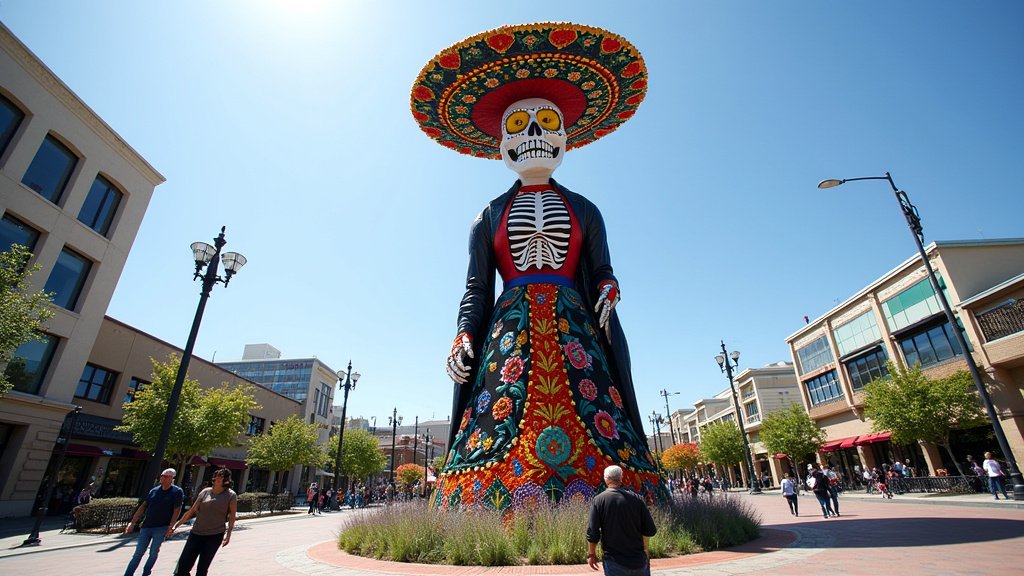
In the heart of Oakland’s historic Fruitvale district, a new, towering sentinel has taken its place in the skyline. The Unity Council has officially unveiled a monumental La Catrina sculpture in Fruitvale Plaza, a landmark installation that has been verified as the tallest of its kind in the United States. Far more than a mere festive decoration, this massive structure serves as a defiant cultural statement, blending the solemnity of Mexican tradition with a sharp, contemporary message of solidarity for immigrant communities facing an increasingly volatile political landscape. Standing as a beacon of heritage, the sculpture acts as a reclamation of space in an urban center that has fought hard to maintain its cultural integrity amidst rapid demographic and economic shifts.
Key Highlights
- Record-Breaking Scale: Standing at a height that cements its status as the tallest La Catrina sculpture in the United States, the installation dominates Fruitvale Plaza, drawing thousands of onlookers.
- The Unity Council’s Mission: Commissioned and managed by The Unity Council, the project reflects the organization’s decades-long commitment to fostering economic and cultural stability in the East Bay.
- Cultural Resistance: The sculpture serves as an unapologetic celebration of Mexican heritage, specifically Día de los Muertos, functioning as a political and social anchor for immigrant rights.
- Urban Revitalization: The installation is strategically placed to reinforce Fruitvale as a thriving, vibrant hub of Latinx commerce, arts, and community activism.
A Towering Assertion of Identity in Fruitvale
The erection of the La Catrina sculpture in Fruitvale Plaza is not merely an artistic endeavor; it is a tactical assertion of presence. In the context of the San Francisco Bay Area, where the cost of living and gentrification have displaced many long-term residents, the sculpture stands as a physical manifestation of the phrase, “We are still here.” The Unity Council, which has been the heartbeat of the Fruitvale district since 1964, spearheaded this project to ensure that as Oakland evolves, its Latinx soul remains anchored in the public consciousness.
The Artistic Significance of La Catrina
La Catrina, originally created by Mexican printmaker José Guadalupe Posada and later popularized by Diego Rivera, was designed as a social satire—a reminder that death is the great equalizer, regardless of class, wealth, or status. By scaling this figure to monumental proportions, the Oakland installation elevates this message. It is no longer just a figure of death, but a figure of endurance. The vibrant colors and intricate decorative motifs painted across the sculpture speak to the rich, kaleidoscopic history of Mexican art, while the sheer size of the installation makes it impossible to ignore for those traversing the busy corridors of the Fruitvale BART station and surrounding commercial zones.
Political Context and Immigrant Solidarity
In the current national discourse surrounding immigration and human rights, the sculpture serves as a rallying point. The Unity Council has framed the installation as an extension of their broader advocacy work. It provides a visual platform for the immigrant community, representing the resilience required to navigate systemic challenges. The sculpture does not stand in a vacuum; it stands in a plaza that is a primary transit and community hub, ensuring that its message of defiance and pride is viewed daily by thousands of commuters, residents, and visitors. This is public art functioning as a shield and a megaphone simultaneously.
The Economic and Cultural Ripple Effect
Beyond the symbolic, the sculpture acts as a catalyst for local economic engagement. The Fruitvale district relies heavily on small businesses—restaurants, bakeries, and retail shops—that often face pressure from larger corporate interests. By creating a “destination” piece of art, the project drives foot traffic into the heart of the district. This is a classic application of the “Bilbao Effect” on a community scale: using culture to secure economic viability. When visitors come to photograph the tallest La Catrina in the U.S., they are also spending money at local taquerias and vendors, circulating capital within the community.
Secondary Angles: Future-Proofing Culture
1. The Preservation of Cultural Zones: The success of this installation prompts a discussion on how other cities can designate specific zones for cultural preservation, using public art to protect heritage neighborhoods from the erosion of gentrification.
2. Día de los Muertos Evolution: Examining how traditional festivals are being transformed into modern tools for social activism, moving away from purely religious or holiday-based observance toward year-round cultural engagement.
3. Public-Private Partnerships: Analyzing the model used by The Unity Council—collaborating with local artists and city entities—to prove that large-scale art can be achieved without relying solely on tax dollars, but rather on community-driven development.
FAQ: People Also Ask
Q: Where exactly is the La Catrina sculpture located?
A: The sculpture is permanently installed in the heart of the Fruitvale Plaza in Oakland, California, located adjacent to the Fruitvale BART station, which serves as a major transit nexus for the community.
Q: How tall is the La Catrina sculpture?
A: While specific measurements can shift slightly based on the base platform used for display, it has been officially recognized and widely cited as the tallest La Catrina sculpture in the United States, standing as a dominant, multi-story structure.
Q: What is the primary purpose of this sculpture?
A: It serves a dual purpose: celebrating the rich cultural heritage of Día de los Muertos and acting as a defiant political statement of support and visibility for the immigrant communities that define the Fruitvale district.
More Stories
The Prairie Pivot: Can ‘Shoe-Leather’ Politics Win the 2026 Midterms?
Privacy Under Fire: Doctors Denounce Student Genital Exams
In Pursuit: Reclaiming American Leadership Values