











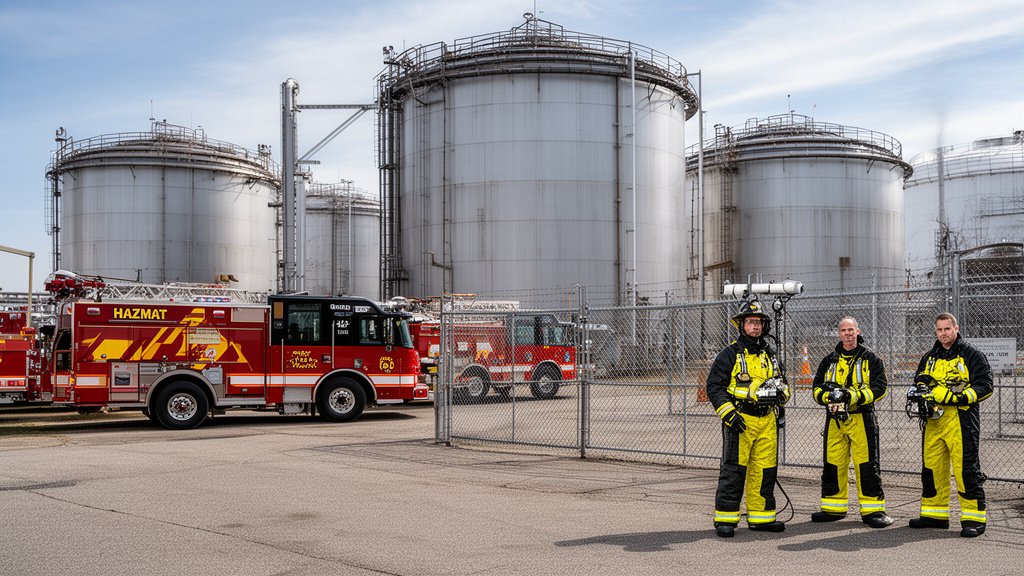
Mandatory evacuation orders are currently in effect for all residents within a 1-mile radius of the MC Tank Terminal in North Toledo, as emergency crews struggle to contain a significant hazardous materials release that was first detected late Tuesday night. For those residing within a 3-mile radius of the industrial site, authorities have issued an urgent shelter-in-place order, directing individuals to seal windows and doors and shut off HVAC systems while local response teams work to mitigate the air quality threat.
Key Highlights
- Mandatory Evacuations: Residents within a 1-mile radius of the MC Tank Terminal must evacuate immediately to avoid potential chemical exposure.
- Shelter-in-Place Protocol: A 3-mile radius zone is under a strict shelter-in-place order; residents are advised to stay indoors, seal off vents, and monitor official channels.
- Incident Origins: The hazardous release began late Tuesday night; incident command is currently assessing the chemical composition and dispersion patterns.
- Emergency Response: Toledo Fire and Rescue, alongside the Lucas County Emergency Management Agency, have established an incident command post to manage the containment and public safety efforts.
The Containment Operation: Managing the North Toledo Hazmat Release
The situation unfolding in North Toledo is a developing critical incident. Following the initial reports of the leak at the MC Tank Terminal, local authorities activated emergency protocols designed to protect the immediate population from exposure to volatile compounds. The decision to enforce a 1-mile evacuation radius suggests that incident commanders are concerned about the immediate concentration levels of the hazardous substance, while the 3-mile shelter-in-place order serves as a secondary layer of protection against drifting vapor plumes.
Incident Command and Tactical Response
The Lucas County Emergency Management Agency has established a unified command structure. This involves integrating the resources of Toledo Fire and Rescue with hazardous materials (HazMat) technicians who specialize in containment and decontamination. The primary objective for these teams is to identify the source of the leak within the MC Tank Terminal facility and establish a physical barrier or containment boom—or in the case of gaseous leaks, employ suppression techniques to neutralize or dissipate the chemical plume.
Standard HazMat operations at a tank terminal involve real-time air quality monitoring. Teams move throughout the exclusion zone and the surrounding shelter-in-place area, using sensors to detect parts-per-million (PPM) concentrations of the hazardous substance. These readings dictate whether the evacuation zone needs to be expanded or contracted. Residents are urged to remain vigilant; the lack of a visible plume does not guarantee safety, as many chemical releases are odorless or colorless.
Understanding Shelter-in-Place Protocols
For residents in the 3-mile radius, the shelter-in-place order is not merely a suggestion—it is a critical safety measure. When hazardous materials are released into the atmosphere, the primary risk is inhalation. By staying indoors, sealing gaps in windows and doors with plastic sheeting or duct tape, and turning off all heating, ventilation, and air conditioning (HVAC) units, residents create a safer ‘micro-environment’ that limits the intake of contaminated exterior air. This protocol provides emergency crews the vital time they need to secure the site without the logistical complication of evacuating tens of thousands of additional residents.
Industrial Risks in Urban Environments
The North Toledo incident highlights the complex relationship between industrial infrastructure and residential zoning. The MC Tank Terminal, like many similar facilities across the Great Lakes region, sits in a geographic area where industrial capacity and residential density intersect. This proximity creates inherent risks that are only manageable through rigorous adherence to safety standards, frequent equipment testing, and robust emergency response training. As the region moves past the immediate danger of this event, municipal leaders and state regulators are likely to face scrutiny regarding the safety buffers between these high-risk facilities and the communities that border them.
The Role of Environmental Monitoring
As the situation continues, the Environmental Protection Agency (EPA) Region 5 will likely be brought in to oversee the long-term mitigation and environmental cleanup. This is not just a localized public safety issue; it is an environmental one. Soil and groundwater contamination are often secondary risks associated with large-scale releases at tank farms. Monitoring teams will be deployed to ensure that the chemical spill does not migrate beyond the immediate containment site, potentially threatening the local water table or drainage systems in North Toledo. The transparency of this monitoring data will be crucial for the public to feel confident in the safety of their homes when evacuation orders are eventually lifted.
FAQ: People Also Ask
Q: How long will the shelter-in-place order last?
A: The duration of the order depends entirely on air quality monitoring data. Officials will provide updates as soon as the hazardous plume has dissipated and the site is secured. There is no predetermined timeline; safety is the priority.
Q: What should I do if I feel symptoms of exposure?
A: If you experience difficulty breathing, nausea, dizziness, or burning in your eyes or throat, call 911 immediately. Do not attempt to drive to a hospital if you are in an active exposure zone; wait for emergency personnel instructions.
Q: Can I return to the evacuation zone to check on my home or pets?
A: Absolutely not. The 1-mile evacuation zone is closed for the safety of both the residents and the first responders. Accessing the area interferes with emergency operations and puts you at significant risk of exposure.
Q: How will I be notified when it is safe to return?
A: Authorities will communicate the ‘all-clear’ through local emergency alert systems, official city social media channels, and local news broadcasts. Keep a radio or phone charged to receive these emergency notifications.
More Stories
Global Election Tensions: Legal Battles in CA, High Stakes in Brazil
US Envoy Witkoff Labels Putin ‘Humanitarian’ in Peace Push
Saudi Arabia Reports Thwarted Drone Attack