











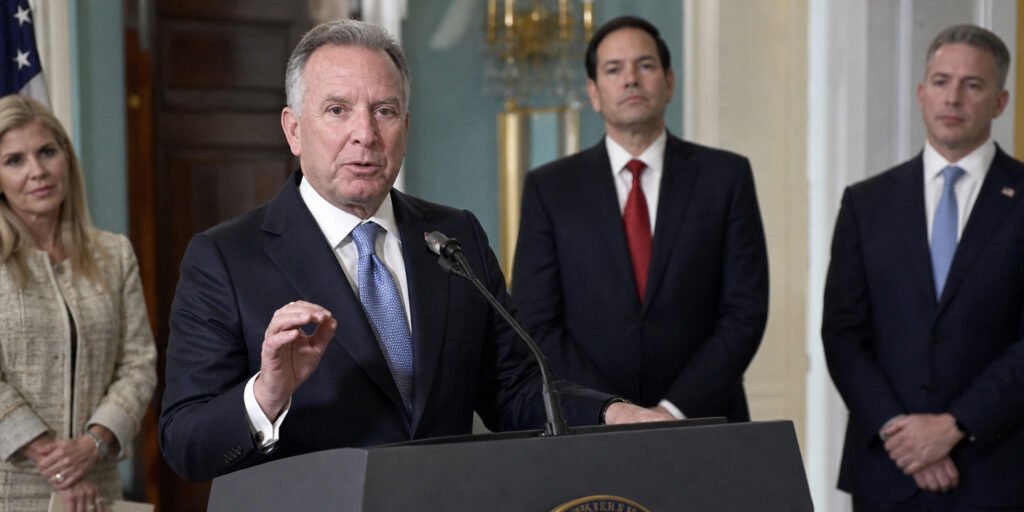
U.S. Special Envoy Steve Witkoff has ignited a firestorm of diplomatic controversy, characterizing Russian President Vladimir Putin as a “humanitarian” while simultaneously spearheading a renewed push for peace negotiations to halt the ongoing conflict in Ukraine. The remarks come at a precarious moment for the administration, as President Donald Trump asserts that Starlink satellite services, a vital lifeline for Ukrainian military and civilian communication, have been fully restored, a claim that stands in direct opposition to reports from Ukrainian officials on the ground who cite persistent, disruptive outages.
Key Highlights
- Diplomatic Rhetoric: Steve Witkoff’s description of Vladimir Putin as a “humanitarian” has drawn immediate and sharp criticism from both domestic opponents and international allies, complicating the administration’s attempts to frame the diplomatic outreach as a necessary strategic pivot.
- Negotiation Strategy: The envoy is actively attempting to facilitate a resumption of peace talks, arguing that a pragmatic approach is required to end the war, even if it necessitates framing the Russian leadership in softer, more diplomatic terms to achieve a ceasefire.
- The Starlink Disconnect: While President Trump has publicly claimed that Starlink internet access for Ukraine has been resolved, Ukrainian authorities maintain that service remains sporadic and unreliable, suggesting a widening gap between high-level diplomatic messaging and the technological reality of the battlefield.
The Geopolitical Fallout of the ‘Humanitarian’ Label
The choice of the word “humanitarian” by a high-level U.S. envoy to describe a leader currently sanctioned for extensive military actions has sent shockwaves through the international intelligence and diplomatic communities. In the context of the Russo-Ukrainian war, where the Kremlin is accused of systematic targeting of civilian infrastructure and widespread human rights violations, Witkoff’s framing is perceived by many experts as not merely a diplomatic gaffe, but a calculated, albeit controversial, attempt to lower the temperature of the conflict.
Analyzing the Rhetorical Shift
Diplomatic analysts suggest that the strategy here relies on “de-escalation through normalization.” By shifting the characterization of the adversary from a pariah to a figure capable of negotiation—and, according to Witkoff’s rhetoric, a “humanitarian” concern—the administration may be testing whether a softened tone can coerce the Kremlin to the bargaining table. However, this strategy carries significant risk. Critics argue that such language undermines the moral authority of the United States and demoralizes Ukrainian forces, who see their existential fight being reframed as a manageable diplomatic dispute.
Furthermore, this language creates a divergence from NATO’s established stance. As the alliance continues to provide military aid under the premise of defending sovereignty against an aggressor, labeling that aggressor a “humanitarian” introduces a cognitive dissonance that could weaken transatlantic unity. The question remains whether this is a trial balloon for a larger “America First” peace proposal or an isolated error in judgment.
The Technological Divide: Starlink as a Barometer
Beyond the diplomatic rhetoric, the situation on the ground remains dictated by technology, specifically SpaceX’s Starlink network. The service has been the backbone of Ukraine’s “C4ISR” (Command, Control, Communications, Computers, Intelligence, Surveillance, and Reconnaissance) capabilities since the early days of the invasion. President Trump’s recent assertion that Starlink access has been fully restored signals a desire to present the situation as “solved,” effectively removing a point of friction from the political narrative.
The Reality of Frontline Connectivity
Conversely, Ukrainian military officials, speaking on condition of anonymity, report that while service is functioning in some sectors, they continue to experience significant “blackout zones” and latency issues, particularly during critical offensive or defensive operations. This discrepancy suggests a potential disconnect between the administration’s reliance on private-sector assurances—likely provided by SpaceX leadership—and the tactical reality experienced by infantry and artillery units.
This technology gap has significant military consequences. Reliable, low-latency communication is essential for the effective use of precision-guided munitions and drone swarms. If Starlink is intermittently failing, it forces Ukrainian units to revert to less secure or slower communication channels, thereby increasing their vulnerability to Russian electronic warfare units, which are actively working to jam and track signals. The administration’s insistence that the problem is resolved, when the frontline says otherwise, creates a dangerous blind spot in policy planning.
The Future of Private-Sector Diplomacy
This crisis highlights the growing, and often uncomfortable, role of private entities like SpaceX in sovereign warfare. When the foreign policy of the United States becomes inextricably linked to the service-level agreements of a single private corporation, the government loses a degree of autonomy. The current impasse suggests that future diplomatic efforts must involve not just the Kremlin and the White House, but also the corporate boardrooms that control the hardware of modern war.
FAQ: People Also Ask
Q: What is Steve Witkoff’s official role in the current administration?
A: Steve Witkoff serves as a Special Envoy, tasked with navigating complex regional conflicts. His recent focus has been on facilitating back-channel communications to explore potential ceasefires and peace agreements, particularly regarding the war in Ukraine.
Q: Why is the label ‘humanitarian’ causing such a stir?
A: The term is historically loaded and, in the eyes of many world leaders and human rights organizations, directly contradicts the documented actions of the Russian state in Ukraine. Using this language is viewed by many as a dangerous normalization of a leader accused of war crimes.
Q: How does the Starlink issue impact the war?
A: Starlink is crucial for the Ukrainian military’s ability to communicate, coordinate drone strikes, and manage artillery fire. Any disruption, or dispute over the status of that disruption, directly impacts the combat effectiveness of Ukrainian forces and complicates strategic planning.
More Stories
Global Election Tensions: Legal Battles in CA, High Stakes in Brazil
Toledo Hazmat Crisis: Mass Evacuations Ordered for North Side
Saudi Arabia Reports Thwarted Drone Attack