











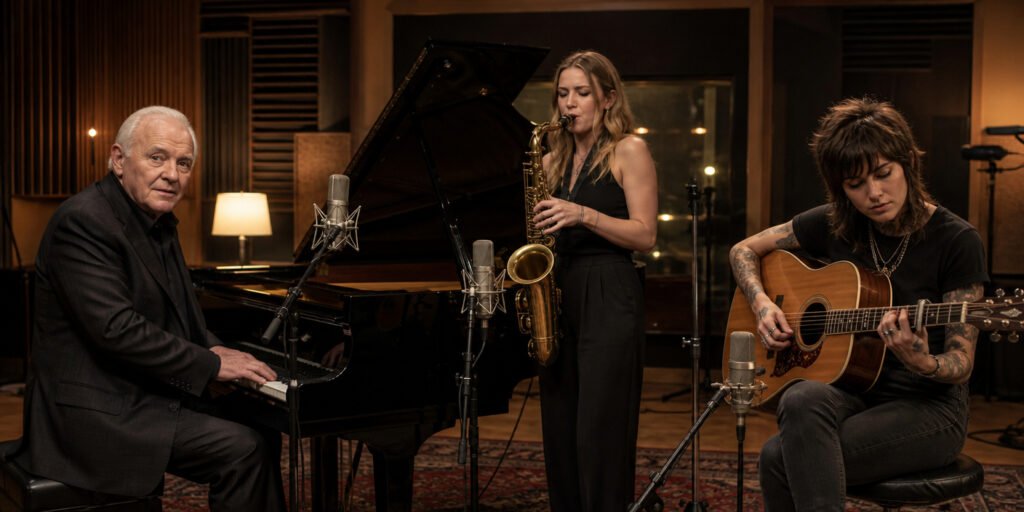
In a sweeping assessment of the current sonic landscape, The Guardian has spotlighted a diverse array of recent album releases, traversing the complex intersections of jazz, country, and classical-crossover. This latest critical roundup does more than merely catalog new releases; it maps a shift in how modern listeners engage with composition, performance, and narrative storytelling. By placing heavyweights of the screen like Sir Anthony Hopkins alongside emerging virtuosos like Gaia Wilmer and the raw, narrative-driven sounds of Stella Lefty, the publication emphasizes a growing appetite for genre-fluidity that ignores traditional radio-play boundaries.
Key Highlights
- The Classical-Crossover Renaissance: Sir Anthony Hopkins demonstrates a profound pivot to formal composition, challenging the notion of the ‘celebrity musician’ by engaging with complex structural music.
- Jazz Complexity: Gaia Wilmer continues to push the boundaries of jazz, utilizing avant-garde arrangements that defy commercial standardization.
- Country Narrative Evolution: Stella Lefty’s latest work is identified as a standout in country music, focusing on the return of the lyric-first, raw storytelling tradition.
- Genre-Blurring Trends: The roundup highlights an increasing trend where listeners are prioritizing emotional authenticity over rigid adherence to genre categorization.
Musical Fluidity: The Critical Vanguard of Genre-Blurring Soundscapes
The contemporary music market is currently undergoing a structural transformation, one that the critics at The Guardian are meticulously documenting. No longer are audiences siloed into the rigid silos of ‘pop,’ ‘jazz,’ or ‘classical.’ Instead, there is a burgeoning ecosystem where a single listener might transition from the orchestral sensibilities of Sir Anthony Hopkins to the intricate, improvised tapestries of Gaia Wilmer within a single digital playlist. This shift is not merely incidental; it represents a fundamental change in how artists are approaching composition and how audiences are consuming sonic content.
The Anthony Hopkins Phenomenon: Beyond the Screen
Few figures in modern entertainment possess the cultural gravity of Sir Anthony Hopkins. While his career has been defined by his unparalleled screen presence, his recent foray into the world of classical composition has surprised, and subsequently captivated, the critical establishment. The Guardian’s recent appraisal underscores a crucial point: Hopkins is not treating music as a hobby, but as a discipline. His latest work exhibits a structural integrity often lacking in ‘crossover’ projects. Critics note that his compositions avoid the saccharine trap of film-score genericism, opting instead for a brooding, introspective tonality that draws on deep-rooted classical traditions. This adds a layer of intellectual rigor to his public persona, suggesting that for Hopkins, music is the final frontier of his artistic expression.
Gaia Wilmer: Architects of Modern Jazz
While Hopkins brings a classical weight, the jazz sphere is being reinvigorated by figures like Gaia Wilmer. Her recent releases serve as a counterpoint to the more accessible compositions of the crossover movement. Wilmer’s work is characterized by its daring approach to harmony and timing. The Guardian highlights her ability to maintain a ‘conversational’ tone within complex musical arrangements. For the jazz enthusiast, this is a necessary evolution; it signals a departure from the nostalgic revivalism that has plagued the genre for years. Wilmer is not looking back at the mid-century icons; she is building a new vocabulary for the genre that feels both urgent and technically demanding.
Stella Lefty and the Narrative Country Revival
Perhaps the most poignant angle within The Guardian’s coverage is the spotlight on Stella Lefty. In an era dominated by high-production, stadium-filling country music, Lefty represents a ‘return to the root.’ Her latest album is described as a masterclass in narrative songwriting, where the instrumental backing acts as a scaffolding for the lyricism rather than the focal point. This aligns with a broader trend in country music that values vulnerability over technical perfection. By celebrating Lefty’s work, critics are signaling a fatigue with the over-produced Nashville sound, suggesting that the industry—and its audience—is starving for the kind of unvarnished storytelling that defined the genre’s golden age.
The Impact of Critical Curation in the Digital Age
One cannot discuss these albums without addressing the platform of The Guardian itself. In an age dominated by algorithm-driven recommendations, the ‘curated roundup’ serves as a vital gatekeeper of quality. Algorithms tend to feed users ‘more of the same,’ whereas a curated critical analysis introduces the listener to disparate worlds. By placing Hopkins, Wilmer, and Lefty in the same editorial space, the publication forces a cross-pollination of audiences. It asks the jazz listener to consider the classical narrative, and the country enthusiast to engage with the structural complexities of avant-garde jazz. This is not just journalism; it is an act of cultural synthesis that helps sustain the vitality of the music industry.
Looking Toward the Future of Genre
As we look forward, the trend toward hybridization is only likely to accelerate. The success of these albums, as measured by critical reception and growing fan interest, suggests that we are entering a post-genre era. The ‘crossover’ label may soon become obsolete, simply replaced by a singular descriptor: good music. Artists like Wilmer, Hopkins, and Lefty are the vanguards of this movement, proving that listeners are more sophisticated than the industry often gives them credit for. They are willing to follow an artist through the complexities of a symphonic structure or the raw honesty of an acoustic country ballad, provided the emotional core of the work remains intact.
FAQ: People Also Ask
Q: Why is The Guardian grouping these disparate artists together?
A: The grouping reflects a ‘critical roundup’ format, which aims to provide a snapshot of the cultural moment rather than adhering to rigid genre tags. It highlights the diversity of quality music currently being produced across different styles.
Q: Is Sir Anthony Hopkins a professional musician?
A: Yes, Sir Anthony Hopkins has been composing music for several years, with his works appearing in film and independent releases. His approach is rooted in classical piano and orchestral composition.
Q: How does Gaia Wilmer’s jazz differ from traditional jazz?
A: Gaia Wilmer’s work is often categorized as contemporary or avant-garde jazz. It incorporates complex, non-standard rhythmic structures and a heavier emphasis on modern composition rather than traditional swing-era improvisation.
Q: Where can I hear the music mentioned in these reviews?
A: Most of the artists mentioned, including Gaia Wilmer and Stella Lefty, have their catalogues available on major digital streaming platforms like Spotify, Apple Music, and Bandcamp.
Q: What is the significance of the country revival mentioned in the review?
A: The ‘country revival’ refers to a trend among new artists to move away from pop-polished production in favor of traditional storytelling, acoustic-first arrangements, and lyrics that emphasize personal or social narrative.
More Stories
J Mascis: How Black Sabbath Turned Him Into a Rock Outlier
Sound Strokes: A Sonic Bridge Between China and Scotland
TV Week: Chad Powers Returns, Furious Finale Hits