










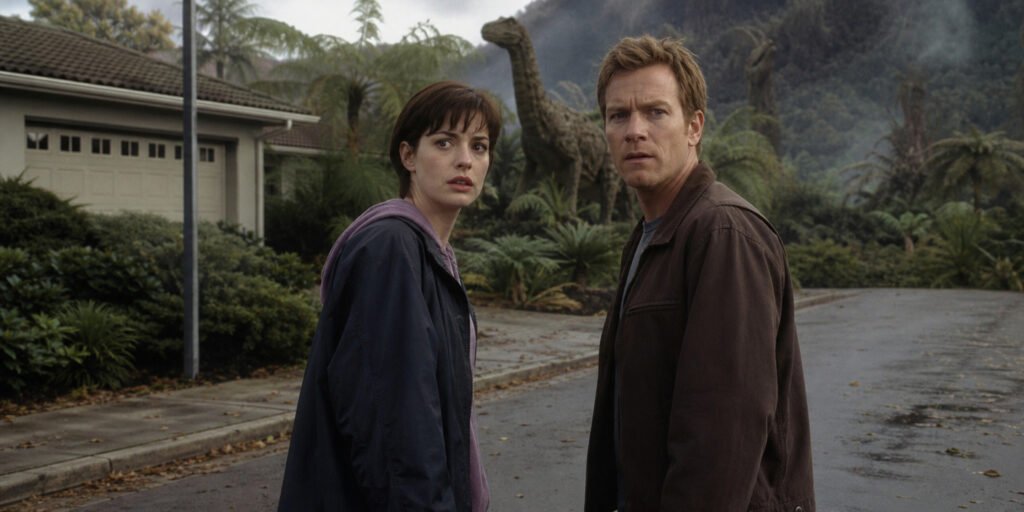
The latest science-fiction thriller, The End of Oak Street, arrived with significant anticipation, primarily due to its powerhouse leads, Academy Award-winner Anne Hathaway and Golden Globe-winner Ewan McGregor. However, the critical reception, particularly from publications like Mashable, has been swift and unforgiving. The film, which attempts to merge the mundane tension of suburban life with the high-stakes terror of a creature feature, has been labeled “bleak and stupid,” struggling to find its footing among the pantheon of successful genre entries.
Key Highlights
- Star Power Mismatched: Despite the heavyweight talent of Anne Hathaway and Ewan McGregor, critics argue the script fails to provide the depth required for such seasoned performers.
The Jurassic Comparison: The film’s core premise—a quiet suburban street inexplicably transported to a Jurassic-era dimension—is unfavorably compared to the logistical and thematic success of Jurassic Park*.
Critical Consensus: Initial reviews, including the one from Mashable*, cite a lack of narrative coherence, describing the final product as both “bleak” and intellectually hollow.
- Genre Failure: The movie serves as a case study in why high-concept “fish-out-of-water” narratives require a grounded internal logic, which this film reportedly lacks.
The Anatomy of a High-Concept Failure
When a film relies on a premise as wild as a residential cul-de-sac being ripped from modern-day safety and dropped into a prehistoric, dinosaur-infested dimension, the burden of proof lies entirely on the suspension of disbelief. The End of Oak Street attempts this daring narrative feat, but according to the consensus of current reviews, it crumbles under the weight of its own ambition.
The Problem with Premise
At its core, science fiction relies on the “what if” proposition. In Jurassic Park, Michael Crichton and Steven Spielberg successfully established a set of rules: genetic engineering, corporate hubris, and the chaos theory of nature. The End of Oak Street seemingly attempts a similar structural backbone but fails to establish the “how” or the “why” behind its central inciting incident. Without a tether to reality, the characters—no matter how well-played by Hathaway and McGregor—drift through the narrative without agency or clear motivation.
The film’s attempt to paint a “bleak” picture of isolation is hampered by the ridiculousness of the situation. Critics note that while the film aims for the existential dread of isolationism, it instead lands on a tone that is jarringly inconsistent. The tonal whiplash between domestic melodrama and prehistoric survival horror makes it difficult for the audience to invest in the stakes of the protagonists. When the environment is meant to be a terrifying, lethal ecosystem, the characters’ reactions often feel detached, further highlighting the script’s failure to bridge the gap between human emotion and creature-feature spectacle.
The Star Power Paradox
Anne Hathaway and Ewan McGregor are two of the most bankable and critically respected actors of their generation. Their involvement in The End of Oak Street likely secured the project its substantial budget and marketing push. Yet, this creates a “star power paradox.” When audiences see two elite actors in a film that is described as “stupid,” the cognitive dissonance is jarring. The performances are not necessarily criticized as bad—Hathaway and McGregor bring their characteristic professionalism to their respective roles—but they are described as under-utilized, struggling to sell a script that relies on plot contrivances rather than character development.
The Failure of Logic
Narrative coherence is the silent engine that drives any successful sci-fi thriller. In The End of Oak Street, the rules of the “Jurassic dimension” appear to shift to suit the needs of the scene rather than the laws of the established world. This is where the comparison to Jurassic Park becomes fatal. Spielberg’s classic functioned because every encounter with a dinosaur was governed by geography, physics, and character capability. The End of Oak Street is reported to abandon these pillars, resulting in a viewing experience that feels less like a survival epic and more like a series of disconnected, illogical sequences designed solely to showcase creature CGI that often fails to impress.
Analyzing the Future of Suburbia-Horror
The genre of “Suburban Horror” is a time-honored tradition. From Poltergeist to The ‘Burbs, audiences love the idea of the familiar turning lethal. The challenge, which The End of Oak Street fails to meet, is maintaining that intimacy when the scope expands to global or geological levels. The film’s failure to ground the horror in the specific details of the characters’ lives means the audience never feels the loss of their “home.” The street becomes just a backdrop, an empty set piece rather than a character in its own right.
For future filmmakers, this serves as a cautionary tale. High concept does not equate to high quality. Audiences, and critics alike, are increasingly demanding that even the most far-fetched scenarios adhere to a internal, logical consistency. Without that foundation, even the best acting talent in the world cannot save a project from being written off as merely bleak, stupid, and fundamentally incoherent.
FAQ: People Also Ask
1. What is the main plot of ‘The End of Oak Street’?
A suburban street is mysteriously teleported into a Jurassic-era dimension, forcing residents to survive against prehistoric creatures and unknown environmental hazards.
2. Is ‘The End of Oak Street’ worth watching for the cast alone?
Critical reviews, including Mashable, suggest that despite the star power of Anne Hathaway and Ewan McGregor, the film’s narrative failings and lack of coherence make it difficult to recommend.
3. How does the movie compare to ‘Jurassic Park’?
Critics argue that while it aims for the scale and tension of Jurassic Park, it lacks the necessary logical grounding and narrative structure, rendering the comparisons unfavorable.
4. What does ‘bleak and stupid’ mean in the context of this review?
It refers to the film’s attempt at existential, dark themes (bleak) combined with a script that is seen as illogical, contrived, or lacking in intelligence (stupid).
More Stories
J Mascis: How Black Sabbath Turned Him Into a Rock Outlier
Sound Strokes: A Sonic Bridge Between China and Scotland
TV Week: Chad Powers Returns, Furious Finale Hits