










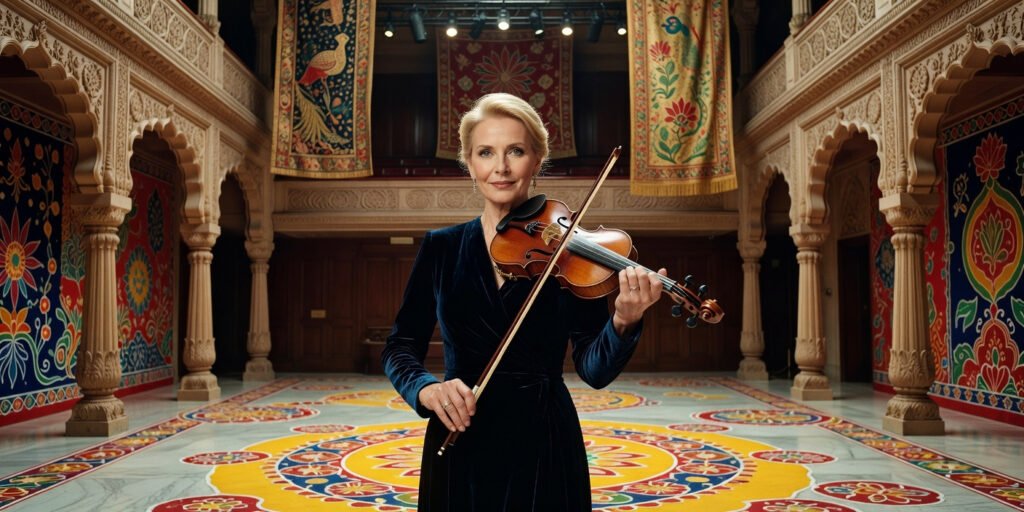
Renowned violinist Anne-Sophie Mutter’s album “Crosscurrents” is making waves in the classical music scene, challenging traditional boundaries by exploring the vibrant interplay between Western classical music and Indian classical traditions. This ambitious project features collaborations with leading Indian musicians, offering a fresh and dynamic perspective on musical synthesis.
Key Highlights:
- Anne-Sophie Mutter ventures into a unique collaboration with Indian classical musicians.
- The album “Crosscurrents” bridges the gap between Western and Indian classical music.
- Features a diverse ensemble of celebrated artists from both musical worlds.
- Offers listeners an innovative and boundary-pushing auditory experience.
A Symphony of Two Worlds: Deconstructing “Crosscurrents”
Anne-Sophie Mutter, a titan in the world of classical violin, has once again demonstrated her artistic adventurousness with the release of “Crosscurrents.” This album is not merely a collection of performances; it is a carefully curated dialogue between two profoundly rich musical traditions. The project’s genesis lies in the shared sonic landscapes that can be discovered when seemingly disparate musical vocabularies engage in earnest conversation. Mutter’s renowned precision and emotive depth are now set against the intricate rhythmic patterns and melodic improvisations characteristic of Indian classical music.
The Collaborative Spirit
The success of “Crosscurrents” hinges on its collaborative spirit. Mutter has brought together an impressive roster of musicians, including the acclaimed Indian violinist L. Subramaniam, renowned percussionist Zakir Hussain, and the celebrated vocalist Sudha Ragunathan. These artists, masters in their own right, bring an authentic and profound understanding of their respective traditions. The album showcases original compositions and new arrangements that are designed to highlight the synergistic potential between the two genres. Instead of a mere juxtaposition, the album seeks a true fusion, where elements of each tradition inform and enhance the other, creating something entirely novel yet deeply resonant.
Navigating the Sonic Landscape
Listeners will find themselves traversing a rich sonic tapestry. The album moves from pieces that lean heavily on orchestral arrangements with subtle Indian inflections to tracks where the tabla or sitar takes center stage, supported by a Western classical ensemble. Mutter’s violin playing, known for its technical brilliance and emotional intensity, adapts beautifully to these new contexts, whether she’s engaging in a rapid-fire melodic exchange with an Indian instrument or providing a soaring counter-melody over complex rhythmic cycles. The production quality is exceptional, ensuring that the nuances of each instrument and the intricate interplay between them are captured with clarity and fidelity.
Beyond Genre: A Universal Language
“Crosscurrents” ultimately transcends the labels of “Western classical” and “Indian classical.” It speaks to a universal language of music, demonstrating how melody, rhythm, and harmony can connect across cultural divides. The album is a testament to the power of open-mindedness and artistic curiosity, proving that the most exciting innovations often occur at the intersections of different disciplines. For long-time admirers of Mutter’s work, it’s a chance to hear her explore new expressive territories. For newcomers, it’s an accessible entry point into the complex beauty of both Indian and Western classical music.
FAQ: People Also Ask
What is the central theme of Anne-Sophie Mutter’s “Crosscurrents” album?
The central theme of “Crosscurrents” is the exploration and fusion of Western classical music with Indian classical music, highlighting the commonalities and creating new sonic dialogues between the two traditions.
Who are some of the key collaborators on “Crosscurrents”?
Key collaborators include Indian violinist L. Subramaniam, tabla maestro Zakir Hussain, and vocalist Sudha Ragunathan, alongside Mutter’s own ensemble.
How does Mutter’s violin playing adapt to Indian classical music?
Mutter adapts her renowned technique and expressive style to engage with the intricate melodic structures and rhythmic complexities of Indian classical music, often in dialogue with Indian instrumentalists.
What is the significance of “Crosscurrents” in the context of classical music?
“Crosscurrents” is significant for its boundary-pushing approach, demonstrating a successful and innovative fusion of distinct classical traditions, thereby expanding the horizons of contemporary classical music.
Is “Crosscurrents” accessible to listeners unfamiliar with Indian classical music?
Yes, the album is designed to be accessible by showcasing the points of connection and offering a compelling auditory experience that bridges the two genres, making it an engaging listen for both classical and world music enthusiasts.
More Stories
Mike Flanagan’s ‘Carrie’ Stuns Fantastic Fest
J Mascis: How Black Sabbath Turned Him Into a Rock Outlier
Sound Strokes: A Sonic Bridge Between China and Scotland