











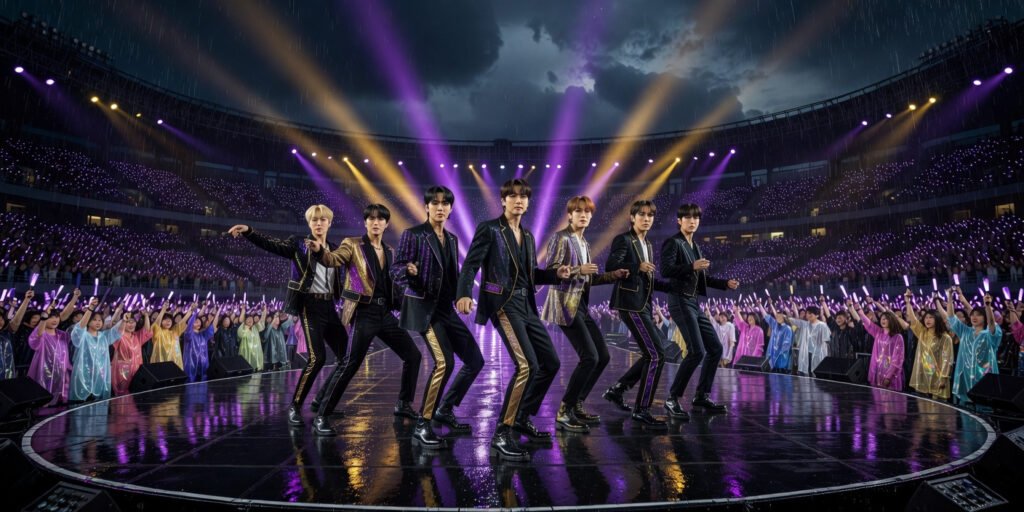
Thousands of fans, clad in purple, descended upon Goyang Stadium in South Korea on Thursday, April 9, 2026, as BTS officially kicked off their ‘Arirang’ world tour. This highly anticipated event signifies the group’s first full-scale concert series since their four-year hiatus, triggered by mandatory military service. With the release of their fifth studio album, ‘Arirang,’ earlier this spring, the seven members—RM, Jin, Suga, j-hope, Jimin, V, and Jungkook—have returned to reclaim their status as the world’s biggest boy band, transforming the stadium into a hub of global pop culture energy.
Key Highlights
- Tour Scope: The ‘Arirang’ World Tour spans 85 dates across 34 cities and 5 continents, making it the most expansive tour in the group’s history.
- Production Innovation: The tour features a groundbreaking 360-degree, in-the-round stage design, ensuring an immersive experience for all attendees.
- Comeback Momentum: The tour supports their fifth studio album, ‘Arirang,’ which topped the Billboard 200 for two consecutive weeks upon its March release.
- Economic Impact: Analysts project the tour could generate over 2.7 trillion won ($1.81 billion) in direct and indirect revenue for South Korea.
The Resurgence of BTS: A New Era for K-Pop
The air outside Goyang Stadium was thick with anticipation as rain fell, yet the spirits of the ‘ARMY’—the group’s famously dedicated fanbase—remained unbreakable. For many, this moment was not just a concert; it was the symbolic conclusion of a period of uncertainty. Since the group began their mandatory military service in 2022, the K-pop landscape has shifted, yet the void left by BTS remained largely unfilled. Their return, dubbed ‘BTS 2.0’ by industry insiders, marks a strategic evolution of their sound and performance capabilities.
Architectural Staging and Sonic Depth
One of the most notable aspects of the ‘Arirang’ tour is the scale of its ambition. The 360-degree stage setup is a direct response to the group’s desire for intimacy, even in massive stadiums. This design choice highlights a maturation in their performance art—moving away from traditional proscenium-style spectacles toward a more communal, shared experience. The setlist, which weaves together the high-energy anthems of their early years with the more introspective, genre-defying tracks from the ‘Arirang’ album, creates a narrative arc that explores their growth, their time apart, and their reunion.
Cultural Ambassadorship and National Identity
By naming their comeback album and tour ‘Arirang’—a reference to a traditional Korean folk song often regarded as an unofficial national anthem—BTS has made a profound statement. In an era where many artists lean heavily into Western-centric marketing to achieve global success, BTS is aggressively doubling down on their heritage. This choice anchors their global stardom in their national identity, effectively using their platform to introduce deep-rooted Korean cultural motifs to an international audience of millions. The tour is not just an entertainment spectacle; it is a display of soft power, reinforcing South Korea’s cultural footprint on the global stage.
The ‘ARMY’ Logistics: A Global Phenomenon
The logistics of the ‘Arirang’ tour represent a masterclass in modern event management. With tickets for North American, European, and South Korean dates selling out within hours, the ‘ARMY’ has once again demonstrated its unmatched organizing power. The ‘hunger games’ for tickets, as fans jokingly refer to the presale process, underscored the sheer disparity between demand and supply. For the Goyang kick-off, fans traveled from across the globe, with some attendees reporting flights from Australia and South America just to witness the first night. This global migration of fans creates a massive economic ripple effect in the host cities, as tourism, hospitality, and local businesses see a significant surge in activity during the tour stop.
Economic Implications: The ‘BTS Effect’ 2.0
Beyond the music, the financial implications of this tour are staggering. The Korea Culture and Tourism Institute has long tracked the ‘BTS effect,’ and this tour is expected to set new benchmarks. The ripple effects go far beyond ticket sales. Each city hosting the tour is projected to see a spike in tourism-related spending, as fans congregate for ‘purple-lit’ celebrations, pop-up stores, and themed events. Major investment firms have already projected a significant boost to HYBE’s operating profits for the fiscal year, anticipating that the total tour earnings could reach unprecedented levels in the K-pop industry.
The Future of the BTS Brand
As the tour moves from South Korea to Japan, and eventually to North America and Europe, the industry will be watching closely to see how the group handles the strain of such a grueling schedule. The 85-date itinerary is demanding, but it reflects the band’s eagerness to reconnect with their fans. This tour represents the definitive end of the ‘hiatus’ chapter and the beginning of a sustained, long-term strategy for the group. They are no longer just idols; they are cultural icons transitioning into a phase of longevity, with the ‘Arirang’ tour serving as the foundational pillar for the next several years of their career.
FAQ: People Also Ask
Q: Where does the BTS ‘Arirang’ world tour begin and end?
A: The tour kicked off on April 9, 2026, in Goyang, South Korea, and is scheduled to continue through March 2027, with the final performance currently slated for Manila, Philippines.
Q: Why is this tour considered ‘BTS 2.0’?
A: The term refers to the group’s return following the completion of their mandatory military service. The tour showcases a more mature sound, a new thematic focus on Korean heritage via the ‘Arirang’ album, and a refined performance style that emphasizes group synergy.
Q: How many dates are included in the ‘Arirang’ world tour?
A: The tour is currently scheduled for 85 performances across 34 cities in 23 countries, making it the most extensive concert tour in the band’s history.
Q: Will there be additional tour dates added later?
A: According to their label, BigHit Music, additional dates in Japan, the Middle East, and other regions are being planned for the 2027 leg of the tour, though official confirmation is pending.
Q: What is the significance of the 360-degree stage?
A: The 360-degree stage is designed to place the members in the center of the stadium, allowing them to interact more closely with fans in every section, reflecting a more intimate and inclusive concert experience compared to traditional stage setups.
More Stories
Sweet Magnolias Creator Bids Emotional Farewell After Cancellation
Lady Gaga Welcomes Daughter Rose Bean Polansky
Ranbir & Alia Launch Major 20-School Mumbai Makeover