











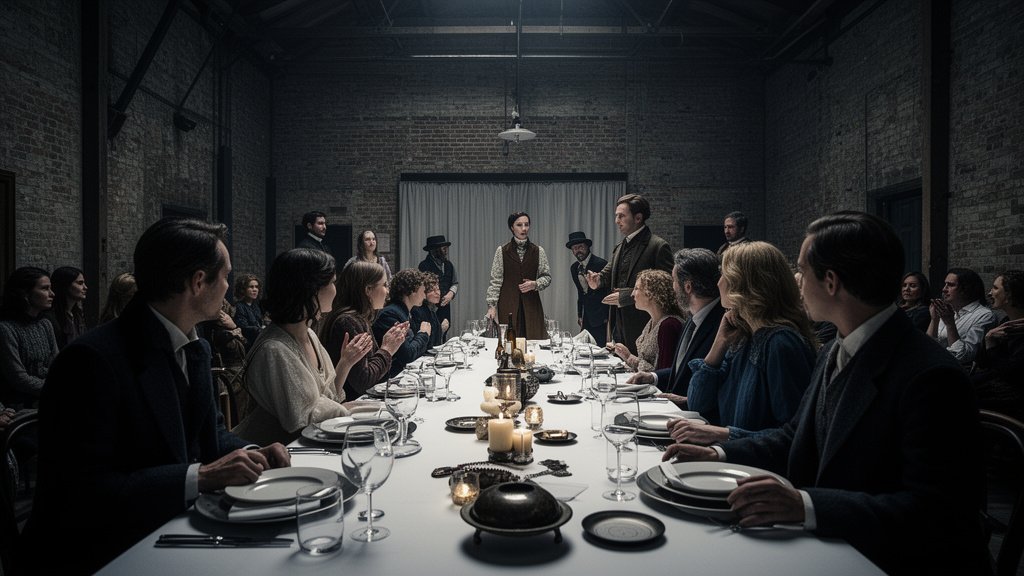
The classic board game that has baffled living rooms for generations is trading its tabletop format for a fully realized, three-dimensional reality in Charlotte. Blumenthal Arts has officially launched ‘Clue: Murder on the Menu,’ an interactive, immersive dining and mystery experience housed within the industrial-chic walls of Blume Studios. As the city continues to cement its reputation as a hub for experimental performing arts, this production represents a significant pivot from traditional theater, placing the audience directly inside the board game—and in the line of fire. Running through December 6, the production is testing the appetite of Charlotte’s cultural scene for high-concept, participant-driven entertainment.
Key Highlights
- Interactive Immersion: Unlike standard dinner theater, guests are active participants, moving through the space to interrogate characters, uncover secrets, and solve the crime.
- Venue: Hosted at Blume Studios, the Blumenthal Arts center’s dedicated space for immersive and avant-garde projects, emphasizing the company’s commitment to unconventional performance art.
- Limited Run: The experience is a strictly limited engagement, with a scheduled closing date of December 6, creating high urgency for ticket sales.
- Thematic Integration: The dining component is woven into the narrative, transforming a standard meal into a critical piece of the investigative puzzle.
The Real-World Mystery: Why Blume Studios is the Perfect Setting
The choice of Blume Studios as the host for ‘Clue: Murder on the Menu’ is no accident. As Blumenthal Arts continues to expand its footprint beyond the traditional proscenium stage of the Belk Theater, the adaptive reuse of industrial spaces has become a hallmark of their recent programming. Blume Studios, a raw, flexible venue, offers the necessary “blank canvas” required to construct the sprawling, atmospheric world of Tudor Mansion. In the context of immersive theater, the environment is not merely a background; it is a character. By utilizing a non-traditional venue, the production team can manipulate lighting, acoustics, and sightlines to create a disorienting, suspenseful environment that a standard theater could not replicate.
This shift reflects a broader trend in the performing arts industry: the movement toward the “experience economy.” Modern audiences, particularly Millennials and Gen Z, increasingly demand agency in their entertainment. They no longer want to be passive spectators; they want to influence the outcome. By adapting a familiar intellectual property (IP) like Clue, Blumenthal is leveraging a massive, pre-existing cultural nostalgia to lower the barrier to entry for this experimental format. It provides a “safe” intellectual framework for audiences to try a form of theater that might otherwise feel intimidating or alienating.
The Mechanics of the Game
For those accustomed to the static nature of a board game, the live-action translation requires a recalibration of expectations. The production functions less like a play and more like a high-stakes escape room blended with a five-course meal. Attendees are not just watching Colonel Mustard or Miss Scarlet; they are interacting with them. The script is structured to be non-linear, allowing different clusters of the audience to uncover different clues depending on their choices throughout the evening.
This necessitates a complex logistical operation. The pacing of the food service must be perfectly synchronized with the dramatic beats of the investigation. If the narrative stalls, the dinner service suffers; if the service is rushed, the mystery unravels. This delicate “dance” between front-of-house staff and actors is what defines the success of such immersive events. It requires a level of rehearsal and coordination that is significantly more rigorous than a traditional play, as there is no “fourth wall” to hide behind when a patron asks an unscripted question or disrupts a scene flow.
The Evolution of Dinner Theater
Historically, “dinner theater” has struggled with a reputation for kitsch—cheesy costumes, mediocre food, and predictable scripts. However, ‘Clue: Murder on the Menu’ is part of a deliberate industry push to shed this stigma. By pairing high-quality culinary elements with sophisticated staging, venues like Blumenthal are attempting to elevate the genre into the realm of “experiential fine dining.” This isn’t just about solving a crime; it is about the production value, the tactile nature of the props, and the craftsmanship of the environment.
Economically, this is a savvy move for Blumenthal Arts. Immersive experiences have a significantly higher price-per-ticket ceiling than traditional theater because they offer exclusivity and scarcity. With a limited run ending December 6, the scarcity principle is fully engaged, likely driving robust sales as the closing date approaches. Furthermore, by curating these events, the arts organization attracts a younger, affluent demographic that may not subscribe to traditional Broadway-touring seasons.
Future Implications for Charlotte’s Arts Scene
What does this mean for the future of Charlotte’s cultural landscape? If this production succeeds, it validates the strategy of investing in permanent “immersive-ready” venues like Blume Studios. We are likely to see a proliferation of such projects, moving away from touring roadshows and toward local, bespoke productions that cannot be seen anywhere else in the world. This “site-specific” content creation is vital for cities looking to distinguish themselves as cultural destinations rather than just regional stops for touring theater.
Moreover, the successful integration of IP—using recognizable brands like Clue—to drive ticket sales for experimental formats creates a roadmap for other arts organizations. It demonstrates that the audience is willing to embrace radical changes in the theatrical format, provided the vessel for that change is a familiar, comforting story.
FAQ: People Also Ask
Q: Is ‘Clue: Murder on the Menu’ appropriate for all ages?
A: Due to the nature of the show and the complexity of the mystery, it is generally recommended for older teens and adults. Prospective attendees should check the official Blumenthal Arts website for specific age ratings or content advisories before purchasing.
Q: Can I attend if I have specific dietary restrictions?
A: In almost all immersive dining experiences, dietary restrictions are managed at the point of ticket purchase. It is essential to communicate any allergies or dietary needs to the box office or event coordinators during the checkout process to ensure the kitchen can accommodate your needs.
Q: Will the show be extended past December 6?
A: As of current reporting, the production is scheduled to conclude on December 6. Immersive productions are heavily reliant on venue availability and actor scheduling, so extensions are rare. It is advisable to secure tickets as soon as possible.
Q: Do I need to be familiar with the board game to enjoy the experience?
A: No prior knowledge of the board game is required. The narrative is self-contained. However, those familiar with the classic characters will likely find additional layers of enjoyment in the subtle nods and “Easter eggs” planted throughout the production.
More Stories
Chris Brown Faces Sentencing in London Assault Case
Derrick Harriott, Reggae Legend and Crystal Records Pioneer, Dies at 87
Remembering Michael Gray: The ‘Shazam!’ and ‘Brady Bunch’ Icon Dies at 75