











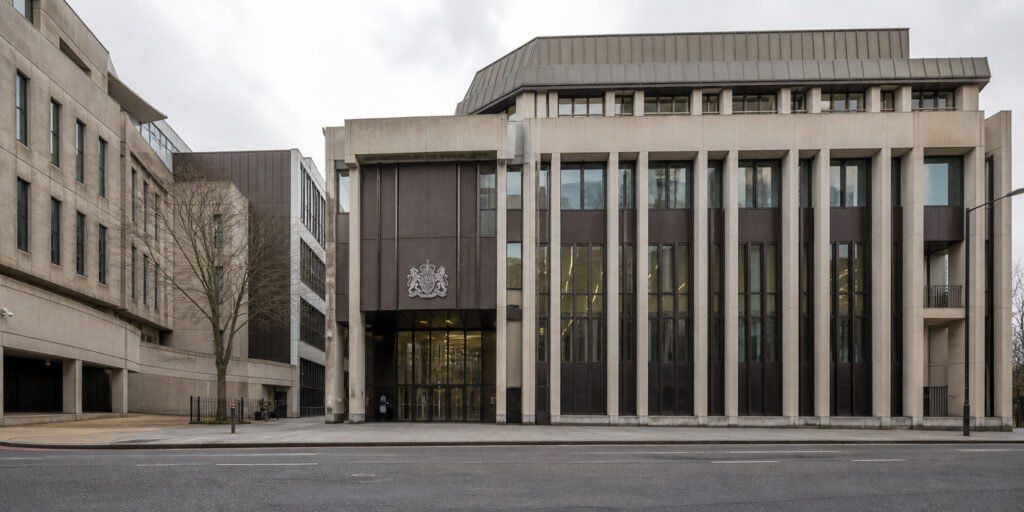
Comedian and actor Russell Brand has officially arrived at London’s Southwark Crown Court, marking the start of a closely watched trial addressing serious charges of rape and sexual assault. The legal proceedings, which have commanded significant public and media attention, are scheduled to unfold over a rigorous 10 to 12-week period as the prosecution and defense present their respective arguments before the judiciary. The arrival at the courthouse represents the culmination of a protracted investigation and sets the stage for a complex examination of evidence in one of the most prominent criminal cases in the UK’s recent entertainment history.
Key Highlights:
- Russell Brand has appeared at Southwark Crown Court for the commencement of his trial.
- The legal proceedings encompass charges of rape and sexual assault.
- The trial is structured to last between 10 and 12 weeks, reflecting the complexity of the evidentiary presentation.
- The case is being closely monitored by legal experts and the public, given the defendant’s high-profile status.
The Legal Crucible: Inside the Southwark Proceedings
The initiation of proceedings at Southwark Crown Court serves as a pivotal moment in what is expected to be an exhaustive judicial inquiry. For the next several months, the courtroom will act as a theater for the presentation of legal arguments, witness testimonies, and the rigorous testing of facts. The 10 to 12-week timeline provided by the court is a significant indicator of the case’s scope, suggesting a methodical approach to evaluating the allegations brought against Mr. Brand.
The Anatomy of a High-Profile Trial
When a public figure of Russell Brand’s stature faces criminal prosecution, the logistical and procedural demands on the court are substantial. Southwark Crown Court, a facility accustomed to handling serious criminal matters, must balance the necessity of an open, fair trial with the inevitable circus of public and media interest that accompanies such figures. The legal process here involves a deliberate sequence: the opening of the case, the presentation of evidence by the Crown, the defense’s response, and the eventual deliberation by the jury. This structure ensures that regardless of public sentiment or previous media coverage, the verdict is reached based strictly on the evidence presented within the four walls of the courtroom. The length of the trial—10 to 12 weeks—allows for this depth of examination, ensuring that no stone is left unturned.
The Mechanics of the Prosecution
At the heart of the proceedings are the specific charges of rape and sexual assault. Under UK law, the burden of proof rests heavily on the prosecution to establish guilt beyond a reasonable doubt. The upcoming weeks will see a meticulous review of witness statements, digital evidence, and perhaps historical context that predates the charges. Legal analysts suggest that the prosecution’s challenge lies in presenting a cohesive narrative that aligns with the rigid requirements of the Sexual Offences Act. Conversely, the defense team is expected to focus on the credibility of the accusations and the strength of the corroborating evidence. This binary dynamic—prosecution versus defense—is the engine of the criminal justice system, and it will be functioning at full capacity throughout this lengthy trial.
Media Dynamics and Public Interest
It is impossible to ignore the context in which this trial is occurring. Russell Brand’s transition from a household name in comedy to a polarizing figure has generated intense public discourse. However, the courtroom operates in a sphere largely insulated from the “court of public opinion.” Judges and juries in the UK legal system are rigorously instructed to ignore external narratives, social media commentary, and past characterizations. The challenge for the defense and the prosecution alike is to navigate the inherent bias that potential jurors might hold. The selection process and the continuous monitoring of the trial environment are essential to ensuring that the focus remains entirely on the alleged offenses rather than the celebrity status of the accused.
Procedural Integrity and Judicial Rigor
Ultimately, the trial represents the endurance of the UK’s judicial system. Regardless of the public perception of the defendant, the trial is a fundamental demonstration of the right to due process. The 12-week duration is a testament to the court’s commitment to fairness; such a timeframe ensures that complex testimonies can be heard, cross-examined, and assessed without the pressure of haste. For the legal system, this trial is not about the personality of Russell Brand; it is about the adjudication of serious allegations through established, democratic, and transparent legal channels. The outcome will set a precedent for how the judiciary handles high-visibility cases involving sexual misconduct in an era of heightened awareness and scrutiny.
FAQ: People Also Ask
1. Q: How long is the Russell Brand trial expected to last?
A: The trial is scheduled to take place over a period of 10 to 12 weeks, reflecting the complexity and the volume of evidence involved in the case.
2. Q: Where is the trial being held?
A: The trial is being held at Southwark Crown Court in London, a prominent venue for serious criminal proceedings in the United Kingdom.
3. Q: What are the primary charges in this case?
A: The case involves serious charges of rape and sexual assault. The trial will focus exclusively on evidence related to these specific allegations.
4. Q: How does the legal system ensure a fair trial for a high-profile defendant?
A: The UK judicial system employs strict procedures, including the selection of an impartial jury, instructions to ignore media coverage, and a rigorous presentation of evidence, all overseen by a judge to ensure that due process is upheld regardless of the defendant’s fame.
More Stories
Chris Brown Faces Sentencing in London Assault Case
Derrick Harriott, Reggae Legend and Crystal Records Pioneer, Dies at 87
Remembering Michael Gray: The ‘Shazam!’ and ‘Brady Bunch’ Icon Dies at 75