











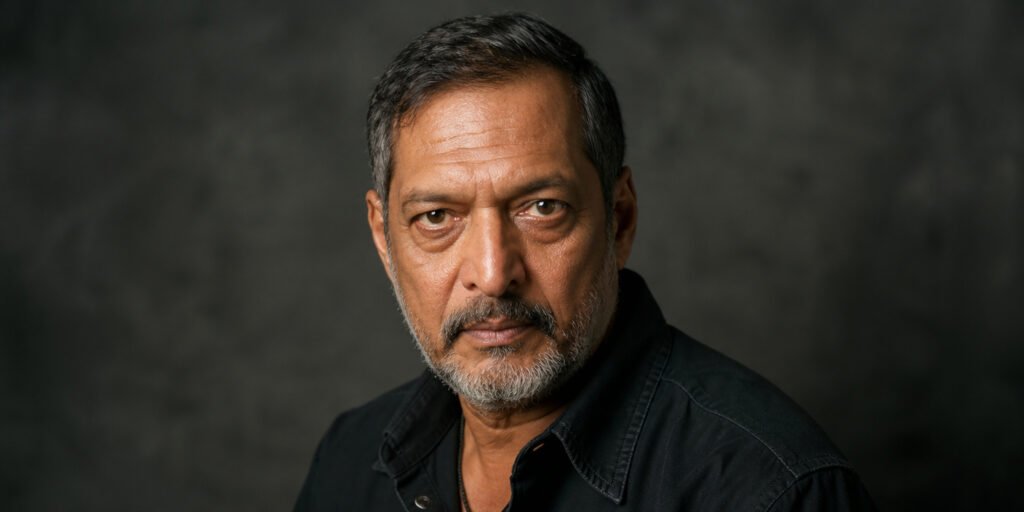
In a profound loss for the landscape of Indian cinema, the celebrated actor and filmmaker Nana Patekar has passed away at his residence in Goa, India, at the age of 75. The news, confirmed earlier today, marks the end of an era for an artist whose career was defined by raw, unfiltered intensity and a masterclass in method acting that resonated across generations.
Key Highlights
- Passing: Nana Patekar died at his home in Goa, India, at the age of 75.
- Cause: Preliminary reports indicate the cause of death as suspected cardiac arrest.
- Legacy: Celebrated for his transformative performances in both Marathi and Hindi cinema, spanning over four decades.
- Artistic Impact: Known for his unique ‘Patekar style’—a blend of simmering, controlled aggression and profound emotional vulnerability.
- Recognition: A multi-time National Film Award winner, recognized for his contributions as both an actor and a director.
The Unrivaled Intensity: A Retrospective of a Cinematic Titan
The passing of Nana Patekar leaves a chasm in the Indian entertainment industry that few can hope to fill. Born into a world of humble beginnings, Patekar did not merely act; he inhabited his characters with a frightening, almost visceral authenticity. From his early days in Marathi experimental theater to his ascent as a pan-Indian superstar, his journey was defined by a rejection of the superficial. He was an actor who thrived in the spaces between lines—in the twitch of a facial muscle, the modulation of a whisper, or the sudden eruption of righteous fury.
Redefining Method Acting in Indian Cinema
For decades, the Indian film industry often leaned toward stylized, melodramatic portrayals. Nana Patekar, however, became the architect of a new, gritty realism. When he burst onto the national scene with films like ‘Parinda’ (1989), audiences were introduced to an actor who brought a terrifying unpredictability to the screen. His role as the menacing yet complex Anna in ‘Parinda’ didn’t just earn him accolades; it fundamentally changed how villainy and complex anti-heroes were portrayed in mainstream Bollywood.
He did not rely on the vanity often associated with stardom. Instead, Patekar wore his characters’ scars—both literal and metaphorical—with a sense of grim ownership. His voice, often described as gravelly and hypnotic, became one of his most powerful tools, capable of delivering a punchline with dry wit or a monologue with heart-wrenching gravitas. He was, in every sense, a purist.
The Director’s Eye and Cross-Regional Dominance
While his acting garnered the most headlines, Patekar’s work behind the camera solidified his status as an auteur. His directorial debut, ‘Prahaar: The Final Attack’ (1991), was not just a commercial success; it was a gritty, uncompromising look at military discipline and societal apathy. It showcased a filmmaker who was unafraid to tackle uncomfortable truths. This duality—the ability to act in mass-market hits and direct thoughtful, socially conscious narratives—allowed him to bridge the often-fragmented gap between commercial Hindi cinema and intellectual regional cinema.
He moved fluidly between the Marathi film industry, his cultural bedrock, and the sprawling Hindi film industry. He was one of the few actors who commanded the same level of respect in the local theater circles of Mumbai as he did on the red carpets of global film festivals. This cross-regional dominance provided him with a unique vantage point, allowing him to weave local cultural nuances into stories that possessed universal appeal.
Humanitarian Commitment Beyond the Silver Screen
Perhaps less discussed but equally significant was Patekar’s commitment to social causes. He was not a celebrity who merely lent his face to charity; he was an active participant in grassroots movements, particularly in rural Maharashtra. His work regarding drought relief and the plight of farmers reflected a deep-seated empathy that was often masked by his onscreen persona of the ‘angry man.’ He used his celebrity not as a pedestal, but as a lever to elevate the voices of the marginalized, demonstrating a quiet, persistent philanthropy that defined his later years.
A Nation in Mourning: The Cultural Vacuum
The outpouring of grief from the film fraternity is not merely a courtesy; it is a recognition of the loss of an institution. Directors, co-stars, and fans have flooded social media with tributes, reflecting on his mentorship and his uncompromising standards. In an industry often accused of being ephemeral, Nana Patekar’s body of work stands as a monolith of consistency. He leaves behind a legacy of integrity, having navigated the high-pressure environment of show business without ever diluting his artistic convictions. As Indian cinema moves forward, the silence left by his absence will be palpable, a reminder of the man who showed that true power onscreen comes from the truth found within.
FAQ: People Also Ask
What was the primary cause of Nana Patekar’s death?
The primary reported cause of death for Nana Patekar is a suspected cardiac arrest, which occurred at his residence in Goa.
For which films is Nana Patekar most remembered?
While his filmography is extensive, he is most iconically remembered for his performances in ‘Parinda,’ ‘Krantiveer,’ ‘Agni Sakshi,’ and his directorial work in ‘Prahaar.’
Did Nana Patekar receive any major national awards?
Yes, Nana Patekar is a decorated artist who won multiple National Film Awards throughout his career, recognizing his exceptional talent in both acting and directing.
Will there be a public memorial?
Details regarding funeral arrangements and public memorials are currently being coordinated by the family, and announcements are expected to follow in the coming days.
More Stories
Chris Brown Faces Sentencing in London Assault Case
Derrick Harriott, Reggae Legend and Crystal Records Pioneer, Dies at 87
Remembering Michael Gray: The ‘Shazam!’ and ‘Brady Bunch’ Icon Dies at 75