











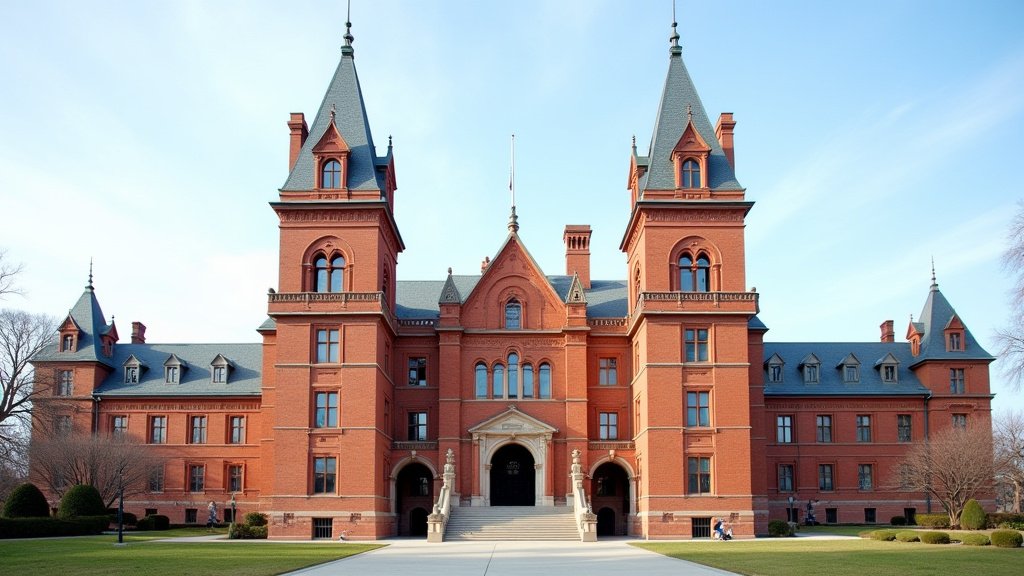
In a decisive move to protect the nation’s premier cultural repository, the American Alliance of Museums (AAM) has formally condemned the sustained criticism and policy actions directed at the Smithsonian Institution by the Trump administration. This public intervention marks a significant escalation in the ongoing dialogue regarding the independence of federal cultural institutions, as the AAM explicitly cited the risks these pressures pose to the Smithsonian’s foundational institutional integrity.
Key Highlights
- Formal Condemnation: The American Alliance of Museums has issued a clear rebuke of the recent political rhetoric and policy threats directed at the Smithsonian.
- Institutional Integrity: The AAM emphasizes that the Smithsonian’s status as a non-partisan, educational entity is being compromised by outside political actors.
- Broad Sector Impact: This dispute is not isolated to the Smithsonian; it signals a wider tension between government administrations and federal cultural institutions regarding their research and curation mandates.
- Operational Risks: Concerns remain that continued administrative pressure could influence federal funding, staff morale, and public trust in the institution’s historical accuracy.
Safeguarding the Smithsonian: A Stand for Cultural Autonomy
The American Alliance of Museums, acting as the primary advocate for the nation’s museum community, has drawn a firm line in the sand. By challenging the Trump administration’s approach, the AAM is not merely defending a singular museum group; it is defending the established doctrine that federal cultural institutions must remain insulated from the shifting winds of electoral politics.
The Anatomy of the Conflict
The Smithsonian Institution, currently led by Secretary Lonnie G. Bunch III, operates as both a research center and a public museum complex, funded in large part by the federal government but governed by an independent Board of Regents. The friction arises from the administration’s specific critiques of museum programming, which they argue has drifted into political bias. Conversely, the AAM and other cultural watchdogs argue that the Smithsonian’s mission—to increase and diffuse knowledge—requires the examination of difficult, and often contested, American histories. When a presidential administration uses its platform to challenge the factual integrity of these exhibits, it creates a ‘chilling effect’ that can discourage researchers and curators from tackling sensitive topics for fear of political reprisal.
The Financial and Reputational Stakes
Beyond the philosophical arguments of autonomy, there is a tangible threat to the Smithsonian’s fiscal health. While a significant portion of its budget is provided by congressional appropriations, the institution also relies heavily on private philanthropy. Donors and sponsors are traditionally risk-averse; they tend to retreat when an institution becomes the target of a high-profile political firestorm. The AAM’s intervention serves as a stabilizing signal to the philanthropic sector, aiming to reassure donors that the Smithsonian remains committed to its mission and is being unjustly targeted by external actors.
Navigating the Politicization of History
One of the most concerning aspects of this clash is the increasing trend toward the politicization of historical narrative. In the view of the AAM, history is an academic discipline rooted in rigorous methodology, not a tool for partisan messaging. The pressure exerted on the Smithsonian acts as an attempt to enforce a particular ideological viewpoint on a collection of museums that are intended to serve the entire American public. By standing with the Smithsonian, the AAM is reinforcing the necessity of academic freedom—a principle that is arguably just as important for a museum as it is for a university.
Historical Precedents and Future Predictions
Historically, the Smithsonian has navigated various administrations with differing views on how the nation’s history should be presented. However, the current intensity of rhetoric represents a departure from previous norms. Looking forward, the resolution of this conflict will likely set a precedent for how federal institutions interact with future executive branches. If the Smithsonian successfully withstands this pressure, it will confirm the durability of its independent governance structure. If, however, the institution is forced to alter its programming or policies in direct response to political threats, it could signal a long-term erosion of the wall that separates administrative power from cultural education.
FAQ: People Also Ask
1. Why is the American Alliance of Museums involved in this dispute?
As the national organization representing museums of all types, the AAM is the primary body responsible for upholding professional standards and defending the collective interests of the museum field. Defending the Smithsonian against external political pressure is a core aspect of protecting the autonomy of all museums in the United States.
2. What are the specific ‘institutional integrity’ risks mentioned?
The risks include potential self-censorship by staff, a decline in public trust due to claims of partisan bias, and the long-term threat to federal budget appropriations being used as political leverage to dictate programming content.
3. Is the Smithsonian solely controlled by the Trump administration?
No. The Smithsonian is an independent federal trust instrument, governed by a Board of Regents that includes the Chief Justice of the United States, the Vice President, and members of Congress, alongside private citizen regents. It was specifically designed to be distinct from the executive branch to prevent direct political interference.
More Stories
Lowriding’s Rise: SF Celebrates Cruising Culture
U.S. Repatriates 64 Cultural Relics and Fossils to China
Betting on Viral Fame: Novig’s Strategic Use of Sydney Sweeney