











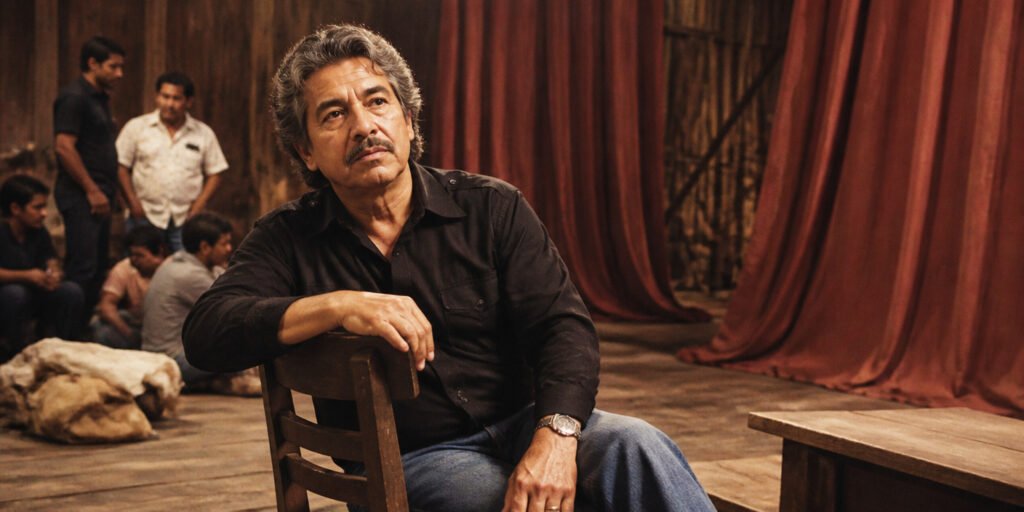
The narrative of 20th-century American arts has long been curated by a specific, narrow lens—one that often relegates the contributions of Chicano culture to the periphery. A new documentary, American Pachuco, directed by David Alvarado, shatters this exclusion by chronicling the career and profound cultural impact of Luis Valdez. From his roots as the child of migrant farmworkers to his ascent as a groundbreaking playwright and filmmaker, Valdez’s life is not merely a biography; it is a testament to the struggle for visibility in an industry historically resistant to non-white narratives. By examining his work, Alvarado’s film poses a crucial question: Why has such a titanic figure, responsible for shaping the American cultural landscape, been consistently treated as a footnote rather than a pillar?
Key Highlights
Founder of a Movement: Luis Valdez founded El Teatro Campesino* in 1965, creating the first theater company to support the United Farm Workers (UFW) and the Delano grape strike.
Hollywood Disruption: Valdez brought Chicano stories to the mainstream with the smash-hit play and film Zoot Suit (1981) and the cinematic success La Bamba* (1987).
- The ‘Pachuco’ Context: The documentary centers on the ‘Pachuco’ subculture—the 1940s Mexican-American youth movement—using it as a metaphor for the struggle for identity and respect in America.
- The Archival Challenge: The film critically analyzes the systematic ‘siloing’ of Chicano art, which prevents it from being recognized as core ‘American’ history, despite its deep influence on the theatrical and filmic arts.
The Genesis of a Cultural Revolution
To understand Luis Valdez, one must understand the fields of Delano, California, where he spent his youth. Born in 1940 to migrant farmworkers, Valdez did not initially seek the spotlight of Hollywood; he sought the power of the picket line. In 1965, he founded El Teatro Campesino (The Farmworker’s Theater). This was not high-brow art intended for the elite; it was agitprop—a tool for labor organizing. Valdez utilized the ‘acto’ (a short, satirical skit) to educate and motivate farmworkers, turning the struggles of the United Farm Workers (UFW) into powerful, communal performances.
This early period is where the documentary American Pachuco finds its deepest resonance. Alvarado illustrates that Valdez’s genius lay in his ability to blend ancient Aztec symbolism with contemporary political reality. He wasn’t just performing for farmworkers; he was constructing a new American mythology, one where the laborer was the hero. This foundation is essential to understanding why he became a force to be reckoned with: his art was never ornamental; it was functional, revolutionary, and deeply grounded in the American soil.
Hollywood and the High Cost of Being ‘Chicano’
By the late 1970s and 1980s, Valdez had successfully bridged the gap from the picket line to the professional stage and screen. His play Zoot Suit, based on the 1943 Sleepy Lagoon murder trial and the subsequent Zoot Suit Riots, became a sensation. When it moved to the Mark Taper Forum and then Broadway, it defied the skepticism of critics who insisted that a play about Mexican-American history in Los Angeles wouldn’t resonate with ‘mainstream’ audiences. It did, and it paved the way for La Bamba, the 1987 biographical film about rock-and-roll legend Ritchie Valens.
La Bamba was a watershed moment in American cinema. It proved, in undeniable box-office numbers, that a film centered entirely on a Mexican-American experience could be a global blockbuster. Yet, the documentary American Pachuco highlights a darker, secondary reality: the industry’s tendency to categorize such works as ‘Latinx Cinema’ or ‘Chicano Studies’ rather than ‘American Cinema.’ This ghettoization, as critics and the documentary suggest, has historically served to keep Valdez in a box, limiting his perceived legacy to a cultural niche rather than recognizing him as a foundational architect of American culture. The film argues that this ‘fight to be seen’ is not just about Valdez; it is about the structural resistance within arts institutions to integrate non-Western-European narratives into the core canon.
The Archive of Resistance: Why Recognition Fades
One of the most compelling aspects of Alvarado’s film is the exploration of memory and archiving. As years pass, the specific urgency of social movements often fades, and cultural figures like Valdez—who never chased mainstream celebrity for its own sake—can risk being obscured by the passage of time.
Economic impact is a key secondary angle explored in the film. Valdez’s work created massive value in the industry, yet the institutional support systems that maintain the reputations of his contemporaries (often white, male auteurs) were never extended to him with the same rigor. American Pachuco serves as an act of archival resistance, re-contextualizing his filmography and playwriting not as ‘alternative’ theater, but as essential American history.
By highlighting his collaborations with figures like Cesar Chavez and his influence on younger generations of directors, the documentary makes a bold claim: the American theatrical canon is incomplete without the inclusion of Luis Valdez. He did not just represent a demographic; he evolved the art form, blending performance art, agitprop, and Hollywood narrative structures. The ‘long fight to be seen’ is, ultimately, a fight for the integrity of the American story itself—a story that cannot be fully told without the Zoot Suiters, the farmworkers, and the visionaries like Valdez who gave them a voice.
FAQ: People Also Ask
Q: What is the significance of the term ‘Pachuco’ in the documentary?
A: ‘Pachuco’ refers to the 1940s Mexican-American youth subculture known for their distinctive fashion (zoot suits) and defiance against social norms. In the documentary, the term is used as a metaphor for the struggle for identity and the fight against societal marginalization that Valdez has faced throughout his career.
Q: Is ‘American Pachuco’ a traditional biopic?
A: No. While it covers Luis Valdez’s life, it functions more as an analytical documentary that juxtaposes his artistic career against the broader, often exclusionary history of American entertainment, focusing on the systemic reasons for his under-recognition.
Q: How did Luis Valdez influence American theater history?
A: Valdez is widely credited as the father of Chicano theater. By founding El Teatro Campesino and utilizing the ‘acto’ format, he fundamentally changed how social issues are addressed in live performance, bridging the gap between community activism and professional theater.
Q: Where can viewers see the impact of Luis Valdez’s work today?
A: His influence can be seen across contemporary American theater and film, from the rise of activist playwrights who use theater for social change, to the success of mainstream films portraying Latinx experiences, a path he carved during the 1980s with La Bamba.
More Stories
Lowriding’s Rise: SF Celebrates Cruising Culture
U.S. Repatriates 64 Cultural Relics and Fossils to China
Betting on Viral Fame: Novig’s Strategic Use of Sydney Sweeney