











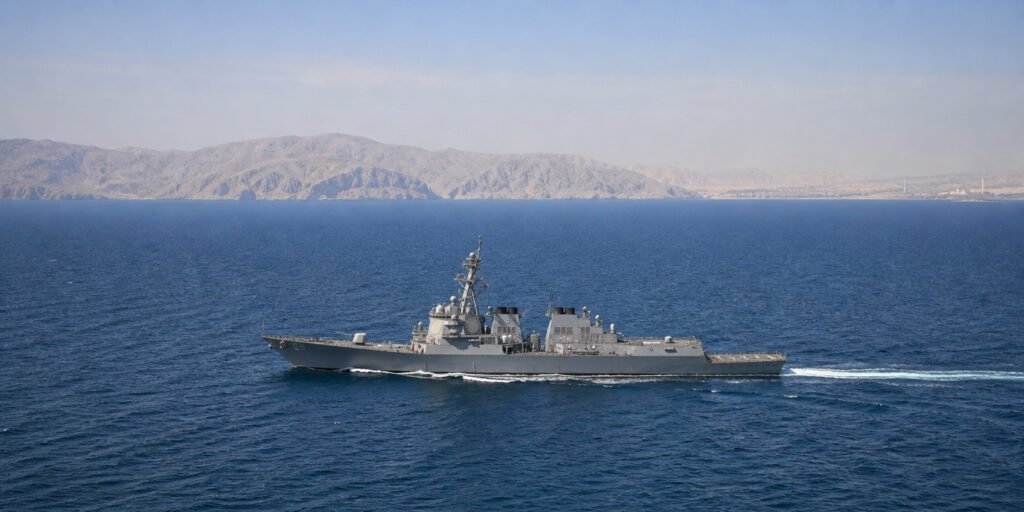
President Trump has officially confirmed that United States military forces are conducting a series of ‘large and powerful’ strikes against Iranian targets in the vicinity of the Strait of Hormuz. The military operation, which marks a significant escalation in regional tensions, comes in direct response to a recent missile attack on a US military base in Jordan and an attempted mining operation targeting international shipping lanes within the critical maritime corridor. The administration has coupled this military offensive with a vow to intensify economic pressure on the regime, signaling a two-pronged strategy aimed at curbing Iranian aggression in the Persian Gulf.
Key Highlights
- Direct Retaliation: The strikes were explicitly ordered following a lethal missile attack on a US military installation in Jordan, which resulted in American casualties and crossed a key red line for the administration.
- Maritime Security: The military action addresses the attempted mining of the Strait of Hormuz, a vital energy chokepoint through which approximately 20-30% of the world’s petroleum consumption flows daily.
- Dual-Track Strategy: Alongside kinetic military operations, the administration is preparing a new suite of aggressive economic sanctions to isolate the Iranian regime further.
- Strategic Deterrence: Officials have characterized the strikes as ‘large and powerful,’ intended to degrade Iranian military capabilities specifically involved in anti-access and area-denial (A2/AD) operations in the Gulf.
Escalation in the Gulf: Assessing the Strategic Shift
The Catalyst: From Jordan to the Strait
The current military engagement is not a sudden development but the culmination of a rapidly deteriorating security environment. The missile attack on the US base in Jordan served as the primary catalyst, compelling the administration to abandon the policy of restraint that had characterized the preceding months. By targeting a US military installation—a sovereign site hosting American personnel—the Iranian-aligned forces responsible for the strike fundamentally altered the rules of engagement. This was not merely a local skirmish but a direct challenge to the US military footprint in the Middle East, necessitating a kinetic response that would be perceived by Tehran as credible and overwhelming.
Simultaneously, the situation in the Strait of Hormuz has reached a boiling point. The attempted mining of the strait represents a strategic escalation that threatens the global economy. The Strait of Hormuz is the world’s most important oil chokepoint, and any attempt to disrupt transit through these narrow waters is viewed by the international community as an act of economic warfare. By targeting Iranian assets involved in these mining operations, the US is attempting to degrade the Islamic Revolutionary Guard Corps’ (IRGC) naval capability to hold global energy supplies hostage.
The Strategic Chokepoint: Why Hormuz Matters
The Strait of Hormuz is narrow, with a shipping lane only two miles wide in either direction for inbound and outbound tanker traffic. This geographic bottleneck makes it exceptionally vulnerable to asymmetric tactics, such as the use of fast-attack craft, anti-ship missiles, and sea mines. The administration’s decision to strike near the strait is a clear message of ‘freedom of navigation’ enforcement.
Historically, the US has maintained a significant naval presence in the Fifth Fleet area of operations precisely to prevent such blockades. However, the current strategy reflects a shift from passive monitoring to active suppression of threats. By engaging targets near the strait, the US is attempting to push back against the IRGC’s ‘gray zone’ tactics—actions that fall below the threshold of declared war but cause significant operational friction. The ‘large and powerful’ nature of these strikes suggests that the goal is not merely to deter future attacks but to physically dismantle the infrastructure currently being used to project power in this corridor.
Economic Warfare: The Second Front
The kinetic strikes are only one half of the administration’s response. Parallel to the naval and air operations, there is an aggressive push to ramp up economic sanctions. The objective here is to drain the financial resources that fuel the IRGC’s operations. The administration is reportedly targeting specific entities involved in the financing of missile proliferation and the facilitation of illegal oil exports, which serve as the primary revenue streams for the Iranian military establishment.
This strategy is designed to create a cumulative effect: military strikes degrade the regime’s ability to project power, while economic sanctions degrade its capacity to pay for that power. This dual approach is intended to force a strategic retreat by the Iranian leadership, essentially raising the cost of their provocations to an unsustainable level. The effectiveness of this policy will depend heavily on the willingness of regional allies to align with these sanctions and the global markets’ resilience to potential disruptions in oil flow.
Geopolitical Ripples and Future Risks
The long-term implications of these strikes are profound. By engaging in direct military action near the Strait, the US has inserted itself into the heart of regional power dynamics. While the immediate goal is deterrence, the risk of escalation remains high. Iranian doctrine often relies on asymmetrical responses—not necessarily a direct symmetric war, but the activation of proxy networks across the region, including in Iraq, Syria, Lebanon, and Yemen.
Furthermore, the reaction of global energy markets will be a primary concern. Even the threat of sustained conflict in the Strait of Hormuz can send shockwaves through crude oil futures. If the strikes lead to a temporary closure or a significant disruption in tanker traffic, the global economy could face immediate inflationary pressure. Consequently, the administration must balance the necessity of defending its assets and international law with the requirement to keep the global energy artery open. The coming weeks will likely see a period of high-intensity diplomatic signaling, where the US attempts to contain the conflict while maintaining the upper hand in the current escalation cycle.
FAQ: People Also Ask
Q: How will these strikes impact global oil prices?
A: Oil markets are highly sensitive to disruptions in the Strait of Hormuz. While the strikes are intended to protect the flow of oil, the uncertainty of military conflict in the region typically causes a risk premium to be added to prices, leading to immediate market volatility.
Q: Is this the beginning of a broader war with Iran?
A: Administration officials have characterized these strikes as ‘retaliatory’ and ‘deterrent’ rather than an act of war intended to overthrow the regime. However, the risk of escalation is significant, and the ultimate outcome depends on how Tehran chooses to respond to these specific military actions.
Q: Why was the base in Jordan targeted?
A: The attack on the base in Jordan, which hosts US personnel, was a significant escalation in the ongoing shadow war. It was seen as a deliberate attempt by Iranian-backed militias to force the US to withdraw its presence from the region by making the cost of staying too high.
Q: What is the significance of the ‘attempted mining’ of the Strait?
A: Mining the Strait of Hormuz is a classic A2/AD (Anti-Access/Area Denial) tactic. It is designed to close the chokepoint without needing a traditional navy, forcing international ships to stop and endangering global energy security.
More Stories
Costco Goes Nationwide on Uber Eats: A New Era for Bulk Delivery
Elena Rybakina Wins US Open, Ascends to World No. 1
Rubio Seals Security Pacts; Vance Drives Policy Agenda