











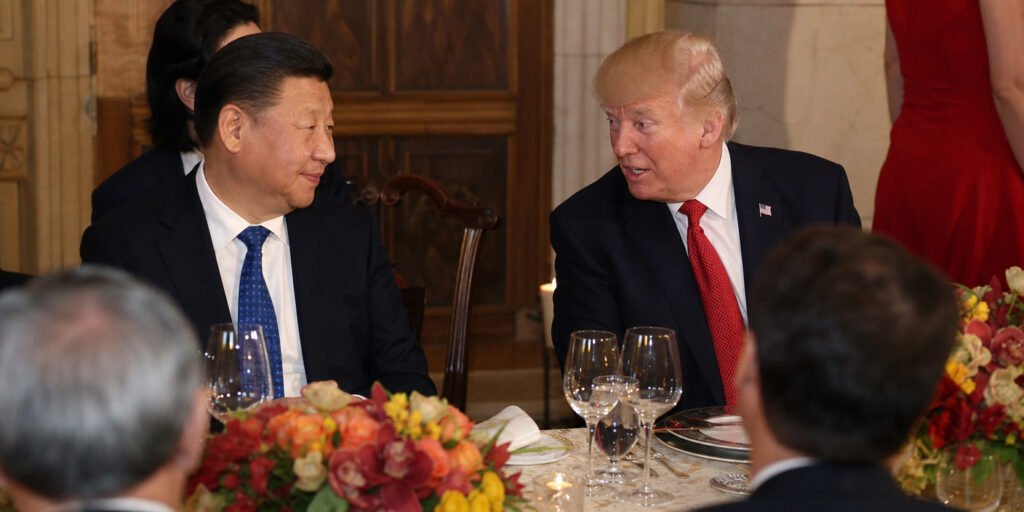
U.S. President Donald Trump and Chinese President Xi Jinping have solidified a renewed commitment to diplomatic stability at a White House state dinner, announcing an immediate extension of the existing trade truce to foster bilateral economic cooperation. This pivotal meeting marks a significant recalibration in U.S.-China relations, as both leaders moved to de-escalate tensions and prioritize mutual market stability.
Key Highlights
- Diplomatic Warming: A high-profile White House state dinner served as the backdrop for a formal declaration of “New Era” cooperation.
- Trade Truce Extended: Both administrations have officially agreed to extend the current trade truce, providing a critical buffer for global markets.
- Strategic Pivot: The dialogue emphasized bilateral economic integration over conflict, signaling a move toward reduced tariff volatility.
- Bilateral Commitment: President Trump and President Xi Jinping underscored the importance of stronger ties to maintain global supply chain integrity.
A New Era of Economic Cooperation: Beyond the Rhetoric
The atmosphere at the White House state dinner represented more than mere ceremonial pleasantries; it signaled a calculated shift in the trajectory of the world’s two largest economies. For years, the U.S.-China relationship has been characterized by tariff disputes, technological protectionism, and rhetorical fire. However, the announcement of an extended trade truce serves as an immediate, concrete stabilizer for global commerce. By choosing this high-level forum to address economic friction, the administrations of Trump and Xi have signaled to global investors that the era of erratic trade escalation may be transitioning into a phase of managed competition.
The Mechanics of the Truce Extension
At the core of the agreement is the extension of the trade truce, a mechanism that effectively puts a pause on the implementation of new, punitive tariffs that have historically plagued market sentiment. Economists note that this “cooling-off” period is essential for businesses that have been operating under the shadow of uncertainty. For multinational corporations relying on cross-border supply chains, this truce offers the predictability needed to invest in capital projects and long-term expansion.
This decision is not merely about holding the status quo; it is about providing the necessary breathing room for more granular negotiations. By freezing tariff hostilities, the U.S. and Chinese delegations have cleared the path to discuss more complex issues, such as intellectual property protections, technology transfers, and the structural imbalances that initially fueled the trade wars. The extension is widely viewed as a strategic win for both parties, allowing President Trump to secure a victory for American exporters while providing President Xi with the stability required to manage internal economic pressures.
Diplomatic Protocol as an Economic Tool
State dinners have historically served as the pinnacle of “soft power” diplomacy. The choreography of this event—from the guest list to the formal toasts—was clearly engineered to project an image of parity and respect. In the high-stakes world of international relations, the optics of such a dinner are often as vital as the policy outcomes. By hosting President Xi with the full weight of presidential hospitality, the Trump administration signaled a willingness to treat China as a peer in a competitive global arena rather than an adversary in an existential struggle.
This “New Era” of cooperation is predicated on the understanding that economic decoupling is neither feasible nor desirable in the current global climate. The dinner allowed both leaders to establish a rapport that could potentially bypass the bureaucratic inertia that often stalls trade negotiations. As global supply chains continue to recover from the shocks of the past decade, the stability offered by this truce provides a foundational layer of security that will likely be reflected in market performance and corporate earnings reports over the coming quarters.
Future-Proofing Global Supply Chains
Looking ahead, the extension of the trade truce is only the first step in a broader strategy to recalibrate the U.S.-China economic relationship. Analysts are now closely watching for follow-up measures, including potential joint task forces aimed at addressing digital trade, agricultural exports, and sustainable manufacturing practices. The challenge for both administrations remains balancing national security concerns with the realities of an interconnected global economy. However, if this state dinner is any indicator, the path forward appears to be one of managed dialogue.
The impact of this decision will likely be felt far beyond Washington and Beijing. As commodity prices stabilize and investor confidence in tech-sector manufacturing grows, the global economy may see a sustained period of reduced volatility. This development underscores the reality that while geopolitical competition is inevitable, it need not result in self-defeating economic isolation. By choosing to extend the trade truce, Trump and Xi have demonstrated a pragmatic recognition of their interdependence, setting a tone for bilateral relations that prioritizes economic durability over short-term political posturing.
FAQ: People Also Ask
What does the extension of the trade truce practically mean for businesses?
It means that the threat of sudden, unexpected tariff increases has been neutralized for the immediate future. Businesses can proceed with supply chain planning and inventory management without the imminent fear of retaliatory duties, leading to greater stability in cost structures.
How does this “New Era” of cooperation differ from previous diplomatic attempts?
Unlike past attempts that focused largely on addressing surface-level trade deficits, this “New Era” approach, as signaled at the state dinner, focuses on the institutional framework of the U.S.-China relationship. It implies a deeper, more sustained dialogue aimed at long-term systemic stability rather than short-term concessions.
What are the primary economic benefits expected from this truce?
Key benefits include reduced inflationary pressure on imported goods, stabilized stock market indices, and a more favorable environment for foreign direct investment (FDI). Both the U.S. and Chinese markets rely on this stability to maintain growth in the technology and agricultural sectors.
Does this agreement end the geopolitical rivalry between the U.S. and China?
No. The agreement addresses trade friction and economic cooperation. It does not resolve fundamental geopolitical differences regarding security, sovereignty, or regional influence. It is a tactical “de-escalation” of the economic front, not a comprehensive resolution of all bilateral tensions.
More Stories
Global Election Tensions: Legal Battles in CA, High Stakes in Brazil
US Envoy Witkoff Labels Putin ‘Humanitarian’ in Peace Push
Toledo Hazmat Crisis: Mass Evacuations Ordered for North Side