











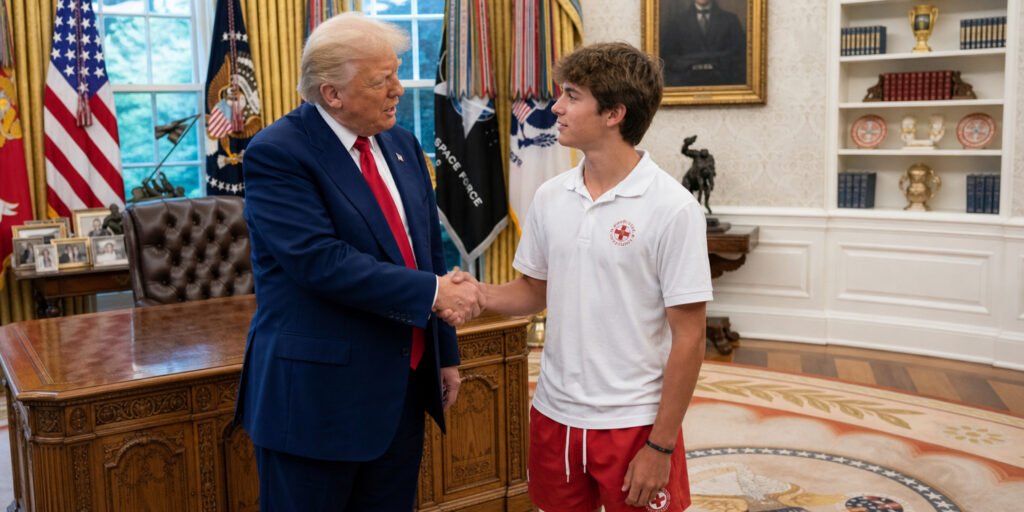
In a display of presidential recognition that transcended typical political discourse, President Donald Trump welcomed a young hero to the White House to celebrate a remarkable act of bravery. The event centered on the courageous actions of 16-year-old Alex Stabile, a junior lifeguard whose quick thinking at the Huntington Beach coast saved 10-year-old Isaac Hernandez from drowning. The encounter served as a poignant reminder of the power of individual initiative and the public recognition of civilian heroism.
Key Highlights
- The Rescue: Alex Stabile, aged 16 at the time, successfully rescued 10-year-old Isaac Hernandez after the boy was swept into distress at Huntington Beach, California.
- The White House Meeting: President Trump hosted both the lifeguard and the young survivor in the Oval Office to formally recognize the teenager’s life-saving intervention.
- The Presidential Quote: During the interaction, President Trump famously remarked to the young lifeguard, “I don’t know if I’d do it,” acknowledging the immense bravery required to dive into the ocean to save a stranger.
- Symbolic Importance: The visit highlighted the tradition of the presidency platforming individual acts of community service and courage to foster national unity.
The Intersection of Bravery and Governance
The story of Alex Stabile and Isaac Hernandez represents a quintessential American narrative—the triumph of individual courage in the face of sudden crisis. When a 16-year-old lifeguard, acting with the training and instinct honed by his local program, entered the treacherous waters of Huntington Beach, he was not thinking of accolades or political recognition. He was executing a rescue protocol that has become the hallmark of California’s legendary lifeguard culture. The rescue, which took place in the summer of 2017, quickly went viral, drawing attention to the often-unseen work of young people who step up when emergencies strike.
The Anatomy of the Rescue
On that fateful day in Huntington Beach, the Pacific waters were unforgiving. Isaac Hernandez, then 10, found himself in a life-threatening situation, struggling against the current. Alex Stabile, despite his youth, recognized the severity of the threat immediately. His decision-making process was a testament to the rigorous training standards of beach safety units. By the time the rescue was complete, a potential tragedy had been averted, and a bond had been formed between the rescuer and the rescued. This event, while local in nature, carried the kind of universal resonance that often captures the attention of the national media, eventually reaching the desk of the President of the United States.
A Moment of Candid Recognition
The Oval Office, typically the site of high-stakes policy debates and international diplomacy, transformed into a stage for a more human-centric narrative when the President met with Stabile and Hernandez. The visual of a high-ranking official interacting with a teenager in the seat of power is a well-established tradition, but the specific interaction here felt different. When President Trump told the 16-year-old, “I don’t know if I’d do it,” it was a moment of vulnerability—a rare admission from a leader often associated with projecting strength and certainty. This comment did not diminish the President’s authority; rather, it underscored the magnitude of Stabile’s bravery. It was a recognition that what the teenager had done—risking his own life for a stranger—is a standard of courage that is exceptionally rare, regardless of status.
Secondary Angles: Examining the Heroic Archetype
To understand why this event resonated so deeply, one must look at three distinct secondary angles:
1. The Sociological Impact of Youth Heroism: Modern society frequently debates the impact of digital media on youth, often focusing on screen time or lack of engagement. Stories like Stabile’s serve as a crucial counter-narrative, proving that the younger generation remains capable of profound physical and moral courage in high-stakes environments. The event solidified the lifeguard program’s reputation as a nursery for future community leaders.
2. The Tradition of Presidential Recognition: Presidents have long used the Oval Office as a vehicle to spotlight “everyday heroes.” This practice serves a dual purpose: it boosts the morale of the local community where the incident occurred and allows the presidency to connect with the populace on an emotional level. By elevating Stabile’s story, the executive branch effectively validated the importance of community-level service.
3. The Lifeguard Culture in California: The rescue sheds light on the specialized, hyper-localized culture of California beach safety. The intensive physical and psychological training that allows a 16-year-old to manage a drowning victim is a fascinating subculture of public service that is often overlooked in national news. It serves as a reminder that the safety of the public often rests on the shoulders of well-trained volunteers and seasonal employees, not just professional first responders.
Conclusion: The Legacy of the Meeting
The meeting between the President and the two boys was brief, but its implications were lasting. It served as a reminder that in a politically divided nation, the impulse to save a life is a universal language. Whether it is a 16-year-old in the surf or a world leader in the Oval Office, the capacity for compassion and the recognition of courage remain central tenets of the national character. The image of the President shaking hands with a teenager who saved a life remains a historical footnote in the 2017 presidential calendar, but for those involved, it was a validation of the highest order—a moment where the risks taken in the cold Pacific water were mirrored by the warmth of national appreciation.
More Stories
U.S. Repatriates 64 Cultural Relics and Fossils to China
Betting on Viral Fame: Novig’s Strategic Use of Sydney Sweeney
DHS Scrubs Optimus Prime Posts After AI Misuse Backlash