











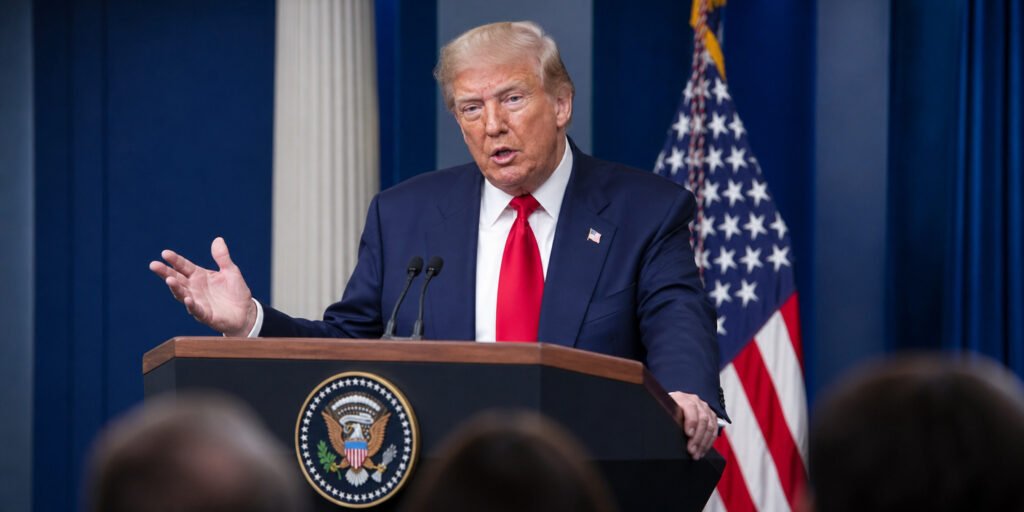
President Donald Trump has publicly announced that the United States will not initiate any military strikes against Iran prior to the November 3 midterm elections. This significant declaration marks a strategic pivot in the administration’s foreign policy, tempering the heated rhetoric that has characterized US-Iran relations throughout the year. While emphasizing that the administration is currently engaged in what he described as ‘productive discussions’ with Iranian leadership, the President maintained that the strict economic blockade on the Islamic Republic will remain firmly in effect.
Key Highlights
- No Pre-Election Conflict: The Trump administration has explicitly pledged that no military action will be launched against Iran before the November 3 midterm elections.
- Diplomatic Channels: President Trump cited ‘productive discussions’ with Iran as a primary driver for the current pause in military escalation.
- Economic Pressure Persists: Despite the halt in military plans, the President confirmed that the comprehensive economic blockade, a cornerstone of the ‘maximum pressure’ campaign, will not be lifted.
- Strategic Timing: The decision serves to decouple foreign military engagement from the immediate domestic political calendar, aiming to stabilize regional volatility during the campaign season.
Geopolitical Calculus and Diplomatic Restraint
The declaration that the United States will refrain from military intervention in Iran until after the midterm elections represents a significant recalibration of the ‘maximum pressure’ doctrine. By explicitly tying this decision to the election timeline, the administration is making a calculated move to minimize volatility in the global oil markets and reduce the risk of ‘October Surprise’ scenarios that could negatively impact voter sentiment. However, the juxtaposition of this military restraint against the continuation of the economic blockade highlights a nuanced, dual-track approach to foreign policy.
The ‘Maximum Pressure’ Doctrine vs. Open Dialogue
Since the withdrawal from the Joint Comprehensive Plan of Action (JCPOA) in 2018, the US government has consistently applied heavy economic sanctions aimed at crippling Iran’s financial capabilities. The term ‘blockade’ used by the President refers to these sweeping financial and trade restrictions, which include sanctions on Iran’s banking, shipping, and energy sectors. The recent announcement clarifies that while the kinetic—or military—option is off the table temporarily, the administration is not signaling a retreat from its overarching economic goals. The ‘productive discussions’ noted by the President suggest that there are backchannel communications occurring, likely focused on hostage releases, regional de-escalation, or specific compliance metrics, rather than a broad geopolitical rapprochement.
Market Volatility and Midterm Strategy
A military conflict in the Middle East, particularly one involving the Strait of Hormuz, would have immediate and potentially disastrous consequences for global crude oil prices. With the November 3 midterms approaching, the White House is keenly aware of the domestic economic impact such a conflict would have on American consumers. Gas prices are a highly visible indicator for voters; skyrocketing costs due to a conflict would be politically toxic. By promising stability until at least early November, the administration is attempting to insulate the domestic economy from external shocks, allowing the focus to remain on campaign issues like the economy, immigration, and trade.
Historical Context: The Iran-US Relationship
The history of US-Iran relations is marked by cycles of escalation and tentative de-escalation. The current administration has operated on a policy of disrupting the status quo established by the 2015 nuclear deal. Understanding the current freeze in military action requires looking at the broader, systemic tension. The administration’s rhetoric has often been fluid, oscillating between warnings of total devastation and offers of direct talks. This latest announcement is arguably the most concrete boundary set by the President to date. It creates a ‘predictability window’ that international observers and regional actors can use to recalibrate their own stances. Whether this window remains open post-election depends entirely on the outcome of those ‘productive discussions’ and the internal political pressures that will shift once the electoral dust settles.
FAQ: People Also Ask
1. Does the ‘no attack’ promise include defensive military actions?
The President’s statement specifically addresses the initiation of new attacks. It does not preclude defensive responses should American forces or regional interests be directly fired upon or severely compromised. The administration maintains that it retains the right to defend itself at all times.
2. What is the status of the economic blockade against Iran?
The economic blockade, which includes sanctions on Iran’s oil exports, banking sector, and other key industries, remains fully in effect. The President’s announcement creates a distinction between military and economic actions, signaling that economic pressure will not be eased.
3. Why did the administration choose to mention the midterm elections specifically?
By anchoring the commitment to a specific date—November 3—the administration provides clarity to global markets and international allies. It also signals to voters that the current foreign policy is deliberate and controlled, rather than reactive or chaotic, which serves as a talking point during the final phase of the midterm campaign.
More Stories
Global Election Tensions: Legal Battles in CA, High Stakes in Brazil
US Envoy Witkoff Labels Putin ‘Humanitarian’ in Peace Push
Toledo Hazmat Crisis: Mass Evacuations Ordered for North Side