










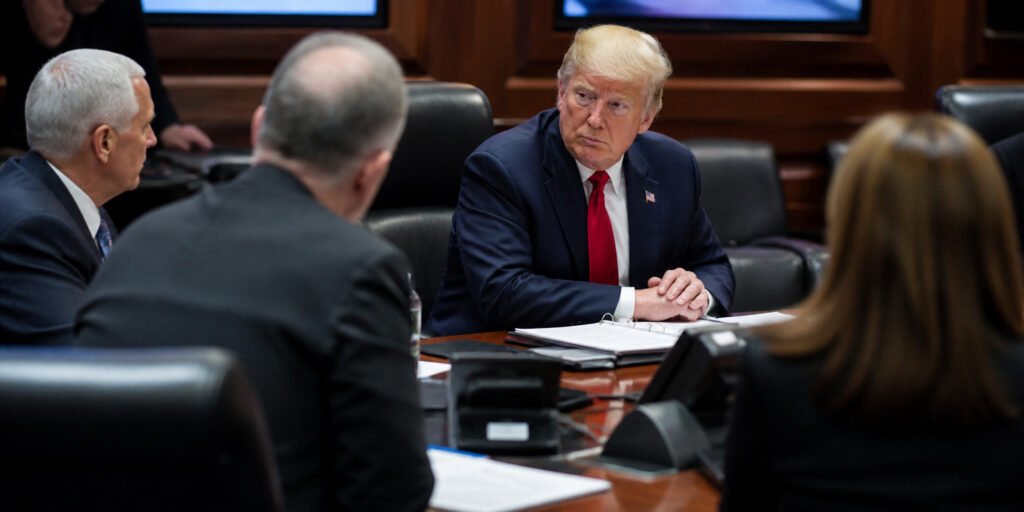
President Donald Trump has expressed an inclination to resume military operations against Iran following the New Year if diplomatic talks remain stagnant, marking a new phase in the ongoing US-Iran regional tensions. This potential shift signals a return to a more aggressive, kinetic posture, should the current window for negotiation fail to yield a resolution regarding Iran’s nuclear ambitions and regional proxy activities.
Key Highlights
- Diplomatic Ultimatum: The administration has effectively set a New Year deadline for measurable progress in diplomatic channels before reconsidering military options.
- Maximum Pressure Doctrine: The potential shift represents a return to the ‘Maximum Pressure’ strategy, focusing on both economic strangulation and direct deterrence.
- Regional Volatility: Increased scrutiny is being placed on the Islamic Revolutionary Guard Corps (IRGC) and its network of regional proxies, which remain central to US strategic calculations.
- Energy Market Impact: Analysts warn that any resumption of hostilities carries immediate risks for global energy stability, particularly regarding tanker transit in the Strait of Hormuz.
The Resurgence of the Maximum Pressure Campaign
The specter of renewed military intervention looms large as the New Year approaches. For observers of the Trump doctrine, this development is less of a surprise and more of a predictable pivot back to a strategy that prioritizes leverage above all else. During his previous tenure, the ‘Maximum Pressure’ campaign defined the US-Iran relationship, characterized by heavy unilateral sanctions and precise, targeted military engagements designed to degrade Iranian capabilities without escalating into a full-scale regional war.
If the current diplomatic stagnation continues, the White House is preparing a playbook that bypasses prolonged negotiation in favor of decisive action. This is rooted in the belief that Iranian leadership responds only to significant, tangible shifts in the power balance. By signaling a willingness to resume strikes, the administration is attempting to create a sense of urgency in Tehran, hoping to force a concession before the kinetic clock runs out.
The Strategic Calculus: Deterrence vs. Escalation
The core of this strategy lies in the definition of ‘deterrence.’ Pentagon planners are currently assessing the effectiveness of previous strikes and the evolving nature of Iran’s defensive posture. The challenge is not merely the technical capacity to strike, but the regional fallout. Iran’s network of proxy militias—ranging from groups in the Levant to those active in the southern approaches of the Arabian Peninsula—presents a complex, multi-front challenge.
Experts within the security community suggest that any post-New Year military campaign would likely focus on degrading the command-and-control infrastructure of the IRGC rather than broad-spectrum targets. This ‘surgical’ approach aims to avoid civilian casualties while making the cost of continued regional aggression prohibitively high for the Iranian regime. However, this is a delicate balance; miscalculation in the intensity of these strikes could lead to unintended regional escalation.
Diplomatic Stagnation and the ‘Strait’ Reality
Why the New Year? For the administration, the calendar provides a hard, psychological marker for an end to the current grace period. Diplomacy, while preferred, has shown signs of brittleness. The primary concern among Western allies and regional partners is the security of the Strait of Hormuz. Roughly 20% of the world’s petroleum consumption passes through this narrow chokepoint, and any renewed military tension between Washington and Tehran inevitably causes spikes in global energy pricing.
If the diplomatic window closes without a deal, the administration is signaling that the focus will shift from the conference room to the situation room. This transition would likely see an increased presence of US naval assets in the region to counter potential Iranian threats to freedom of navigation. The message is clear: the United States is willing to tolerate a stalemate only so long as it does not come at the expense of its strategic security or the stability of its regional allies.
Economic and Global Ripples
Beyond the tactical military implications, the threat of renewed strikes is already vibrating through global markets. Investors and oil traders are increasingly pricing in the ‘risk premium’ associated with a potential confrontation. Should the talks fail and the military option be exercised, we could see a volatile response in commodity markets. This economic dimension is, perhaps, the most effective tool in the US arsenal—the ability to restrict Iran’s revenue streams through rigorous enforcement of sanctions, paired with military pressure that makes their own extraction and transport of oil perilous.
Ultimately, the path forward remains tied to Tehran’s response. If the regime perceives the threat as credible, it may yet return to the table with genuine compromises. If, however, the calculation in Tehran is that the US lacks the domestic appetite for another regional engagement, the early months of the new year could prove to be some of the most volatile in the recent history of US-Iran relations.
FAQ: People Also Ask
Q: Why has the US set a New Year deadline for Iran?
A: The administration is using the New Year as a psychological and strategic deadline to prevent the perception of endless, unproductive diplomacy, aiming to force a resolution by demonstrating that the alternative—military action—is a credible, impending reality.
Q: What is the ‘Maximum Pressure’ doctrine?
A: It is a foreign policy strategy that combines intense economic sanctions with direct military deterrence to isolate a target country (in this case, Iran) and force changes in its behavior regarding nuclear development and proxy warfare.
Q: Could this lead to a full-scale war in the Middle East?
A: While any military strike carries a risk of escalation, the current US strategic focus is on ‘surgical’ and targeted operations intended to weaken specific assets (like the IRGC command structures) rather than an invasion or total war, aiming to achieve deterrence without necessitating a wider conflict.
Q: How does this impact the global oil market?
A: Markets are highly sensitive to tensions in the Strait of Hormuz. Threats of military action usually drive up oil prices as traders account for potential supply chain disruptions and the risk of tanker blockades.
More Stories
Shenzhen Summit: Trilateral Power Realigned
Anthropic IPO: Navigating the AI Safety-Profit Paradox
Power Summit: Trump, Xi, Putin Converge in Shenzhen