











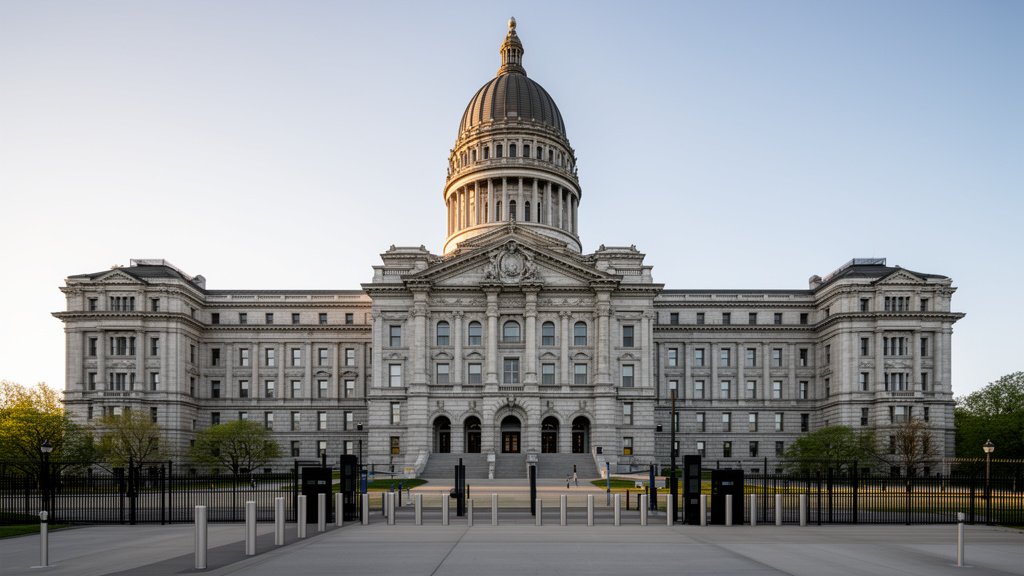
Federal authorities have successfully disrupted a coordinated plot targeting the New York State Capitol in Albany, preventing what officials described as a significant domestic terror threat. The culmination of a sophisticated federal sting operation, the intervention highlights ongoing concerns regarding security at state government installations and the heightened vigilance of the Joint Terrorism Task Force (JTTF) in identifying domestic violent extremists before they can mobilize.
Key Highlights
- Targeted Interruption: Federal agents executed a precision operation to neutralize a specific threat against the New York State Capitol building.
- Coordinated Defense: The operation involved seamless collaboration between the FBI, the New York State Police, and local Albany law enforcement agencies.
- Heightened Security: Authorities have moved to increase security protocols across state government facilities, citing the necessity of proactive intelligence gathering in the current threat environment.
- Ongoing Investigation: The Department of Justice is leading the prosecution, with the investigation remaining open to identify potential accomplices or broader network connections.
Unmasking the Threat: The Mechanics of the Capitol Plot
The attempted attack on the New York State Capitol represents a sobering reminder of the persistent security challenges facing legislative seats across the United States. Following the disruption of the plot, federal authorities revealed that the operation was characterized by months of meticulous surveillance and intelligence gathering by the Joint Terrorism Task Force. The individual involved was not acting in a vacuum; rather, they were identified during a phase of the radicalization process that allowed federal agents to intercept the plan before the acquisition of the necessary explosives or the initiation of any kinetic action.
The Operation: Surveillance and Interdiction
The success of this operation was predicated on a “sting” methodology, a hallmark of federal counter-terrorism efforts where undercover agents or confidential human sources maintain contact with suspects to monitor their intent and capability. By positioning themselves within the suspect’s circle of communication, federal investigators were able to document specific plans, intent, and the attempted procurement of materials required for a detonation. The interception occurred at a critical juncture: the transition from ideological aspiration to physical mobilization. This precise timing is vital, as it provides the evidentiary foundation required for federal prosecution while ensuring that the public remains unaware of the danger until the threat is effectively neutralized.
The Interplay of Federal and State Intelligence
Security at the New York State Capitol is a multi-layered, interagency responsibility. The coordination between the FBI’s Albany Field Office and the New York State Police Intelligence Center is the bedrock of this security architecture. In this specific incident, the sharing of real-time intelligence allowed for a managed response that did not require the public closure of the Capitol or mass panic, but rather a contained tactical arrest. This synergy between federal oversight and state-level situational awareness is increasingly critical as the threat landscape shifts from centralized foreign terrorist organizations to decentralized, domestic individual actors who are often harder to track and interdict.
Analyzing the Changing Landscape of Domestic Security
Escalating Concerns: The Landscape of Domestic Violent Extremism
Historically, the security architecture of state capitols was designed primarily to manage large-scale protests and civil unrest. However, the modern threat environment is defined by Domestic Violent Extremism (DVE), a category that includes actors motivated by a diverse array of ideological grievances, often amplified by online echo chambers. The targeting of a seat of government—specifically the New York State Capitol—serves a symbolic purpose for these actors: to disrupt the democratic process and sow fear. Federal officials have noted that the barrier to entry for these “lone wolf” or small-cell actors is alarmingly low, necessitating a shift toward behavioral threat assessment, where the focus is not just on surveillance of actions, but on the analysis of radicalization pathways.
Protecting the Seat of Government: Infrastructure and Protocol
The physical security of the Albany complex has evolved significantly in recent years. While the Capitol remains a public building with open access for citizens and tourists, the “invisible” security—cyber-monitoring, communications interception, and undercover presence—has become the primary line of defense. The successful thwarting of this plot will likely prompt a review of access control measures. Lawmakers and security experts are expected to debate the balance between maintaining an open, democratic institution and the hardening of infrastructure against increasingly sophisticated asymmetric threats. Future investments are likely to focus on advanced surveillance technologies and predictive analytics to identify suspicious procurement of materials far earlier in the planning phase.
Legal Repercussions and Future Policy Implications
The Department of Justice has signaled that it will seek the maximum allowable penalties for individuals who plot to utilize weapons of mass destruction against government institutions. Beyond the immediate legal outcome for the suspect, this event serves as a catalyst for legislative scrutiny. There is a growing bipartisan call for increased funding for the JTTF and state-level fusion centers. Furthermore, this incident highlights the efficacy of the current federal sting model. By arresting individuals during the attempt phase rather than waiting for an overt act of violence, the DOJ effectively manages the risk-to-public ratio. However, this model also demands significant resources, raising questions about whether current federal budgets are sufficient to address the rising volume of domestic threat reports.
FAQ: People Also Ask
Q: Was the New York State Capitol ever in immediate danger of being bombed?
A: Federal authorities confirmed that the plot was disrupted before the suspect could finalize the construction or placement of an explosive device. Because the operation was conducted via a sting, the public was never at risk during the investigation.
Q: How do federal authorities detect these types of plots?
A: Detection often involves a combination of digital footprint analysis, signals intelligence (monitoring of communications), and the use of confidential human sources (informants) who report to the FBI’s Joint Terrorism Task Force.
Q: Does this event signal a higher threat level for other state capitols?
A: While the FBI monitors threats against all government facilities, officials emphasize that this was a targeted investigation of a specific individual. However, it serves as a baseline indicator that state capitols remain high-value targets for extremist actors.
Q: What is the significance of a ‘sting operation’ in these cases?
A: A sting operation allows law enforcement to guide the suspect into committing an overt criminal act, such as attempting to acquire bomb-making materials, which provides the necessary evidence to secure a conviction in federal court while simultaneously neutralizing the threat safely.
More Stories
Costco Goes Nationwide on Uber Eats: A New Era for Bulk Delivery
Elena Rybakina Wins US Open, Ascends to World No. 1
Rubio Seals Security Pacts; Vance Drives Policy Agenda