











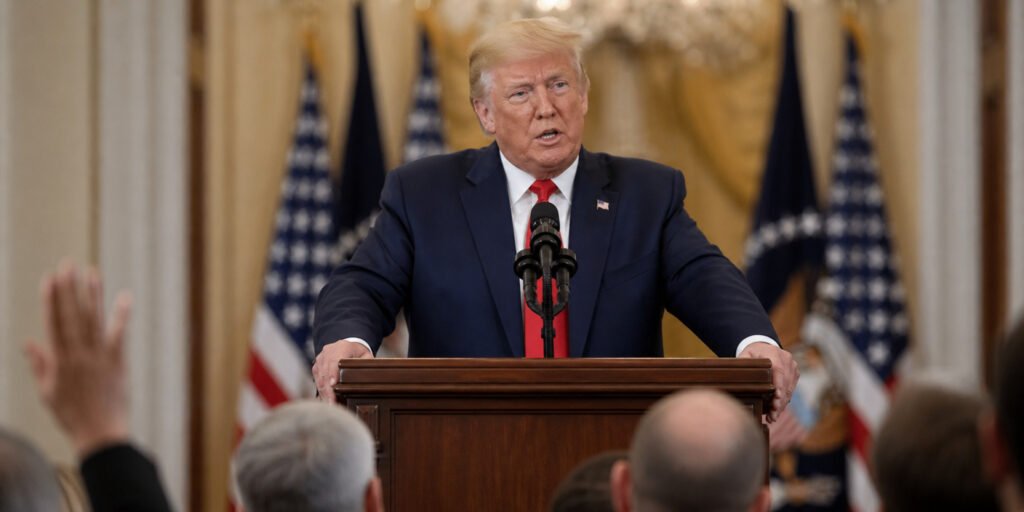
President Trump has officially called off planned military strikes against Iran, a decision announced in a briefing earlier today, Monday, August 3, 2026. The administration has pivoted, announcing that high-level negotiations aimed at de-escalating the growing conflict and securing shipping lanes through the critical Strait of Hormuz are set to commence this afternoon. The abrupt change in policy signals a massive shift in the U.S. approach to the region, focusing on diplomatic intervention over military engagement to address the persistent threats to global maritime commerce.
Key Highlights:
- Military Action Deferred: President Trump has officially suspended the planned airstrikes against Iranian targets, opting for a diplomatic track.
- Negotiation Deadline: Negotiations are scheduled to begin this afternoon, Monday, August 3, 2026, involving key regional stakeholders and administration officials.
- Strategic Priority: The primary goal of these talks is the immediate restoration of safe shipping transit through the Strait of Hormuz, the world’s most critical oil chokepoint.
- Diplomatic Shift: The move represents a significant de-escalation of hostilities, aiming to stabilize energy markets and prevent a wider regional conflict.
The Strategic Pivot to Diplomacy
The sudden cessation of military preparations against Iran on August 3, 2026, marks a pivotal moment in the ongoing geopolitical tension in the Persian Gulf. By opting for negotiations, the administration has signaled a desire to manage the stability of the region through dialogue rather than force. The Strait of Hormuz, through which approximately 20% of the world’s petroleum consumption flows, has long been a flashpoint for international conflict. The U.S. and its allies have repeatedly emphasized that any disruption in this narrow waterway would have catastrophic consequences for the global economy, directly impacting oil prices, inflation, and energy security across Europe and Asia.
The Importance of the Strait of Hormuz
To understand the gravity of today’s announcement, one must consider the sheer scale of the Strait of Hormuz. Stretching roughly 21 miles at its narrowest point between Oman and Iran, it serves as the vital artery for energy exports from Saudi Arabia, Iraq, the United Arab Emirates, and Kuwait. Any military activity in this region creates immediate volatility in the Brent Crude and West Texas Intermediate (WTI) benchmarks. Global markets have been on edge for weeks, tracking the movement of naval assets and the increased frequency of maritime seizures. Today’s decision to pursue negotiations is widely interpreted as a necessary move to preempt an economic crisis, as markets have been pricing in a significant risk premium regarding the potential closure of the strait.
Understanding the Negotiation Framework
The details of the negotiations set to begin this afternoon remain closely guarded, but experts suggest a multi-layered approach will be necessary to achieve a breakthrough. The talks are expected to focus on specific security guarantees for merchant vessels and the establishment of a formal de-confliction channel between U.S. naval forces and the Iranian Revolutionary Guard Corps (IRGC). The inclusion of international intermediaries, potentially involving neutral powers with significant trade interests in the Persian Gulf, could provide the necessary neutral ground to facilitate an agreement. The administration has emphasized that the primary metric for success will be the measurable restoration of free and safe transit for commercial shipping, with a focus on ending the cycle of detentions and harassment that has defined the last few months.
Economic Implications and Market Volatility
The economic fallout of continued uncertainty in the Persian Gulf cannot be overstated. With global economies still balancing energy transitions and recovery, an escalation in the Strait of Hormuz would have triggered a supply shock that central banks have been desperately trying to avoid. By choosing the path of negotiation, the administration is attempting to provide a ‘cooling off’ period for global oil markets. Investors and stakeholders in the energy sector will be watching the outcome of these talks with extreme scrutiny. A positive outcome—specifically, an agreement that ensures the security of transit—would likely lead to a immediate correction in oil prices, providing a much-needed stabilizer for the global economy as we move into the final months of 2026.
Regional Stability and Future Challenges
While the cancellation of strikes is a relief to many, the underlying tensions remain. The success of these upcoming negotiations hinges on the ability of both parties to agree on a concrete framework for maritime conduct. Future challenges include the long-term monitoring of the strait, the role of external naval coalitions, and the broader context of Iran’s regional influence. This afternoon’s start to the talks is merely the first step; a sustainable solution will require ongoing diplomatic effort and, likely, significant concessions on both sides to ensure that the Strait of Hormuz remains an open, global common rather than a contested front line. The international community, including members of OPEC and the UN, will likely be pressuring both Washington and Tehran to move beyond temporary de-escalation and toward a comprehensive maritime security agreement.
FAQ: People Also Ask
1. Why is the Strait of Hormuz so critical to the global economy?
The Strait of Hormuz is the world’s most important oil chokepoint. Approximately one-fifth of the world’s oil supply passes through it daily, making it essential for global energy prices and economic stability. Any threat to shipping here directly impacts the cost of energy globally.
2. What is the immediate goal of the negotiations announced by President Trump?
The immediate objective is the restoration of safe, unimpeded transit for commercial shipping through the Strait of Hormuz and the de-escalation of military tensions between the U.S. and Iranian forces.
3. How might these negotiations impact oil prices?
Markets generally react negatively to conflict and positively to stability. If the negotiations successfully lead to a credible security agreement that guarantees shipping safety, oil prices are expected to stabilize or decrease as the ‘war risk’ premium is removed from trading benchmarks.
4. Are other international entities involved in these talks?
While the U.S. is leading this diplomatic effort, the negotiations are expected to involve regional stakeholders and international bodies interested in maintaining open shipping lanes, given the global nature of energy trade through the Persian Gulf.
More Stories
Costco Goes Nationwide on Uber Eats: A New Era for Bulk Delivery
Elena Rybakina Wins US Open, Ascends to World No. 1
Rubio Seals Security Pacts; Vance Drives Policy Agenda